



Accessibility links

Breaking News

Damascus Officials Slams West For Failing To Protect Palmyra, But Could Its Destruction Help Assad?

A year ago, all was quiet at Palmyra. This picture, from March 14, 2014, shows locals with bicycles at the ancient oasis city.
1/9 A year ago, all was quiet at Palmyra. This picture, from March 14, 2014, shows locals with bicycles at the ancient oasis city.
Syrian authorities say Islamic State militants have advanced to within 2 kilometers of Palmyra, an ancient city with outstanding architectural heritage dating from the first century. The militants have caused significant damage to similar sites they have overrun in Iraq, posting videos of themselves destroying antiquities. UNESCO includes Palmyra on its list of World Heritage sites, describing it as one of the most important cultural centers of the ancient world -- a crossroads for local, Persian, Greek and Roman influences.
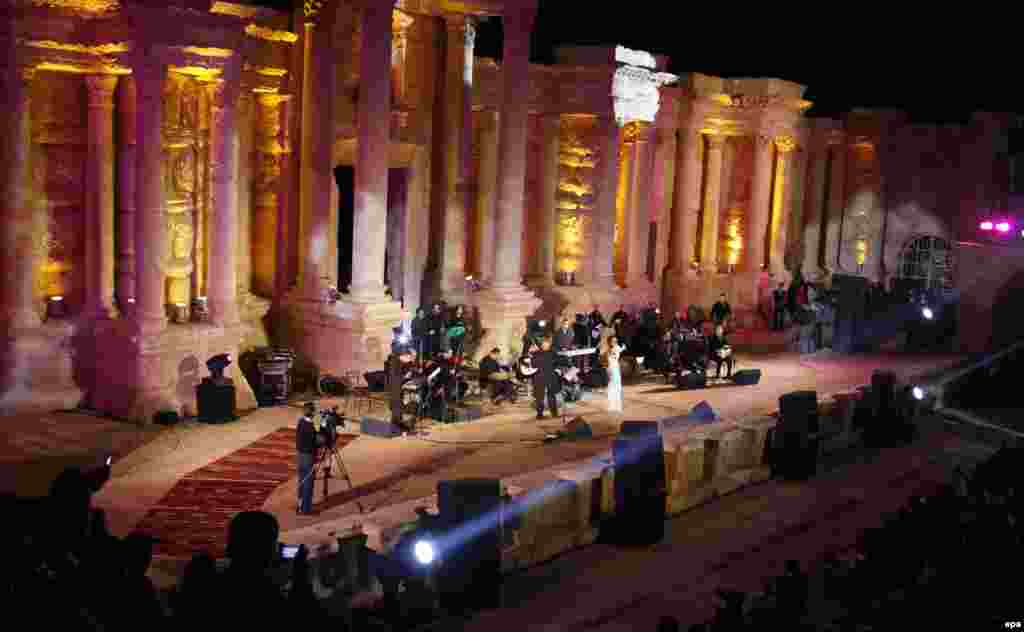
The remains of the Roman theatre date back to the 2nd century. Until recently, it was host to the annual Palmyra Festival.
2/9 The remains of the Roman theatre date back to the 2nd century. Until recently, it was host to the annual Palmyra Festival.
Syrian authorities say Islamic State militants have advanced to within 2 kilometers of Palmyra, an ancient city with outstanding architectural heritage dating from the first century. The militants have caused significant damage to similar sites they have overrun in Iraq, posting videos of themselves destroying antiquities. UNESCO includes Palmyra on its list of World Heritage sites, describing it as one of the most important cultural centers of the ancient world -- a crossroads for local, Persian, Greek and Roman influences.
Lebanese singer Najwa Karam performs at the opening ceremony of the Palmyra Festival in 2010.
3/9 Lebanese singer Najwa Karam performs at the opening ceremony of the Palmyra Festival in 2010.
Syrian authorities say Islamic State militants have advanced to within 2 kilometers of Palmyra, an ancient city with outstanding architectural heritage dating from the first century. The militants have caused significant damage to similar sites they have overrun in Iraq, posting videos of themselves destroying antiquities. UNESCO includes Palmyra on its list of World Heritage sites, describing it as one of the most important cultural centers of the ancient world -- a crossroads for local, Persian, Greek and Roman influences.
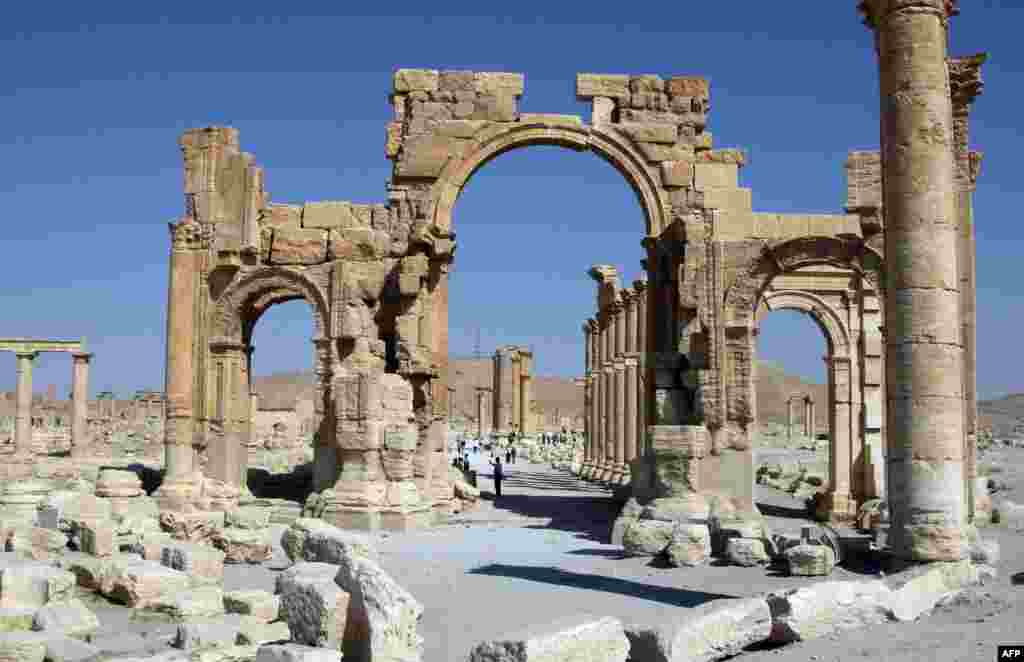
More Roman ruins. Palmyra became increasingly prosperous after the Romans took control at the beginning of the 1st century.
4/9 More Roman ruins. Palmyra became increasingly prosperous after the Romans took control at the beginning of the 1st century.
Syrian authorities say Islamic State militants have advanced to within 2 kilometers of Palmyra, an ancient city with outstanding architectural heritage dating from the first century. The militants have caused significant damage to similar sites they have overrun in Iraq, posting videos of themselves destroying antiquities. UNESCO includes Palmyra on its list of World Heritage sites, describing it as one of the most important cultural centers of the ancient world -- a crossroads for local, Persian, Greek and Roman influences.
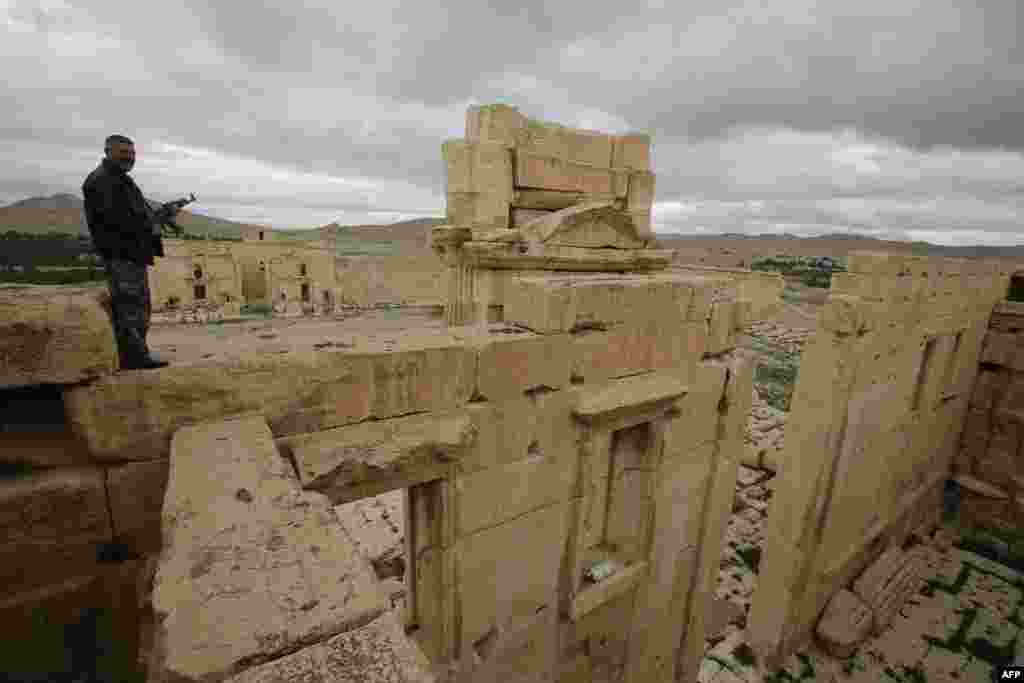
March 2014 - A Syrian policeman stands on the sanctury of Baal, one of three pagan gods worshipped in Palmyra in the 1st century.
5/9 March 2014 - A Syrian policeman stands on the sanctury of Baal, one of three pagan gods worshipped in Palmyra in the 1st century.
Syrian authorities say Islamic State militants have advanced to within 2 kilometers of Palmyra, an ancient city with outstanding architectural heritage dating from the first century. The militants have caused significant damage to similar sites they have overrun in Iraq, posting videos of themselves destroying antiquities. UNESCO includes Palmyra on its list of World Heritage sites, describing it as one of the most important cultural centers of the ancient world -- a crossroads for local, Persian, Greek and Roman influences.
Palmyra is believed to have been founded by King Solomon.
6/9 Palmyra is believed to have been founded by King Solomon.
Syrian authorities say Islamic State militants have advanced to within 2 kilometers of Palmyra, an ancient city with outstanding architectural heritage dating from the first century. The militants have caused significant damage to similar sites they have overrun in Iraq, posting videos of themselves destroying antiquities. UNESCO includes Palmyra on its list of World Heritage sites, describing it as one of the most important cultural centers of the ancient world -- a crossroads for local, Persian, Greek and Roman influences.
A 2nd century limestone relief excavated in 2008 from a cemetery in Palmyra. Shapes of 13 men and women, all from the same family, are engraved on it.
7/9 A 2nd century limestone relief excavated in 2008 from a cemetery in Palmyra. Shapes of 13 men and women, all from the same family, are engraved on it.
Syrian authorities say Islamic State militants have advanced to within 2 kilometers of Palmyra, an ancient city with outstanding architectural heritage dating from the first century. The militants have caused significant damage to similar sites they have overrun in Iraq, posting videos of themselves destroying antiquities. UNESCO includes Palmyra on its list of World Heritage sites, describing it as one of the most important cultural centers of the ancient world -- a crossroads for local, Persian, Greek and Roman influences.
From the same dig - the scene depicts two Palmyrian merchants and a child standing next to a camel.
8/9 From the same dig - the scene depicts two Palmyrian merchants and a child standing next to a camel.
Syrian authorities say Islamic State militants have advanced to within 2 kilometers of Palmyra, an ancient city with outstanding architectural heritage dating from the first century. The militants have caused significant damage to similar sites they have overrun in Iraq, posting videos of themselves destroying antiquities. UNESCO includes Palmyra on its list of World Heritage sites, describing it as one of the most important cultural centers of the ancient world -- a crossroads for local, Persian, Greek and Roman influences.
The sun sets behind ruined columns at Palmyra, November 2010.
9/9 The sun sets behind ruined columns at Palmyra, November 2010.
Syrian authorities say Islamic State militants have advanced to within 2 kilometers of Palmyra, an ancient city with outstanding architectural heritage dating from the first century. The militants have caused significant damage to similar sites they have overrun in Iraq, posting videos of themselves destroying antiquities. UNESCO includes Palmyra on its list of World Heritage sites, describing it as one of the most important cultural centers of the ancient world -- a crossroads for local, Persian, Greek and Roman influences.
Previous slide
Next slide

As Islamic State (IS) overran Palmyra in Homs Province on May 20, Maamun Abdulkarim, the head of Syria's Directorate-General for Antiquities and Museums (DGAM), urged the U.S.-led coalition to prevent the gunmen from destroying the ancient city.

Palmyra's destiny was "dark and dim," Abdulkarim said.

Meanwhile, Syrian state news agency SANA quoted Abdulkarim as criticizing the international community for failing to mobilize to help protect the ancient caravan stop, known to Syrians as the "Bride of the Desert."

Syrian Tourism Minister Bishre Yazaji went even further on May 21, complaining about "international silence and deliberate ignorance of naming what is taking place in Syria with its real name."

The international community, Yazaji added, should "assume responsibility to press the sides which fund and supply terrorists who perpetrate their crimes against our heritage and history."

On the surface, these comments by Syrian government officials do not seem out of place. They come amid a global outcry against the IS capture of Palmyra and legitimate concerns that the militant group will destroy the ancient city.

But previously, Damascus has slammed international action against IS, complaining that U.S.-led air strikes against the group are illegal because Western allies have not coordinated with the Assad government.

Syrian President Bashar al-Assad went on record as saying that the coalition air strikes have been ineffective.

Meanwhile, as Aaron Y. Zelin, a fellow at the Washington Institute for Near East Affairs, noted on Twitter, Assad's forces have themselves bombed a number of historical sites in Syria.

In fact, Damascus is using Palmyra's capture as a lever to pry support in the wake of a series of major strategic defeats for the Assad government.

"The fall of Palmyra is extremely troubling, but it is important to recognize that it is not just a propaganda victory for Islamic State," says Charlie Winter, a researcher at the counter-radicalization group Quilliam Foundation in London. "The Assad regime knows that the worse IS looks, the more palatable it looks to the international community."

According to Winter, Assad could have calculated that the withdrawal of the Syrian Arab Army (SAA) from Palmyra and its destruction by IS militants would "bolster its chances of receiving international support in the fight against its enemies, especially in light of the fact that Assad’s position is looking more precarious than it ever has done."

Assad Losing Ground

While Assad's fall is likely not imminent, Damascus is indeed in trouble.

Charles Lister, a visiting fellow at the Brookings Doha Center and author of Profiling The Islamic State, noted recently that Syria's rebels were making "dramatic gains in the north" while the "Syrian Army and its supporting militias appear at their weakest point since 2013."

"The [Assad] regime is no longer militarily capable of launching definitively successful operations outside of its most valuable territories, while its capacity for defense against concerted attack now appears questionable at best," Lister added.

Over the past several months, Assad has seen significant loss of territory.

IS now holds more than 50 percent of Syria's territory, with a presence in the provinces of Homs, Raqqa, Deir al-Zor, Hasakah, Hama, Aleppo, Damascus, Dara'a, and Suwayda, according to SOHR. (Much of the territory controlled by IS in Syria, is unpopulated desert, however.)

The extremist Sunni group's capture of Palmyra is the first time that IS has succeeded in wresting control of a city directly from Syrian government forces.

And while DGAM director Abdulkarim focused on the threat to Palmyra, with its capture the Assad government has lost far more than a cultural heritage site.

Much more important for Assad's survival are Al-Hail and Arak, significant gas fields northeast of the city that IS seized on May 19. Both are vital electricity-generating sites for government-controlled areas, according to Britain-based monitor the Syrian Observatory for Human Rights (SOHR). The loss of Al-Hail and Arak will therefore weaken Damascus's ability to provide key services for populations under its control.

As well as its archaeological heritage, Palmyra has strategic significance. It is located on key roads that open up routes to Damascus, Homs, and Qalamoun. IS can also now cut off a Syrian government supply route from Damascus to Deir al-Zor in the east.

It's Not Just IS...

Beyond IS, Assad has seen significant losses to Islamist rebel groups.

In March, a coalition of Islamist groups, among them Al-Qaeda Syrian affiliate Jabhat al-Nusra, captured the western Syrian city of Idlib. Since then, Nusra and its allies in the Islamist Jaish al-Fateh coalition have made other gains, capturing the city of Jisr al-Shughur in April and most recently overrunning Syrian government forces at the Al-Mastouma military camp in Idlib, one of Assad's last remaining strongholds in the province.

Nusra's capture of Al-Mastouma and the advance of Islamist rebels toward the town of Ariha, one of the Syrian government's last remaining bastions in Idlib province, is a significant blow for Assad.

Signs Of Weakness

The collapse of Assad's forces at Palmyra points to problems the Syrian Arab Army (SAA) has had with recruitment and manpower.

Alison Meuze of NPR quoted a source in Palmyra as saying that most of the SAA soldiers killed in the battle there with IS were not professional fighters.

Meanwhile, Khaled Omran of the Palmyra's anti-Assad Coordinating Committee told The Daily Beast on May 20 that Damascus had tried to reinforce its front lines with detainees from the notorious nearby Tadmor Prison.

"I saw about 10 busloads of prisoners being driven to the front.... Maybe 1,000 men," Omran was quoted as saying. But most of the conscripts ran away rather than face IS, he claimed.

That Assad is struggling to recruit men for his army was revealed in December when The Washington Post reported that Damascus had begun large-scale mobilizations of reservists and implemented new regulations to prevent draft-dodging, amid increased casualties and evasions of military service.

With the outlook for Assad increasingly desperate, the Western outcry over the capture of Palmyra has offered a golden opportunity for him to call for assistance in fighting IS.

And in mobilizing cultural leaders like DGAM head Abdulkarim and Tourism Minister Yazaji, the Assad government has been able to frame this call in terms of the global fight against terror.

As Yazaji put it, Damascus is asking the world to "prevent terrorists from continuing this ugly crime against the human civilization."

-- Joanna Paraszczuk

This item is part of
XS
SM
MD
LG