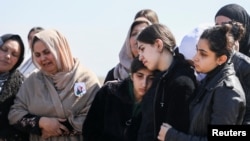
Mourners during a funeral for a Kurdish medical student, who was killed in Latakia, Syria, on March 9.
While the eruption ofviolencein western Syria has raised questions about the transitional government’s ability to control its affiliated factions, it has also brought Russian and Iranian involvement in Syrian affairs into sharp focus.
Various human rights groups monitoring the situation in Syria have documented over 800 casualties, including civilians, since clashes erupted on March 6 between government forces and gunmen loyal to the deposed president, Bashar al-Assad.
Rebel groups led by Ahmad al-Sharaa toppled the government in a lightning offensive in December 2024, bringing an end to half a century of Assad family rule over Syria.
Assad’s government was backed by Russia and Iran. While Russia has maintained ties with the new government, Iran has been completely excluded.
Through interviews and analysis of open-source data, RFE/RL can give a clearer picture of what's happening inside Syria.
Men Executed By Gunshots
Rights groups say among the dead are hundreds of civilian casualties, most of whom were Alawite, a minority community which Assad belongs to. The UN on March 11 said entire families, including women and children, were killed during the violence.
Social-media footage analyzed by Schemes, the investigative unit of RFE/RL's Ukrainian Service,suggests that some of the worst violence against Alawite civilians took place in the port city of Latakia, where Russia’s Hmeimim air base is located.
Some videos showed unarmed men being executed by gunshot from behind and others depicted victims being physically abused and humiliated, such as being forced to bark like a dog and crawl over dead bodies.
Nobil, a Syrian from Latakia who currently lives in Greece, told Schemes that factions affiliated with the transitional government entered his home village of Muzayraa on the night of March 6 and indiscriminately shot at houses with large-caliber machine guns mounted on trucks.
He said he lost six family members in the attack, including two aunts and two nephews, but his brother managed to escape.
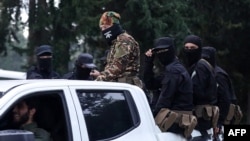
Syrian government forces deployed in the town of Qadmus in Syria's Tartus governorate on March 9
Schemes found the Facebook profile of one of the alleged attackers known as Abu Bakr Mork, also called Talha, whose page is filled with posts about the attacks in western Syria.
In one post, he called for men to come to the area because the women in the area “are widowed and there are no men left.” In another, he wrote about the “campaign to clear the remnants of the defunct regime,” referring to Assad’s government.
Seeking Refuge In A Russian Air Base
Satellite images provided by Planet Labs and analyzed by Schemes show that, as early as March 7, people started to gather near the Russian-operated Hmeimim air base, seemingly seeking refuge from the clashes.
“This very well may be the only safe place for people to stay, given that neither side wants to spoil relations with Russia at the moment,” Ihor Semyvolos, director of the Kyiv-based Center for Middle East Studies, told Schemes.
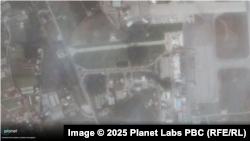
Tents, cars, and crowds of people arriving at the Russian-operated Hmeimim air base can be seen in satellite imagery captured on March 8.
Russia was a major backer of Assad, providing his forces and Iranian-backed proxies air support as they fought not only against Islamic State (IS) militants but also rebels opposed to Assad’s rule.
Those same rebels are now in charge, but Moscow has managed to position itself as a critical partner to Syria’s new rulers, who rely on Russia to print its local currency.
The Russians have maintained a significant presence at their two military bases, especially at Hmeimim.
Systema, RFE/RL’s Russian investigative unit, has confirmed at least 37 flights by large Antonov An-124 cargo planes between December 2024 and March, identifying 22 arrivals and 15 departures from the air base. Each plane can carry up to 150 tons of equipment, indicating substantial movement of personnel or equipment.
Shaky Ground: Inside The Russian Military Bases In Syria
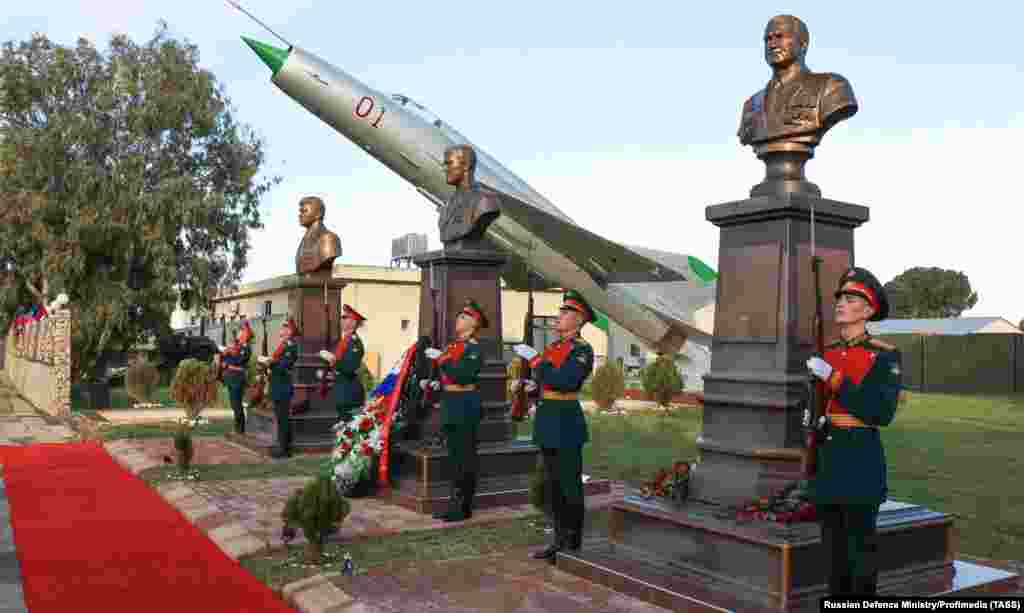
1/12A memorial event for Russian pilot Roman Filipov at the Hmeimim air base near Latakia, Syria, in February 2023.
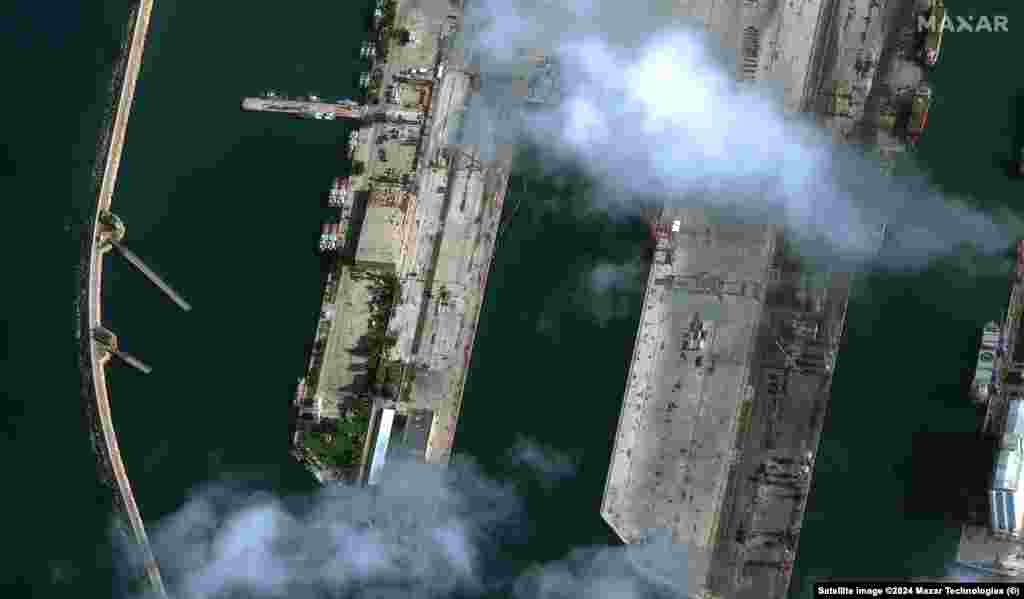
Satellite images made on December 13 show Russia appears to be withdrawing equipment from the Hmeimim base after the recent toppling of its ally, President Bashar al-Assad.
Photographs taken during the rule of Syria's deposed president, Bashar al-Assad, show life inside Russia's air and naval facilities in the Middle Eastern country.
2/12A satellite view of Russia’s naval facility in Tartus, on Syria’s Mediterranean coast on December 13, 2024.
The Kremlin has reportedly been in talks with militant group Hayat Tahrir al-Sham (HTS), now the de facto government in Syria, over the future of Russia’s Syrian bases.
Photographs taken during the rule of Syria's deposed president, Bashar al-Assad, show life inside Russia's air and naval facilities in the Middle Eastern country.
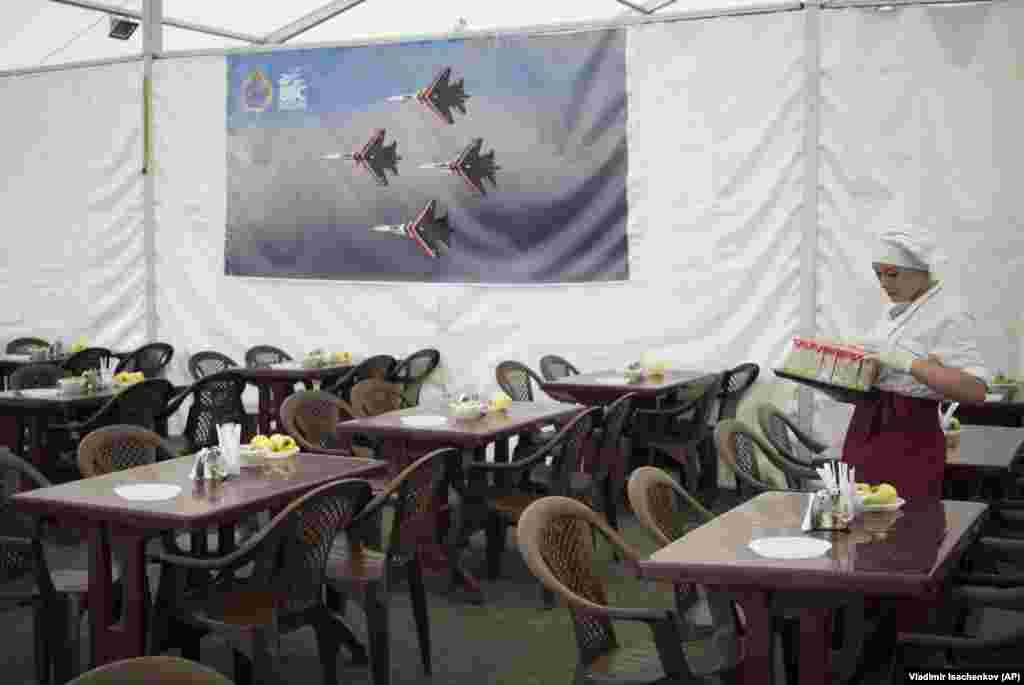
3/12A Russian cafeteria worker prepares tables at the Hmeimim base in October 2015.
Robert E. Hamilton, the head of Eurasia research at the Foreign Policy Research Institute, told RFE/RL Syria's new rulers may be reluctant to tolerate bases from which the Kremlin "launched years of attacks on HTS, other opposition groups, and on Syrian civilians," throughout the country’s civil war.
Photographs taken during the rule of Syria's deposed president, Bashar al-Assad, show life inside Russia's air and naval facilities in the Middle Eastern country.
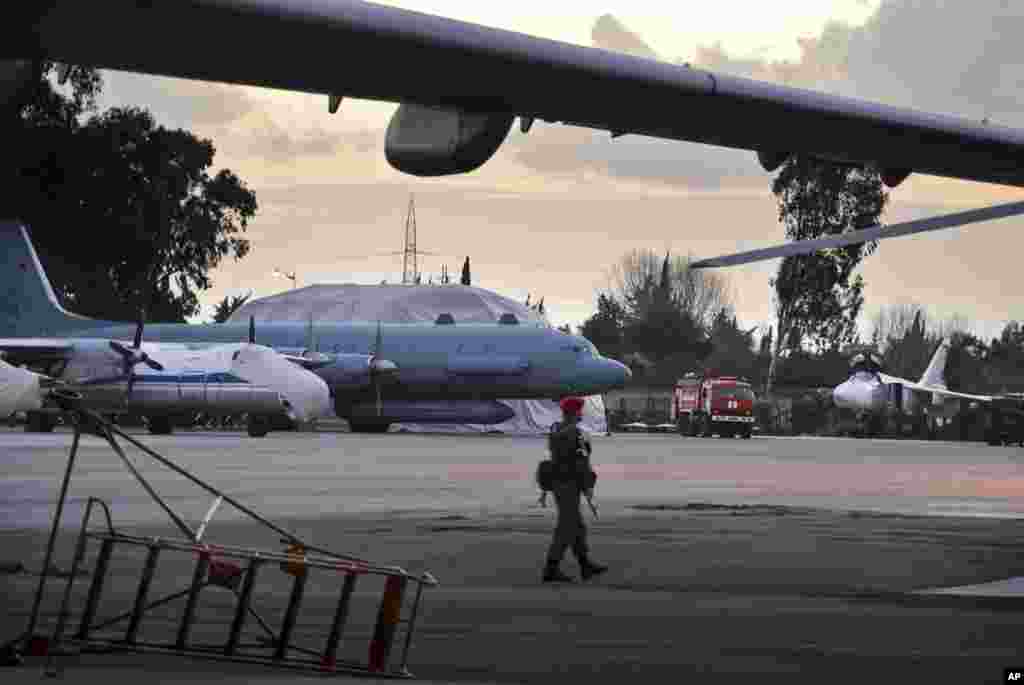
4/12A Russian military policeman patrols the Hmeimim air base in March 2016.
Hamilton says it remains to be seen whether talks between Russia and HTS, "are about ensuring an orderly withdrawal of Russian forces from Syria, or about ensuring Russia can maintain its bases there."
Photographs taken during the rule of Syria's deposed president, Bashar al-Assad, show life inside Russia's air and naval facilities in the Middle Eastern country.
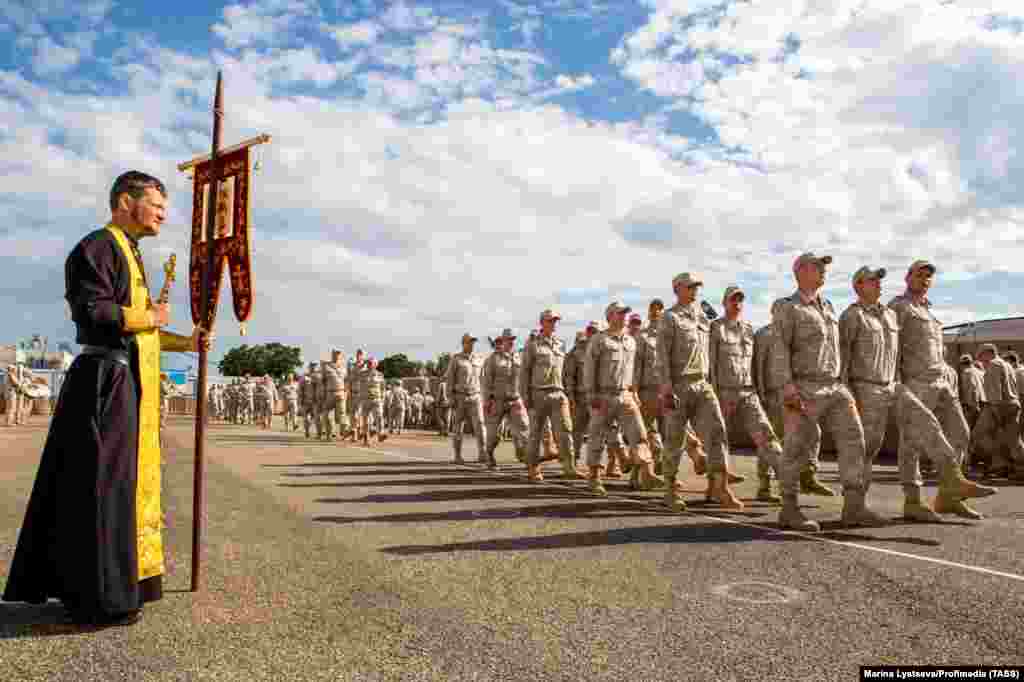
5/12Russian troops march past an Orthodox priest at the Hmeimim base in April 2018. The soldiers are wearing sand-colored Russian uniforms issued to some servicemen based in Syria.
Ben Dubow, a senior fellow at the Center for European Policy Analysis, told RFE/RL the current talks between Russia and HTS could result in "a greatly reduced Russian presence," in the Syrian bases compared to the active combat phase during Assad’s rule.
Photographs taken during the rule of Syria's deposed president, Bashar al-Assad, show life inside Russia's air and naval facilities in the Middle Eastern country.
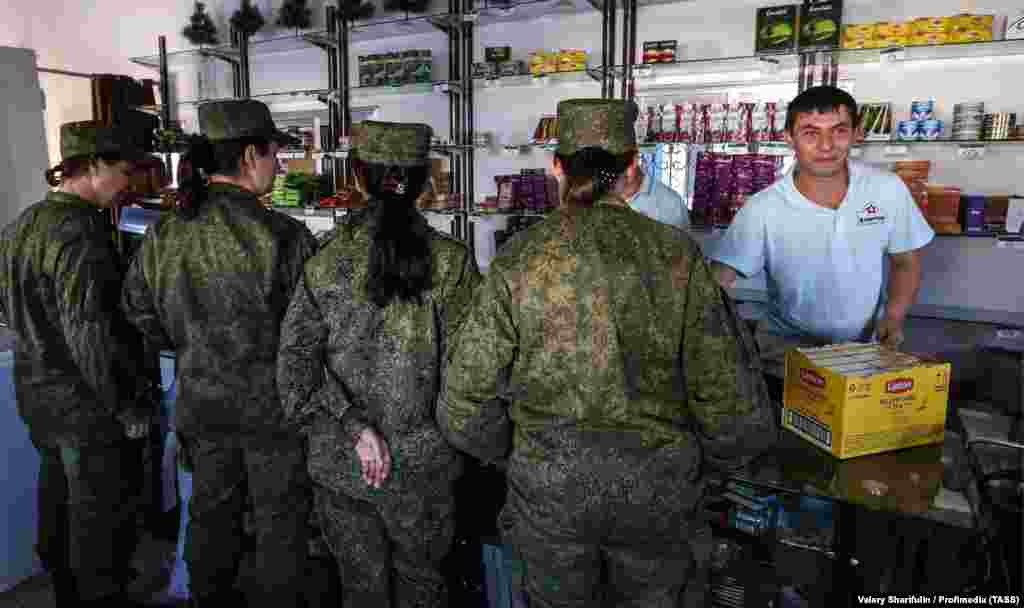
6/12Russian servicewomen wait at a store inside the Hmeimim base in February 2016.
Dubow said Moscow might be able to negotiate a reduced foothold in Syria, "to continue possessing vital transit stations for projecting power across the Middle East and Africa."
Photographs taken during the rule of Syria's deposed president, Bashar al-Assad, show life inside Russia's air and naval facilities in the Middle Eastern country.
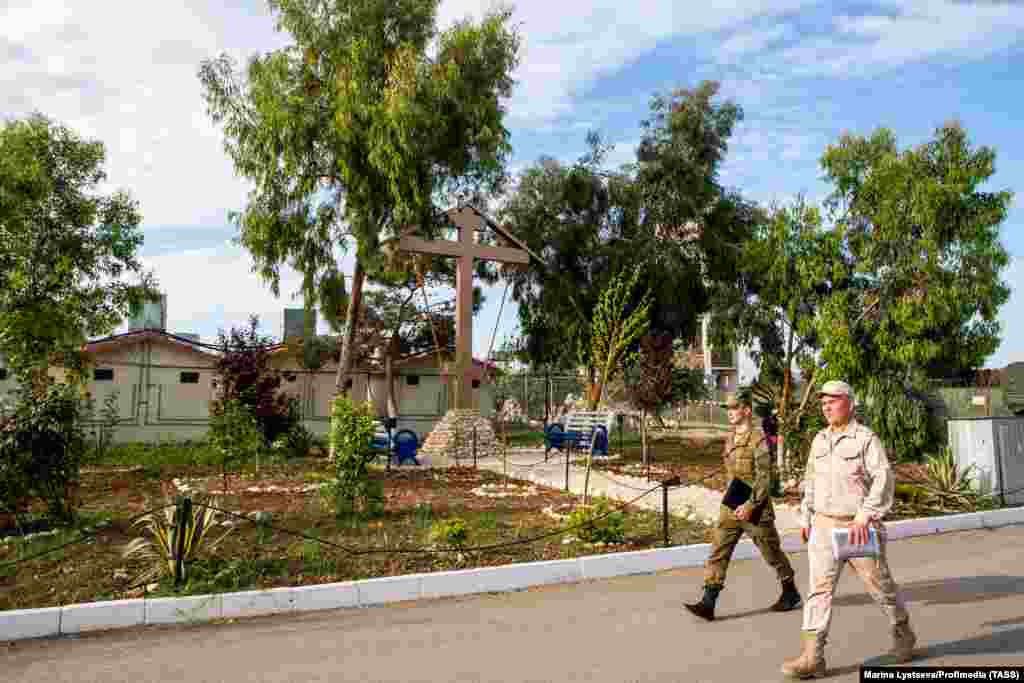
7/12Russian soldiers walk past an Orthodox cross at the Hmeimim base in April 2018.
The Hmeimim air base has been a hub for Russian military aircraft since 2015, when the Kremlin moved to shore up Assad’s forces in the Syrian civil war.
Photographs taken during the rule of Syria's deposed president, Bashar al-Assad, show life inside Russia's air and naval facilities in the Middle Eastern country.
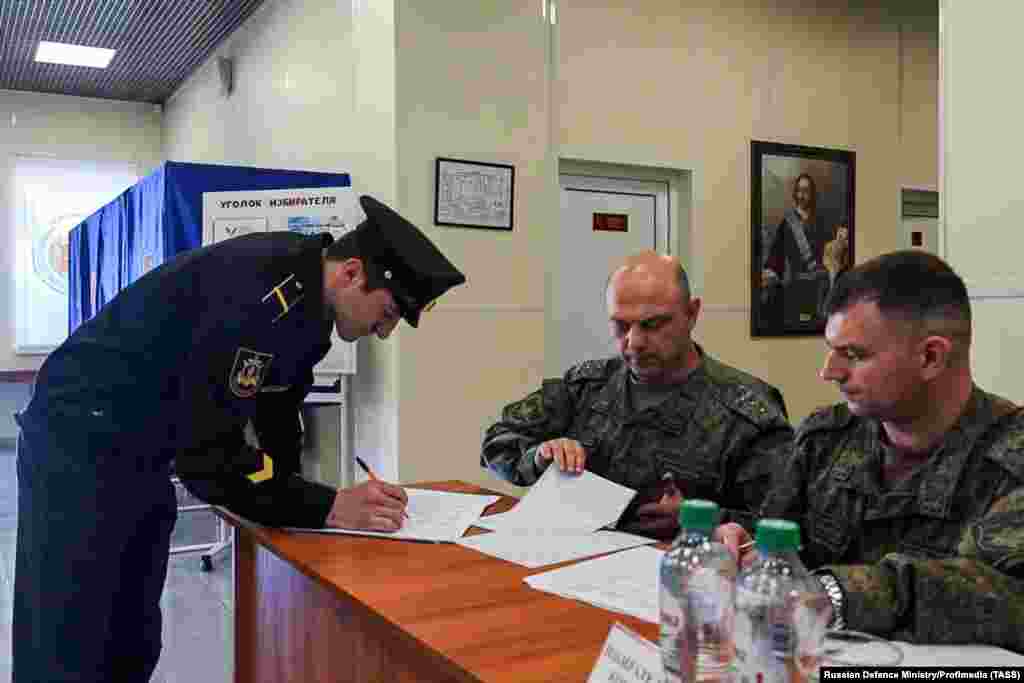
8/12A Russian sailor votes in the March 2024 presidential election near a portrait of Peter the Great, in the Tartus naval facility.
In 2017, Russia signed a 49-year lease on the Hmeimim base, and the Tartus naval facility (pictured) which was first established by the Soviets in 1971. Those agreements have been rendered meaningless by the collapse of the Assad government in Syria.
Photographs taken during the rule of Syria's deposed president, Bashar al-Assad, show life inside Russia's air and naval facilities in the Middle Eastern country.
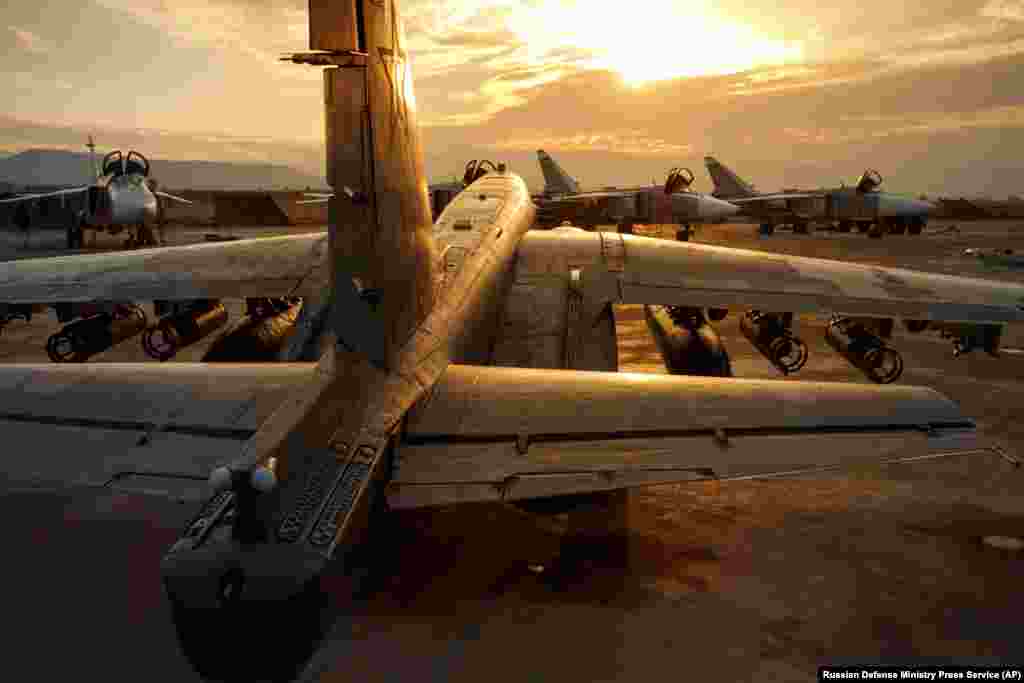
9/12A bomb-laden Su-25 jet at the Hmeimim air base in December 2015.
Russia's lease agreement obliged Assad’s military to safeguard the perimeter of the Hmeimim base, while giving Moscow legal jurisdiction over the facilities inside. Negotiating perimeter protection from Syria’s new rulers will be vital for the Russian bases in an era of wire-controlled drones immune to jamming.
Photographs taken during the rule of Syria's deposed president, Bashar al-Assad, show life inside Russia's air and naval facilities in the Middle Eastern country.
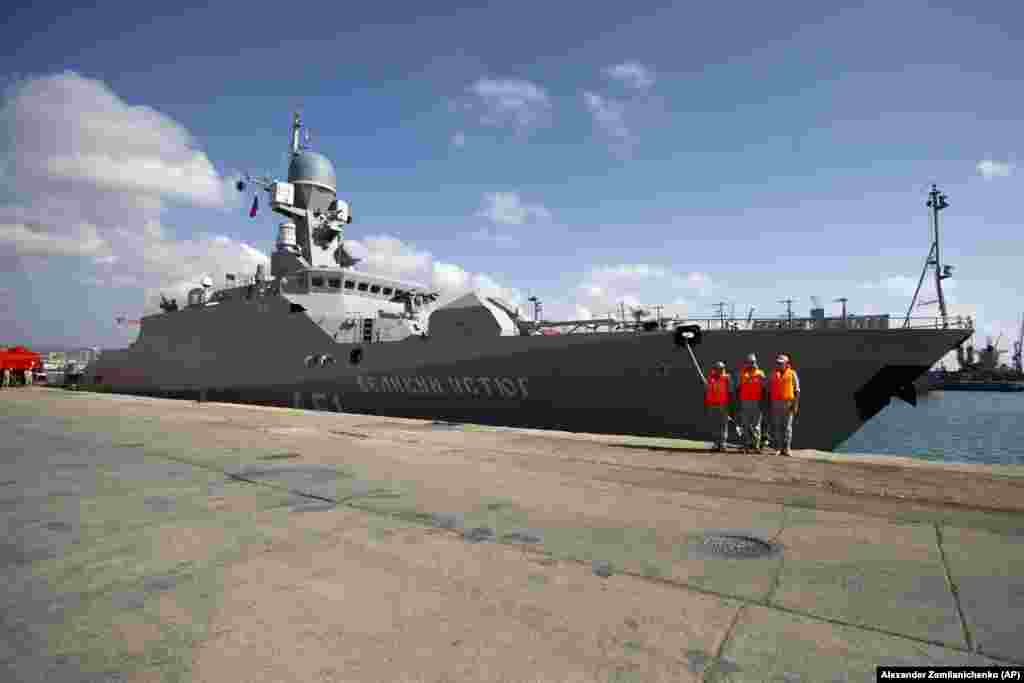
10/12A Russian corvette anchors in Tartus in September 2019.
Russian Deputy Foreign Minister Mikhail Bogdanov told Russian media on December 13: “the bases are still there, where they always were, on Syrian territory. No other decisions have been made for the moment."
Photographs taken during the rule of Syria's deposed president, Bashar al-Assad, show life inside Russia's air and naval facilities in the Middle Eastern country.
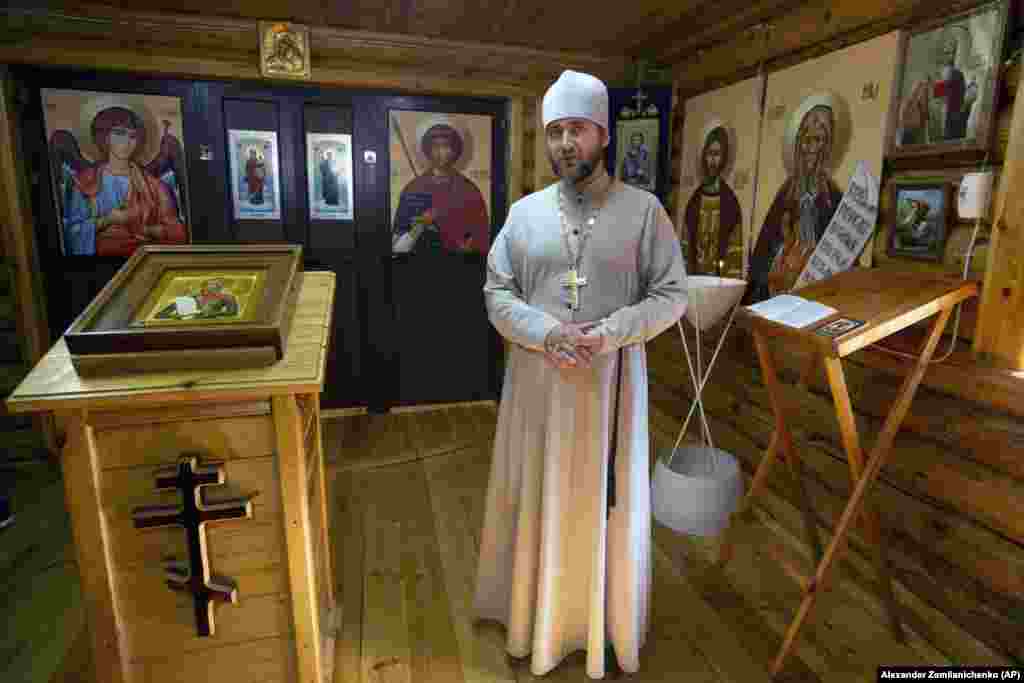
11/12A Russian Orthodox priest stands inside a chapel at the Tartus naval facility in September 2019.
A Britishintelligence report issued on December 13 linked the collapse of the Assad regime and subsequent shaky status of Russia's Syrian bases to the Kremlin's invasion of Ukraine.
Photographs taken during the rule of Syria's deposed president, Bashar al-Assad, show life inside Russia's air and naval facilities in the Middle Eastern country.
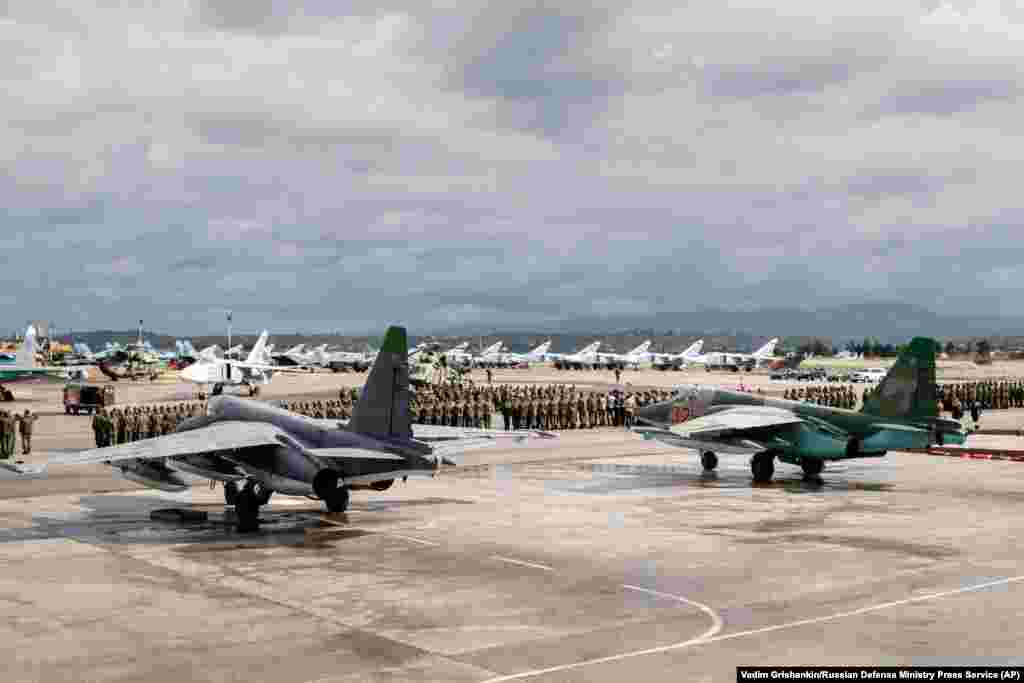
12/12Russian personnel line up on the tarmac of the Hmeimim air base in March 2016.
The British intelligence report cited "Russia's prioritization of the Ukraine conflict" as having "degraded Russia's ability and capacity to keep the Assad regime in power."
Photographs taken during the rule of Syria's deposed president, Bashar al-Assad, show life inside Russia's air and naval facilities in the Middle Eastern country.
Previous slide
Next slide
Analyzing images on social media from the last few days,Systema has found that Major General Sergei Gashkov, head of Russia's Center for Reconciliation and Refugee Movement Control in Syria, is currently at the air base.
It is unsurprising that Russia seeks to maintain strong ties with Damascus under its new leadership, as retaining control over the Hmeimim air base and the naval base in Tartus provides strategic access to the Middle East, North Africa, and the Mediterranean Sea.
What Is Iran’s Role?
There is no solid evidence suggesting that Russia is involved in fomenting unrest along Syria’s western coast, but some have accused Iran of playing a part.
In Assad, Iran lost a key ally who had allowed Tehran to use Syria as a land corridor to connect its regional proxies in Iraq and Lebanon.
When Syrian rebels deposed Assad, Iran’s Supreme Leader Ayatollah Ali Khamenei vowed that Syrians would rise and resist the rebel government.
Iran currently has no way of getting funds or arms into Syria, but several key figures leading the pro-Assad resistance to the new government are close to Tehran and trained by the Islamic Revolutionary Guards Corps (IRGC).
Assad’s surviving loyalists are led by four figures: Major General Suhail al-Hassan, whose hometown of Aita was among the first to witness clashes; Muqdad Fatiha, founder of the Coast Shield armed group; Ibrahim Hawija, former head of Syrian Intelligence; and Ghias Dalla, aformer officer in Syria's elite 4th Armored Division with links to the IRGC and the US-designated Lebanese terrorist group Hezbollah.
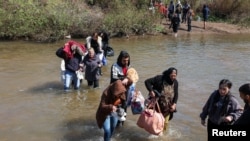
Alawite Syrians, who fled the violence in western Syria, walk in the water of the Nahr al-Kabir River in Akkar, Lebanon, on March 11.
Phillip Smyth, an expert on Iranian proxies and Shi'ite militias, told RFE/RL that Iran “desired an overreaction” from the transitional government, and it got what it wanted.
Tehran "is happy this was set off," especially since it establishes that Iran "can cause massive disruption" in Syria, Smyth said.
With reporting by Olya Ivleva, Kyrylo Ovsyaniy, Anna Myroniuk of Schemes; Daniil Belovodyev, Dmitry Sukharev, Svetlana Osipova, Yelizaveta Surnacheva of Systema; and Iliya Jazaeri of RFE/RL’s Radio Farda
Kian Sharifi is a feature writer specializing in Iranian affairs in RFE/RL's Central Newsroom in Prague. He got his start in journalism at the Financial Tribune, an English-language newspaper published in Tehran, where he worked as an editor. He then moved to BBC Monitoring, where he led a team of journalists who closely watched media trends and analyzed key developments in Iran and the wider region.
Schemes (Skhemy) is the award-winning investigative project of RFE/RL's Ukrainian Service. Launched in 2014, it has exposed high-level corruption and abuse of power for over a decade. Following Russia's full-scale invasion in February 2022, the project expanded to uncovering Russian war crimes.
Systema is RFE/RL's Russian-language investigative unit, launched in 2023. The team conducts in-depth investigative journalism, producing high-profile reports and videos in Russian.
RFE/RL's Radio Farda breaks through government censorship to deliver accurate news and provide a platform for informed discussion and debate to audiences in Iran.