



WASHINGTON -- As US President Donald Trump concluded a high-stakes Situation Room meeting on a possible Iran agreement, major questions remained open: Iran’s uranium enrichment, the fate of its nuclear stockpile, sanctions relief, and the reopening of the Strait of Hormuz.
To understand where negotiations stand and whether diplomacy can still prevent another escalation, RFE/RL spoke with Ethan A. Goldrich, a veteran US diplomat who served under multiple administrations, most recently as Deputy Assistant Secretary of State overseeing Near Eastern affairs between 2021 and 2024.
'Fundamentally Different Ideas'
RFE/RL: US officials now say the cease-fire extension framework with Iran is close but not finalized. What is still blocking the deal, in your opinion?
Ethan A. Goldrich: Even at the moment where President Trump is making a decision on whether to go forward with whatever the current version of the deal is or not, I think what has been blocking the deal ever since April 8, when the cease-fire took place, is that the US and Iran seem to have some fundamentally different ideas on what should or shouldn't be discussed at the moment.
On the US side, President Trump has been very clear over and over again that Iran cannot have a nuclear weapon. On the Iranian side, they think that they have an inherent right to enrich uranium or to develop a nuclear capacity -- they claim not for a weapon. So in that respect, they have been very consistent in negotiations in saying that they're not ready to give the kinds of guarantees that the US wants to see on what they're doing with their nuclear capacity.
On the US side, we've also been very clear that the Strait of Hormuz should open up again, and the Iranians there are also taking a different position on reopening the Strait of Hormuz.
So I think those are the key issues. And then on every other issue, I think there hasn't been agreement. There are very clear US ideas and requirements, and then a different Iranian view. So far, the Iranians haven't felt pressured into changing their positions, so we'll see what happens today.
RFE/RL: The White House says the dispute now largely centers on uranium enrichment and stockpile limits. How difficult is it to bridge that gap diplomatically?
Goldrich: When President Trump is speaking directly to the issue, sometimes he's talking about US troops going to -- I think in his last Truth Social post he talked about US troops going to dig up the uranium, maybe with the IAEA with them, or maybe coordinating with the Iranian authorities.
But I'm sure that is a difficult idea for the Iranians -- that the US would be there and would dig up the highly enriched uranium. And then where does it go if it can be found and discovered and removed? Is it being removed from their country?
We certainly want it removed, and I think there have been different ideas out there on where it could go. But since no one has really seen what's in the negotiations or in the agreement, we don't really know how that's going to work.
RFE/RL: Is Iran’s insistence on maintaining enrichment capabilities a red line Washington can realistically accept?
Goldrich: I think it's been very hard for the US, which was involved in the Midnight Hammer operation to destroy the Iranian nuclear capacity and the highly enriched uranium in June, and then reentered into a conflict in February with that as one of the top goals.

So it has to be crystal clear how that issue is being resolved, because that was the main cause, I think, of the conflict. And I think if it's not resolved explicitly at this time, then there are going to be more rounds to this conflict.
We saw earlier efforts through diplomacy to deal with this issue, and the Trump administration ultimately left the JCPOA [2015 nuclear deal] because they didn't think that was an effective and correct way to deal with the issue. And now we've seen rounds of military action to deal with the issue before coming back to negotiations.
But in all these circumstances, without explicit resolution to the issue, I think we just keep getting pulled back into more and more rounds of this conflict.
'Every Part Of The Word'
RFE/RL: The proposed framework would also include reopening the Strait of Hormuz. How important is that issue to broader diplomacy?
Goldrich: I think the issue is very important. For starters, the economic implications of the Strait of Hormuz being closed affect every part of the world, because the resources that normally come out through the strait are not coming out. It's increasing oil prices and other prices. It's causing economic problems in countries all over the world.
Even here in the US, where we're a little bit more insulated than a lot of places because we have our own resources, we all see how high the price of gas has gone. So that issue needs to be resolved.
And then there's a larger concept also of the free flow of navigation -- that the Strait of Hormuz is not the only maritime strait in the world. There are other areas also that are considered international waterways and shouldn't be under the control of any particular country, even if they're located close to the international waterway.
A concession on the Strait of Hormuz and its status could easily set precedents for other waterways in other parts of the world and cause future crises far away from Iran.
RFE/RL: What leverage do sanctions still give Washington at this stage?
Goldrich: I think the sanctions have given the US a lot of leverage. They were developed over time in coordination with other countries, with our allies, with other members of the UN, and through our own domestic sanctions.
There are many, many layers of sanctions that have constricted Iran's ability to cause even more problems and even more mayhem than they have, and they have been our leverage to lead to changes in their behavior. They probably helped push the Iranians into the initial JCPOA negotiations.

But from the Iranian perspective, they want to get the sanctions relaxed or lifted. Their economy has suffered, and they want to relieve the pressure they're under. So that's clearly one of their top demands at the moment.
But it's a challenge, I think, for the administration to figure out how to address that concern on the Iranian side without looking like we are going softer on the sanctions issue than previous administrations had.
So sanctions are another key issue where it's difficult to see how the US viewpoint is eventually going to reach a point where the Iranian viewpoint can also reach agreement.
'Diplomacy Requires confidentiality'
RFE/RL: Having worked on Middle East diplomacy throughout your career, do public statements from Tehran and Washington risk undermining private negotiations?
Goldrich: I think there's certainly an importance to confidentiality in diplomatic negotiations, often to reach the point where you can talk about things that aren't ready to be discussed publicly or try out new ideas. So traditional diplomacy, I think, does require a level of confidentiality.
We are living in a different age where so much is out in the open, or comes out in the open very quickly because of the technologies available to us. So I think in some ways governments have adjusted themselves to that and started putting more into the public domain faster than they would have in earlier negotiations.
I think sometimes that can hurt a negotiation. Occasionally it can help a negotiation. But ultimately, I think diplomacy is a skill, and diplomats are people who train throughout their lives to be able to perform that skill.
It would be helpful to allow them to work through a difficult and complicated problem like this rather than jump to public messaging as the primary way of moving the issue forward.
RFE/RL: Pakistan’s foreign minister was in Washington today, while Qatar and Oman continue to play mediation roles. What does that tell us about the regional diplomatic landscape?
Goldrich: I think it's a very complicated regional diplomatic landscape.
We have friends in the region who have been suffering through this conflict, including Israel and the Gulf states, and then other allies further afield are having problems because of the economic impact. So I think many different countries want to see a resolution to the conflict.
Looking at it from their different perspectives, though, how it's resolved is important to them as well.
From the Israeli side, I think it's very important that the nuclear issue is resolved -- that Iran's threat to them and to the region is resolved. I don't think they would see it as progress if we reached a solution that didn't address the key issues.
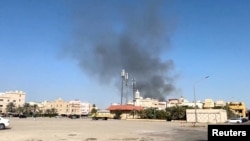
I think some of the Gulf states probably feel the same way, especially the ones that continue to get hit by Iran even during this cease-fire period. They also want to see real resolution to the issue.
Other states, I think, are more concerned now about their own economies and how quickly the economic situation can be fixed and stability can be returned to the region.
I think it's important for the US to be talking to all of its allies and trying to make sure it understands the impacts of what it's doing and what would constitute a real and long-lasting solution to the conflict.
'Needs To Be Resolved Carefully'
RFE/RL: How much does Iran’s regional proxy network factor into these talks beyond the nuclear file?
Goldrich: I think Iran's regional network has caused immense damage throughout the region, including directly to the United States at moments when Hezbollah has killed American citizens.
Hezbollah has disrupted Lebanon and Lebanon's ability to function as a country. I think the proxies functioning in Iraq and in Yemen have also caused problems.
I spent a great deal of time working on Syria at the end of my career, and the role of Iranian proxies in Syria was disruptive for many years.
That is a key issue that needs to be resolved. Iran using these proxies to act in its stead and try to achieve its goals can't be allowed to continue.
And I think as we move toward a solution, and as we're talking directly to the Iranian government, we really have to remember the nature of this Iranian government -- that this is a very dangerous and disruptive group of people.
Whatever solution we arrive at, we are going to have to make sure that they're not only committed to it, but don't have a way to slip out of it as time goes by.
I think everyone wants to see a resolution to the conflict, but the conflict needs to be resolved carefully, and the key issues need to be addressed.
RFE/RL: Some critics argue Tehran is simply buying time. What signs would convince diplomats that Iran is negotiating seriously? What will you be watching in the next 24 to 48 hours?
Goldrich: We need to see what the structure is of whatever negotiation will follow this initial period.
We know that right now the focus is on opening up the Strait of Hormuz, and there needs to be something coming right after that where the parties sit down to deal with the nuclear issue and deal with the highly enriched uranium.
It's the structure of that, which I don't think we have a clear picture of yet, that should start to give us an idea of whether the Iranians are just looking for more time so that they can try to rebuild their capacities and their military, or if there's some way to get into a more serious negotiation that has so far eluded us for many years.
RFE/RL: After months of escalation, are we genuinely closer to a diplomatic breakthrough, or simply managing the next phase of the crisis?
Goldrich: Well, I think that is the question.
I think it's clear that President Trump understands what his goals were in the beginning. He keeps coming back to the nuclear issue, so I think his aim consistently has been to achieve a result.
He attempted using military force in June. He attempted using diplomacy just before June. He used diplomacy again afterward. He used military force again. But all of these indicate that he sees the issue as important and central to what he was trying to achieve as president.
What we don't know at this moment is whether he is able to move forward toward those goals, or if the issue of the economic crisis in the straits will have to be prioritized first, and then how long it will take for progress to be made toward the broader goals.
Those goals are still going to be there. Whether the issue is managed and ignored or dealt with directly, the problem is going to remain, and it will force everyone to focus on it again.

