




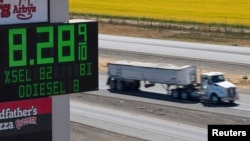
WASHINGTON -- US President Donald Trump said he reached an agreement with President Vladimir Putin to temporarily ease sanctions on Russian diesel exports, a move Ukraine immediately criticized as a "gift" to the Kremlin.
Seeking to contain soaring energy prices, Trump said in a social media post on October 9 that the two leaders agreed to release 300,000 tons of diesel immediately, followed by 500,000 tons in November and another million after that.
The move will see prices "COMING DOWN, IN RECORD NUMBERS, AND FAST!" Trump wrote.

Diesel futures fell about 4 percent after the announcement but remained more than 110 percent higher than at the start of the year. Brent crude traded at around $104 a barrel, down just 0.3 percent on the day.
The decision came as Ukrainian, US, and European officials held talks in Miami aimed at ending Russia’s war against Ukraine. The discussions concluded without a breakthrough.
The waiver drew critical comments from Kyiv to lawmakers in Washington, who warned that easing restrictions could provide Moscow with additional revenue to sustain its war against Ukraine.
It also raised questions about US policy toward Russia following Trump’s recent signing of legislation intended to tighten sanctions against countries supporting Moscow’s energy trade.
"Gifts to Putin will not bring peace or any benefit to the civilized world," Ukrainian President Volodymyr Zelenskyy wrote in a post on social media.
"Russia will 'repay' the diesel with further terror and perfidy. Allowing Russia to sell petroleum products is an investment in a war that must be ended, not prolonged. What is needed is real de-escalation with Russia on a reciprocal basis."
To enable the flow of diesel, the US Treasury Department issued a temporary general license authorizing the sale, delivery, and import of Russian-origin diesel fuel through April 7, 2027.
Trump said that after the initial flows, Russia would supply a further 3 million tons “within a short period of time.”
Russian Deputy Prime Minister Alexander Novak said Moscow was ready to increase supplies in October, with exports expected to rise in November and December as refineries resume operations after maintenance.

Diesel prices have climbed since the United States and Israel launched air strikes on Iran in February, sparking a conflict that is now in its eighth month.
Trump has blamed Ukrainian strikes on Russian refineries for pushing prices higher and urged Zelenskyy to stop targeting Russian energy facilities.
“The problem I have with Ukraine and Russia is that, you know, a lot of the diesel comes … from Russia, and the Russia plants are being hit by Ukraine,” Trump told reporters recently.
Ukrainian officials have said they are prepared to stop attacking Russian oil refineries if Moscow halted its recent barrage of strikes on Ukraine’s energy and other civilian infrastructure installations.
As Ukraine’s negotiating team was in Florida, Zelenskyy also questioned the purpose of the Miami talks while Washington was allowing Russia to earn money from fuel exports.
“I believe our team is simply being used as a smokescreen,” he said.
Earlier on October 9, Zelenskyy welcomed a bipartisan delegation of US senators to Kyiv and called for stronger pressure on Moscow.
Meanwhile, on Capitol Hill, the waiver for Russia drew the ire of several lawmakers.
“It surely looks bad. The president has always had a moral blindness when it comes to Putin. Propping up Russia’s war economy is terrible,” Republican Representative Don Bacon told RFE/RL.

Democrat Senator Richard Blumenthal, a co-author of the bipartisan Russia sanctions legislation, called the decision an embarrassment, arguing that it would benefit Russia and China while undermining congressional efforts to pressure Moscow.
“This poorly concealed attempt to mitigate the havoc caused by Trump’s illegal war in Iran will only benefit the Chinese & Russian economies & lead to the slaughter of more innocents in Ukraine,” he wrote on social media.
Blumenthal called the agreement “a stain on our nation’s character” and said it ran counter to Congress’s intent in its recent passing of a sanctions bill.
He also warned US companies considering purchases of Russian fuel: “Congress is watching.”
Daniel Fried, a former US diplomat and sanctions expert, also criticized the timing of the waiver.
“General License allowing sale of Russian diesel, proceeds of which support Russia’s war against Ukraine. Not a promising start to the imminent talks on ending the war,” Fried said in a social media post.

Kerri Bitsoff, a former senior Treasury Department official who worked at the Office of Foreign Assets Control, said the move showed Trump was prioritizing the Iran conflict and its economic consequences over pressure on Russia.
“The Russia legislation put the onus, and the ability to act, in President Trump's hands,” Bitsoff told RFE/RL.
“Today's diesel license shows Trump is prioritizing the Iran conflict over pressure on Russia, and he likely doesn't intend to use a lot of the authorities in the bill,” she said.
Ukrainian sanctions commissioner Vladyslav Vlasiuk said the waiver could also undermine Trump’s argument that Ukrainian attacks on Russian refineries were the main driver of rising diesel prices.
“If limiting diesel sanctions on Russia provides market relief then it’s clear the primary impact to the global diesel market was the Iran conflict and blockade, not Ukrainian strikes on Russian refineries, which would have had a secondary impact,” Vlasiuk told RFE/RL. “It lines up with price timelines.”
The decision also raises questions about the Ending Importation of Russian Oil Act of 2022, which prohibits Russian oil imports into the United States unless the president certifies that Russia has agreed to withdraw from Ukraine, recognized Ukrainian sovereignty, and poses no threat to NATO.
Supplied materials from officials on the decision does not establish how that provision applies to the new license.
The Miami discussions, initially expected to last two days, concluded on Friday, October 9, according to US envoy Steve Witkoff.
Representatives from the United States, the E3 group of European countries, the European Commission, Ukraine, and NATO held “constructive discussions” on ways to de-escalate and end the war before winter.
Witkoff said the agenda included winter preparedness, energy resilience, grain exports, security guarantees, longer-term security arrangements for Ukraine and Europe, and support for Ukraine’s postwar reconstruction and eventual European Union accession.
“The exchange was productive and helped identify areas for further exploration ahead of the United States’ next engagement with Russia,” he wrote on social media.
The Kremlin said Trump and Putin had also discussed prospects for resolving the war during their phone call, alongside the situation surrounding Iran and other bilateral issues.

