




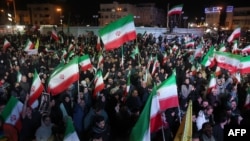
WASHINGTON -- US President Donald Trump and Iran have agreed to a two-week Pakistani-brokered cease-fire, pulling back from the brink to allow the two sides time to negotiate a peace deal.
Trump, who early on April 7 wrote that "a whole civilization will die tonight" if Iran fails to reach a deal, said in a social media post that he had received a 10-point proposal from Tehran and he believes "it is a workable basis on which to negotiate."

The Tasnim news agency, which is close to the powerful Islamic Revolutionary Guards Corps (IRGC), confirmed a cease-fire has been "established" between the two sides "with specific conditions."
"They requested that I hold off the destructive force being sent tonight to Iran, and subject to the Islamic Republic of Iran agreeing to the COMPLETE, IMMEDIATE, and SAFE OPENING of the Strait of Hormuz, I agree to suspend the bombing and attack of Iran for a period of two weeks," Trump wrote.
Trump gave no details of the Iranian proposal, but added that the agreement hinges on Tehran allowing for the free passage of ships in the Strait of Hormuz, a key shipping lane through which some 20 percent of the world's oil and gas passes.
Analysts pointed to that condition as being the key to the deal, adding that the stability of the cease-fire rests on Tehran.
"Now all eyes are on Iran as the president has made the cease-fire contingent upon Iran opening the strait," Alex Plitsas, a nonresident senior fellow with the Atlantic Council and a former Pentagon official, told RFE/RL.


Israel said that it supports Trump's decision to stop attacking Iran for two weeks subject to the immediate reopening of the Strait of Hormuz and the cessation of attacks against the United States, Israel, and other countries in the region.
But the statement, released by the office of Prime Minister Benjamin Netanyahu, said the cease-fire did not include Lebanon, which contradicted an earlier statement from Prime Minister Shehbaz Sharif of Pakistan.
Anne Dreazen, vice president of the American Jewish Committee's Center for a New Middle East, told RFE/RL that while the pause is a "tactical de-escalation," the maritime terms remain highly precarious. She noted that because passage is still being coordinated via the Iranian military, the agreement represents a "controlled and conditional access regime" rather than a true return to international norms.
"In practical terms, Iran is retaining the ability to regulate, restrict, or politicize maritime traffic using the strait as leverage rather than restoring the principle of free navigation," Dreazen said, adding the burden is now on Tehran to prove it is ready to "shift course from coercion and disruption toward meaningful negotiation and de-escalation."
Iranian Foreign Minister Abbas Araqchi confirmed in a post on X that if attacks against Iran are halted, Iran's armed forces "will cease" their retaliatory strikes aimed at targets throughout the Middle East.
"For a period of two weeks, safe passage through the Strait of Hormuz will be possible via coordination with Iran's Armed Forces and with due consideration of technical limitations."
Trump's post followed his warnings that the United States would target Iran's power plants and bridges.
It also came just hours after US and Israeli air strikes hit multiple locations across Iran, including infrastructure and the strategic Kharg Island.
Senior Trump administration officials called the deal "a win," while Jason Brodsky, policy director at United Against Nuclear Iran, characterized the agreement as "a tactical pause -- a delay" by the United States to see if Iran will hold to the deal.
"I think President Trump retains the option of escalating. The attack plans have been prepared. That credible military threat remains," he told RFE/RL, adding that both nations remain in a position to strike.
"The Iranians have the ability to threaten the Strait of Hormuz. So both can revert to previous postures if this deal fails to hold."
The last-minute move came amid global concerns over Trump's remarks on wiping out Iranian civilization, with Pope Leo, an American, suggesting it was "truly unacceptable" and others warning against attacks on civilian infrastructure.

There had been few signs that the sides were ready for compromise in the war, which began with US and Israeli air strikes on Iran on February 28, and little overlap between proposals put forth by Washington and Tehran.
"The cease-fire, should it hold, could serve as a more general off ramp to future hostilities. In this sense, escalation -- even the threat of it -- may have been necessary to precipitate the current de-escalation," Cale Brown, a former deputy spokesperson during Trump's first administration and chairman of Polaris National Security, told RFE/RL.
US Democratic Senator Jeanne Shaheen, ranking member of the Senate Foreign Relations Committee, said she welcomed a temporary cease-fire to stop the fighting with Iran, though concerns remain over what the war has achieved, citing a sharp increase in gas prices, the "enormous disruption" to the global economy, and the deaths of 13 US service members.
“Diplomacy is the only way forward. There must now be an intensive diplomatic effort, alongside our allies, to conclude this conflict and ensure Iran does not develop a nuclear weapon,” the senator from New Hampshire said in a statement late on April 7 after the cease-fire deal was announced.

