




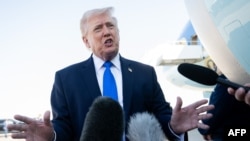
President Donald Trump’s claim that the United States has held talks with Iran has raised hopes of an end to the weekslong war rocking the Middle East.
But it is unclear if the purported talks -- dismissed as “fake news” by Tehran -- are a sign of a potential breakthrough, intended to calm panicked financial and global energy markets, or simply to buy Trump more time.
Even if there is a concerted diplomatic push, a huge gap remains between the United States and Iran. Tehran’s chokehold on the Strait of Hormuz, a key artery for global oil supplies, also gives it leverage in any negotiations to end the war, experts say.

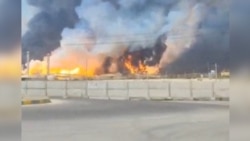
Despite the talk of diplomacy, the war with Iran showed no signs of de-escalation on March 24. The United States and Israel launched a new round of air strikes on Iran, which fired missiles at Israel and hit energy infrastructure in the Persian Gulf.
“I don't think Trump is seeking an off-ramp and an end to the war yet,” said Farzan Sabet, a managing researcher at the Geneva Graduate Institute.
Trump still has “escalatory options to attempt to reopen the Strait of Hormuz and to coerce the Islamic republic to accept his terms,” he said, including the possible use of US troops to seize Iran’s Kharg Island, which serves as the country’s key oil terminal, or capture Iranian territory with the aim of ending Tehran’s effective closure of the narrow waterway.
US media reported last week that two American expeditionary units, with thousands of Marines and supporting ships and aircraft, were on their way to the Middle East.
Experts said Trump’s claim of talks with Tehran provided the US president an opportunity to walk back from his threat to “obliterate” Iran’s power plants if Tehran did not reopen the Strait of Hormuz, through which 20 percent of the world’s oil and liquefied natural gas are shipped. Trump, who had issued a 48-hour ultimatum on March 21, said he was postponing the strikes to allow time for talks to succeed.
“Backing down from his ultimatum and specifically the threat to destroy Iranian power plants probably had more to do with the risks involved with such an action, which could lead Tehran to strike reciprocal targets in the Persian Gulf, with potentially devastating humanitarian and economic consequences for both sides,” said Sabet.
“He likely faced intense pressure not to follow through on this threat,” he added. “There was also likely an element of Trump trying to manipulate global energy prices by giving the impression of de-escalation, coaxing them to go down, even if temporarily.”

'Very Strong Talks'
Trump wrote on his Truth Social platform on March 23 that the United States and Iran had held "very good and productive" conversations about a "complete and total resolution of hostilities in the Middle East."
Trump later told reporters that his special envoy Steve Witkoff and son-in-law Jared Kushner had held discussions with an unnamed top Iranian official in recent days.
"We have had very, very strong talks. We'll see where they lead. We have major points of agreement, I would say, almost all points of agreement," Trump said.
Trump’s comments quickly sent oil prices falling. But they rose back above $100 a barrel after Iran said there had been no direct talks with the United States.
"No negotiations have been held with the U.S., and fakenews is used to manipulate the financial and oil markets and escape the quagmire in which the US and Israel are trapped," Mohammad Baqer Qalibaf, Iran’s powerful speaker of parliament, wrote on X.
Later, the White House said the situation was “fluid” and cautioned that no formal meetings between any US and Iranian officials had been scheduled.
Amid the contradictory claims from the United States and Iran, there appears to have been at least initial contact between the sides through intermediaries, according to US media reports.
'Permanent Political Solution'
Even if there is a genuine push to end the war, the gap between the sides remains significant and the likelihood of a breakthrough is low, experts say.
Trump has demanded an end to all nuclear enrichment and the elimination of all of Iran’s uranium stockpiles that could be potentially used to make a bomb.
Iranian officials have made their own demands, including guarantees that the United States and Israel will not attack Iran again, the lifting of crippling US sanctions, the closure of US military bases in the Persian Gulf, and war reparations from Washington and Israel.
“The Iranians are aiming for a more permanent political solution rather than de-escalation or a cease-fire,” said Sina Azodi, an expert of Iran’s military and history and an assistant professor of Middle East politics at George Washington University.
Iranian officials have said they do not want a repeat of the 12-day war with Israel and the United States in June 2025 which ended with a cease-fire, only for a new war to erupt on February 28.
“They believe that if they stop now, Israel and the US will come back in six months if not a year,” Azodi added. “Their aim is to deter future attacks since they believe this is a fight for their survival.”
Iran’s demands, experts say, reflect its belief that it will come to any negotiation from a position of strength.
US-Israeli strikes have degraded but not destroyed Iran’s ability to fire missiles and drones at Israel and America’s allies in the Persian Gulf. Tehran still maintains a chokehold on the Strait of Hormuz, and Iran’s stockpiles of highly enriched uranium remain buried underneath nuclear sites damaged by US-Israeli strikes.
“Right now, Iran has the upper hand in terms of its ability to deny the US a victory,” said Azodi.

