




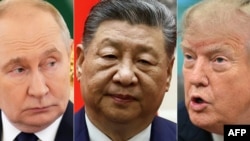
WASHINGTON -- A first-ever trilateral meeting between US President Donald Trump, Chinese leader Xi Jinping, and Russian President Vladimir Putin to be held on the sidelines of this week's Asia-Pacific Economic Cooperation (APEC) conference in Shenzhen may underwhelm despite its eyebrow-raising symbolism.
First proposed by Putin in October and confirmed by the White House on November 13, the trilateral summit has drawn comparisons to the 1945 Yalta conference held in the twilight of World War II. At the Crimean resort city, the victorious US, UK, and Soviet Union established post-war spheres of influence behind closed doors, effectively deciding the fates of many smaller nations across Europe and Asia.
Ukrainian President Volodymyr Zelenskyy, wary of Putin's attempts to sideline him from shaping the outcome of the full-scale war on Ukraine that Russia launched in 2022, told CNN: "We don't want to have Yalta 2.0."
No New Yalta
But multiple experts told RFE/RL that the US-China-Russia meeting on November 19 will differ sharply from the epochal conference held 81 years ago.
"I don't think the analogy is the right one," said Elizabeth Wishnick, an expert on Sino-Russian relations at the CNA Corporation in Virginia. "Even if they wanted the power to make those decisions, they wouldn't be able to implement them, because the world has changed since that time. So many independent actors have the ability to thwart great powers. Look at the Persian Gulf, for example."

Bobo Lo, a nonresident fellow at Australia's Lowy Institute, notes that China has been trying to position itself as the leader of the Global South, ostensibly focusing on the democratization of international relations.
"The idea that three world leaders make the big decisions about global governance runs against Beijing's constant narrative, and the Chinese are extremely wary about that idea," he told RFE/RL.
Putin stands to gain the most among the three leaders even if the summit achieves little of substance, Tsiporah Fried, a visiting senior fellow at the Hudson Institute in Washington, said in an interview.
"It will help him restore his international standing and break out of the isolation that Russia has experienced. He can portray Russia as a great power negotiating the future of Ukraine, without having to think about losing on the battlefield," she said.
Stage Management For Xi
For Xi Jinping, who did not seek out this meeting, effective stage management is paramount.
Xi's priority "is a successful gathering and presenting the image of stabilization of relations among great powers. China will focus on the symbolism rather than specific deals reached," Yun Sun, director of the China Program at the Stimson Center in Washington, told RFE/RL.
Initially, neither Beijing nor Washington agreed to Putin's idea for the summit, which he proposed in an October 9 phone call with Trump. But on October 19, Trump told reporters at the White House that he was willing to hold the meeting if Xi agreed.

China did not acknowledge discussions on the trilateral meeting until November 4.
The Wall Street Journal later reported that Beijing and Washington disagreed on the meeting's format. China wants to leave nothing to chance and is pressing for a tightly scripted affair with a predetermined outcome, while Washington prefers a more flexible format with open discussion.
In this case, Beijing is especially intent on stage managing the meeting because it does not want it to overshadow the main APEC event, CNA Corporation's Wishnick said.
Notably, China has resisted Putin's call to discuss ending the war in Ukraine. German President Frank-Walter Steinmeier, who recently met with Xi on a state visit to China, said in an interview with German public broadcaster ARD that Xi told him any negotiations regarding the conflict must include European participation because the war directly impacts European security.
In Europe, "China is seen as an enabler of Russia's war with Ukraine" and so must tread carefully, Wishnick said. To host a trilateral summit where Washington, Moscow, and Beijing discuss ending the war without Ukrainian and European participation "would just complicate China's diplomacy toward Europe."
The Chinese "want a bigger framework that would involve the Ukrainians and Europeans being onboard," she added.
Trump's Focus: Nuclear Arms Control
Compared to those of Xi and Putin, Trump's objectives for the meeting are the most modest. The US president doesn't have to play host like Xi, nor strive to present himself as an equal with the world's preeminent powers as Putin must.
Instead, Trump aims to discuss nuclear disarmament, a topic he's expressed strong interest in since the 1980s. In 1984, Trump told a Washington Post reporter that he wanted to negotiate nuclear arms control with the Soviet Union on behalf of the United States.
In 2019, the first Trump administration shifted US nuclear strategy away from traditional bilateral arms control with Russia toward a trilateral framework involving Moscow and Beijing.

In an October 15 Newsmax interview, Trump said, "The whole thing is a shame, because I'd love to denuclearize if possible, but we're actually talking to Russia about that, and we're talking to China about that denuclearization."
On November 13, White House spokeswoman Olivia Wales said, "He will discuss the reduction of nuclear weapons in the world, whose proliferation President Trump believes is very dangerous."
China, however, remains wary of broaching nuclear arms control with the United States and Russia.
"China's position on nuclear weapons is clear: Russia and the US should first reduce their much larger arsenals" before any trilateral discussions can begin, said the Hudson Institute's Fried.
The United States and Russia together account for more than 90 percent of the world's nuclear weapons, according to the Federation of American Scientists (FAS), a Washington-based think tank. Russia has 5,420 nuclear warheads while the United States has 5,042, according to the FAS. In contrast, China has just 620.
That said, Beijing is ramping up its nuclear arsenal. The Pentagon estimates China will have 1,500 warheads by 2035.
Beijing says its nuclear expansion is a defensive measure to ensure a credible second-strike capability. It maintains a No First Use (NFU) nuclear policy and pledges to not to use or threaten the use of atomic weapons against states that do not have them or zones free of nuclear weapons.
"There are formidable obstacles to any trilateral arms control agreement, particularly given the asymmetries between the three nuclear powers and their different strategic priorities. Nevertheless, dialogue among them would be valuable," Fried said.
The challenge, she says, is to translate that dialogue into concrete negotiations, with clearly defined objectives, reciprocal commitments, and an agreed framework capable of producing meaningful and verifiable limits on the three countries' nuclear arsenals.