



Iran
Turkish Leader Vows Not To Honor U.S. Sanctions On Iran After Waiver Expires
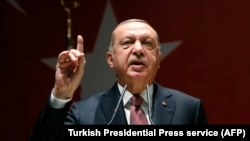
Turkish President Recep Tayyip Erdogan says that Turkey will not honor renewed U.S. sanctions on Iran's oil and shipping industries when waivers granted by Washington expire in six months.
"These are steps aimed at unbalancing the world. We don't want to live in an imperialist world," Erdogan told reporters in Ankara on November 6.
"We will absolutely not abide by such sanctions. We buy 10 billion cubic meters of natural gas. We cannot freeze our people in the cold," he said.
Washington reimposed the sanctions on November 5 after abandoning Iran's 2015 nuclear agreement with world powers.
Erdogan suggested he would discuss the matter when he meets with U.S. President Donald Trump at a summit to commemorate the end of World War I in Paris over the weekend.
Turkey was one of several major Iranian oil customers that was granted a temporary waiver from the sanctions, enabling it to continue buying Iranian crude for another six months.
NATO member Turkey depends heavily on imports to meet its energy needs and neighboring Iran has long been one of its main suppliers of oil and natural gas.
Speaking in Japan earlier on November 6, Turkey's foreign minister said it would be dangerous to isolate Iran and it was not easy for countries like Turkey and Japan to find other suppliers for their fuel needs.
"We do not believe any result can be reached with sanctions. I think meaningful dialogue and talks are more useful than sanctions," Mevlut Cavusoglu said.
The United States is hitting Iran's economy with sanctions to try to force Tehran to further curb its nuclear activities and stop supporting allied militant groups in Syria, Yemen and Lebanon.
Based on reporting by AP and Reuters
More News
- By RFE/RL
Iran Sentences 10 Military Members To Prison In 2020 Downing Of Ukrainian Airliner That Killed 176
Iran has sentenced 10 members of the armed forces to prison on charges of involvement in the 2020 downing of a Ukrainian airliner that killed 176 people, according to the Iranian judiciary's website.
Mizan Online on April 16 reported that a commander was sentenced to 10 years in prison while nine others received terms of one to three years.
"Examining this case has been one of the most important, sensitive, and complex judicial processes in the last few years of the country," the website said.
The website added that the commander's action in leading the downing of the craft "was due to his ignorance of the situation and his misplaced belief that the discovered target was hostile."
Ukraine International Airlines flight PS752 crashed on January 8, 2020, while en route to Kyiv, killing all 176 people on board.
Days after official denials, Iran admitted that a unit of the Islamic Revolutionary Guards Corps (IRGC) had inadvertently shot down the plane amid heightened tensions with the United States over the U.S. drone assassination of top IRGC general, Qasem Soleimani, near Baghdad.
The majority of the victims were Iranians and Canadians, but 11 of them were citizens of Ukraine. The families have demanded transparency and accountability. The Iranian government has allocated $150,000 to compensate the family of each passenger, but some families have refused the money.
Canada said last year that it found no evidence of premeditation in the downing of the airliner. A Canadian court awarded $84 million and interest to the families of six of the victims.
The Group of Seven industrialized countries (G7) last year said in a joint statement that Iran should be held accountable for the shooting down of Flight PS752.
"We continue to support international efforts to hold Iran accountable for the illegal downing of Ukraine International Airlines Flight 752," the June 28, 2022, statement said.
With reporting by RFE/RL's Radio Farda and AFP
- By Reuters
Iran Seizes Foreign Ship Allegedly Smuggling Fuel
Iran’s Islamic Revolutionary Guards Corps (IRGC) has captured a foreign vessel allegedly carrying smuggled fuel in the Persian Gulf, Iran’s Tasnim news agency reported on April 16. The crew was reportedly detained. The Iranian report did not identify the vessel, which was reportedly carrying some 1.45 million liters of fuel, or the country where it is registered. Because fuel in Iran is heavily subsidized, smuggling it out of the country to neighboring countries is rampant.
- By Reuters
Iran Vows Crackdown On People Who Promote Removing The Veil
People who encourage women to remove the hijab will be prosecuted in criminal courts and will have no right of appeal against any conviction, Iran's deputy attorney general, Ali Jamadi, was quoted as saying on April 15. His comments come as an increasing number of women have been defying Iran's compulsory dress code, appearing unveiled in malls, restaurants, shops, streets, and other public areas. "The punishment for the crime of promoting and encouraging others to remove the hijab is much heavier than the crime of removing the hijab itself, because it is one of the clear examples of encouraging corruption," he said. To read the original story from Reuters, click here.
- By AP
In A First, Iran's President Virtually Addresses Palestinians In Gaza
Iran’s president on April 14 delivered an unprecedented speech to an annual pro-Palestinian rally in the Gaza Strip -- a rare display of Iran’s importance to the Hamas militant group that rules the territory. Speaking virtually to hundreds of supporters of Hamas and the smaller Islamic Jihad militant group gathered at a soccer stadium in Gaza City, Iran's conservative President Ebrahim Raisi urged Palestinians to press on with their struggle against Israel. To read the original story by AP, click here.
Iranian Religious Scholar Challenges Khamenei Over Hijab Law
Prominent Iranian female religious scholar Sedigheh Vasmaghi has challenged Supreme Leader Ayatollah Ali Khamenei over the Islamic republic’s mandatory hijab law, holding him responsible for the "financial, physical, social, moral, psychological, and political" consequences of confronting opponents to the legislation.
In a letter to Khamenei, Vasmaghi criticized the Islamic republic's interpretation of the hijab as an obligatory religious law, saying the government's approach to the issue is politically motivated rather than religious.
Vasmaghi’s letter came amid warnings from several senior Iranian officials that the removal of the hijab in public was religiously banned.
In a recent interview with RFERL’s Radio Farda, Vasmaghi said that while she wears a hijab, it is her choice and that others should be able to make their choice without "the influence of force and threats."
In the wake of the September 16 death of 22-year-old Mahsa Amini while she was in custody for an alleged hijab violation, tens of thousands of Iranians have taken to the streets -- with many women removing their head scarves and burning them -- to voice their anger with a 1983 law that makes it mandatory for all women to wear a head scarf while in public.
The Islamic scholar also highlighted the government's recent actions, including sealing shops that serve women not wearing the hijab and issuing disciplinary threats, saying such moves will ultimately do more damage to the government than anything else.
"You have made the religious law a customary one; [a law] that is not accepted by the people and has harmful consequences can no longer be respected in terms of customs," Vasmaghi said.
"Their predictions are not correct. Their analysis of society is wrong. They do not know the young generation, even our generation who created the revolution. They do not know and do not realize that we have changed, too, and we cannot tolerate such behavior, policies, and models."
Written by Ardeshir Tayebi based on an original story in Persian by RFE/RL's Radio Farda
Prominent Iranian Rights Activist Sentenced To Seven Years For Actions 'Against The Regime'
Golrokh Ebrahimi Iraee, a prominent Iranian civil rights activist, has been sentenced to seven years in prison and handed "additional punishments" by the Tehran Islamic Revolutionary Court for actions going "against the regime."
Iraee was convicted of the charges of "assembly and collusion against the regime," for which she received a six-year prison sentence, and "propaganda against the regime," for which she was sentenced to one year.
The sentence also includes a two-year ban on leaving the country, a two-year ban on attending political parties and groups, and the confiscation of her mobile phone.
According to an informed source close to Iraee's family, the judge cited a "recurrence of the crime in Golrokh's previous cases" as the reason for the sentence, even though she had no definitive conviction for the charge of assembly and collusion in any of her previous cases. Iraee was once sentenced to three years in prison for an unpublished story she wrote about the practice of stoning.
The same source reported that security and judicial authorities have told Iraei and her family that the only way for her to be released is to write a formal request for amnesty, a move she has steadfastly refused.
In February, Supreme Leader Ayatollah Ali Khamenei ordered the pardoning of some prisoners as the government faces one of the biggest threats to the Islamic leadership since the revolution in 1979 over anti-government protests triggered by the September 2022 death of Mahsa Amini while in police custody for an alleged head-scarf violation.
State media quoted Sadegh Rahimi, the deputy of the judiciary, as saying that in order to be pardoned, the accused must "express regret for their activities and give a written commitment not to repeat those activities."
However, Iraee has refused to express regret or request amnesty, and the judge has withheld granting her temporary release on bail until the end of the legal proceedings.
Iraee was arrested by security forces at her home in Tehran on October 4 and is now being held in the women's ward of Evin Prison.
Her husband, political activist Arash Sadeghi, was sentenced in January to more than five years for his advocacy work during the ongoing protests sparked by Amini's death. He was already in prison serving a 19-year sentence despite being diagnosed with cancer.
Written by Ardeshir Tayebi based on an original story in Persian by RFE/RL's Radio Farda
Iranian Group Says More Than 400 Students Sanctioned In Wake Of Protests
An Iranian academic group says more than 400 students have been suspended or expelled in the wake of recent nationwide protests sparked by the death of 22-year-old Mahsa Amini last September while being held for allegedly violating the strict Islamic dress code for women.
The Union Council of Iranian Students said on April 13 that 435 students had been hit with disciplinary measures, which were carried out through an illegal and security-driven process. In recent weeks, there have also been several reports of university professors being fired or suspended for accompanying protesting students.
The council said that, in response to the suspensions and expulsions, students from different universities launched a Twitter campaign on April 7 calling for the reinstatement of their colleagues.
Anger over Amini's death has prompted thousands of Iranians to take to the streets to demand more freedoms and women's rights.
Numerous protests have been held at universities, particularly in Tehran, where many students have refused to attend class. At the rallies, protesting students have chanted "Woman, life, freedom" and "Death to the dictator," a reference to the country's supreme leader, Ayatollah Ali Khamenei. Some female students have also removed and burned their head scarves at the demonstrations.
Universities and students have long been at the forefront of the struggle for greater social and political freedoms in Iran. In 1999, students protested the closure of a reformist daily, prompting a brutal raid on the dorms of Tehran University that left one student dead.
Over the years, the authorities have arrested student activists and leaders, sentencing them to prison and banning them from studying.
According to the Human Rights News Agency (HRANA), dating back to the start of the protests, 637 students have been detained among the 144 universities across the country that have participated in the unrest. Some sources within Iran have reported the number of detained students to be over 700.
Written by Ardeshir Tayebi based on an original story in Persian by RFE/RL's Radio Farda
- By AP
Russian, Iranian, Chinese, Pakistani Foreign Ministers Attend High-Level Conference On Afghanistan
The top diplomats from Russia, China, Iran, and Pakistan attended a conference on April 13 that focused on ensuring regional security in light of the situation in Afghanistan. The foreign ministers of the four countries met in Samarkand, Uzbekistan, and discussed the need to cooperate with Afghan authorities to maintain political stability and to prevent a humanitarian crisis, the Russian Foreign Ministry said. Russian Foreign Minister Sergei Lavrov and Chinese counterpart Qin Gang held separate talks to discuss a range of issues, including the situation in Ukraine, according to the Russian Foreign Ministry. To read the original story by AP, click here.
Thousands Of Iranians Send Letter To President Protesting Size Of Wage Increase
Thousands of Iranian workers have signed a protest letter sent to President Ebrahim Raisi against an increase that would see the minimum wage rise by only about half of the current inflation rate.
In the letter, which was signed by almost 20,000 workers, a request was made to immediately annul the increase and instead approve a new pay rise that would reflect rapidly rising prices.
A government resolution based on a decision of the Supreme Labor Council, which includes representatives from the government, employers, and workers, set the increase at 27 percent for minimum wage for workers after the Persian New Year on March 21.
The February inflation rate was 53.4 percent, while annual price growth in March was 63.9 percent.
While the Iranian president's office has yet to officially respond to the letter, Iranian media quoted the government's economic spokesperson as saying that there are currently no plans to change the size of the wage increase.
The new resolution raises the minimum wage for workers from 41,790,000 rials ($82) to 53,073,300 rials ($104). Inflation for the current year is projected to be in the range of 40 to 60 percent.
Hossein Habibi, a member of the board of directors of the High Council of Islamic Labor Councils, stated that the 27 percent wage increase is not in line with the first and second clauses of Article 41 of the Labor Law and is therefore illegal.
He also reported that workers have filed a complaint with the Administrative Justice Court.
Widespread protests have been held across the country against the wage increase resolution, including demonstrations by workers of the Haft Tappeh Sugarcane Agro-Industrial Complex and retirees of the Social Security Organization in the cities of Shush, Shushtar, and Ahvaz.
Unrest has rattled Iran since last summer in response to declining living standards, wage arrears, and a lack of welfare support. Labor law in Iran does not recognize the right of workers to form independent unions.
Adding to the dissent, the death in September of 22-year-old Mahsa Amini while in police custody for allegedly wearing her head scarf improperly breathed new life into nationwide demonstrations, which officials have since tried to quell with harsh measures.
The activist HRANA news agency said that more than 500 people have been killed during the unrest, including 71 minors, as security forces try to stifle widespread dissent.
Thousands have been arrested in the clampdown, with the judiciary handing down harsh sentences -- including the death penalty -- to protesters.
Written by Ardeshir Tayebi based on an original story in Persian by RFE/RL's Radio Farda
- By AFP
Iran Executions Reach Highest Level Since 2015, Rights Monitors Say
Iran saw a “dramatic surge” in executions in 2022, human rights groups reported on April 13. Tehran executed at least 582 people last year, the highest figure since 2015, according to a report by the Norway-based Iran Human Rights (IHR) and France’s Together Against The Death Penalty. IHR’s director said international condemnation was restraining Tehran but added that Iran continues using executions to intimidate the public amid a major surge in anti-government protests since the death in custody of a young woman last September. To read the original story by AFP, click here.
Jailed Iranian Activist's Lawyer Says Client Faces New Charges
Sahand Nourmohammadzadeh, who was detained during recent nationwide protests, faces two new charges of "spreading lies" and "disturbing public opinion," according to his defense attorney Hamed Ahmadi.
The new charges emerged after the release of an audio file in which Nourmohammadzadeh detailed his experience of torture during detention.
Nourmohammadzadeh told the BBC's Persian Service earlier this month that his initial trial lasted only seven minutes and he had been subjected to torture and mock executions throughout his arrest and imprisonment.
Following the release of the audio file, Nourmohammadzadeh was transferred to a solitary confinement cell at the Rajai Shahr prison.
Ahmadi told the Emtedad website that since his client's transfer to solitary confinement, he has had no news about Nourmohammadzadeh and that Rajai Shahr prison officials have denied any contact between the prisoner and his family or attorney.
Nourmohammadzadeh was arrested on October 4 during nationwide protests in front of his home in the Iranian capital of Tehran.
On November 7, Tehran's Revolutionary Court sentenced him to death on charges of "waging war against God through destruction and setting fire to public property, inciting to commit crimes against national security, and disrupting public order and tranquility by participating in gatherings."
However, after the country's Supreme Court ordered Nourmohammadzadeh's case to be referred to a parallel branch of the Revolutionary Court, his lawyer announced the cancellation of his client's death sentence on March 30. The charge of "waging war against God" against the political prisoner still remains.
The death of 22-year-old Mahsa Amini on September 16 prompted tens of thousands of Iranians to take to the streets to demand more freedoms and women's rights in the biggest threat to the Islamic government since the 1979 revolution.
The Islamic republic's judiciary has executed four detained protesters in trials that lacked fair conditions, according to numerous rights groups. Furthermore, several reports have emerged detailing torture, violence, and sexual assaults against detainees taken into custody during the protests.
Human rights groups have decried the push for harsh sentences, noting that political prisoners in Iran are already deprived of many of their rights, including access to their chosen defense attorney.
Written by Ardeshir Tayebi based on an original story in Persian by RFE/RL's Radio Farda
Imprisoned Iranian-British National Raouf Slams Tehran For Taking Foreign Bargaining Chips
Iranian-British dual national Mehran Raouf, imprisoned at Tehran's Evin prison, has criticized Tehran's treatment of prisoners who hold foreign passports and accused it of using them as bargaining chips.
In a letter published on the activist HRANA news agency on April 12, Raouf said political prisoners, women's rights activists, environmental activists, and labor activists are held because of their differing beliefs and convictions, as well as for protesting against the oppressive policies and laws in the country.
Raouf, a labor activist who was sentenced to more than 10 years in prison in August 2021 for participating in the management of an "illegal group" and to eight months in prison for "propaganda activities" against the regime, said Iranian authorities deny dual-national prisoners their citizenship rights without valid reasons.
The 65-year-old also emphasized that temporary leave and conditional release are rarely granted to dual-national prisoners, and they are not eligible for Iran’s leader's recent amnesty order.
“This clear discrimination and oppression are not unfamiliar to us, who have lived under the rule of the Islamic republic for over 40 years," he wrote.
"Many of us, including political prisoners, women’s rights activists, environmental activists, and workers rights activists are imprisoned on charges of having different beliefs and opinions and protesting against wrong and dictatorial policies and laws. We stand in solidarity with the nationwide protests, demanding the unconditional release of all political prisoners."
In recent years, Iranian authorities have jailed dozens of dual nationals, including journalists, academics, and human rights defenders.
Rights activists accuse Iran of trying to win concessions from other countries through such arrests. Tehran, which does not recognize dual nationality, denies holding people for political reasons.
In February, Supreme Leader Ayatollah Ali Khamenei's ordered the pardoning of some prisoners as the government faces one of the biggest threats to the Islamic leadership since the revolution in 1979 over the September 2022 death of Mahsa Amini while in police custody for an alleged head scarf violation.
State media quoted Sadegh Rahimi, the deputy of the judiciary, as saying that in order to be pardoned, the accused must "express regret for their activities and give a written commitment not to repeat those activities."
Reports also indicate that Khamenei's amnesty order does not include dual-national prisoners and those accused of "corruption on Earth," a charge that many of those arrested in the recent nationwide protests over Amini's death are facing and which could carry the death penalty.
Iranian security forces have taken some 40 foreign nationals into custody during the current wave of unrest, often without revealing any charges.
Written by Ardeshir Tayebi based on an original story in Persian by RFE/RL's Radio Farda
The Farda Briefing: Iran, Saudi Arabia Move To Implement Agreement On Restoring Ties
Welcome back to The Farda Briefing, an RFE/RL newsletter that tracks the key issues in Iran and explains why they matter. To subscribe, click here. www.rferl.org/a/31793259.html
I'm RFE/RL correspondent Golnaz Esfandiari. Here's what I've been following during the past week and what I'm watching for in the days ahead.
The Big Issue
Iran appears to be making headway toward renewing official ties with Saudi Arabia and Persian Gulf states that in some cases have been publicly avoiding Tehran for decades.
The foreign ministers of Iran and Saudi Arabia held talks in Beijing on April 6 in a significant step toward restoring diplomatic relations, which were cut in 2016 after protesters attacked Saudi diplomatic missions in Iran following Riyadh’s execution of prominent Saudi Shi'ite cleric Sheikh Nimr al-Nimr.
Iran also accepted an invitation from Saudi King Salman for President Ebrahim Raisi to visit Riyadh, while Tehran said it will send a similar invitation to the Saudi king. Meanwhile, a Saudi delegation traveled to Iran on April 9 to discuss the reopening of the embassy in Tehran and a consulate in Mashhad. The trip came as Iranian media reported on April 8 that a street sign near the Saudi consulate in Mashhad provocatively named after Sheikh al-Nimr had been quietly removed. An Iranian delegation also arrived in Saudi Arabia on April 12 to pave the way for the reopening of Iranian diplomatic missions there.
Iran is meanwhile taking steps to improve ties with other countries in the region, naming an ambassador to the United Arab Emirates (U.A.E.) and working to decrease tensions with Egypt and Bahrain.
Why It Matters: Iran and Saudi Arabia appear to be pursuing implementation of last month’s Chinese-brokered agreement, possibly clearing the way for Tehran to de-escalate tensions with other countries that followed Riyadh’s lead on a rupture seven years ago.
What's Next: Tehran and Riyadh could move surprisingly swiftly toward normalization, but it’s no sure thing. Abdolrasool Divsallar, a visiting professor at the Catholic University of Milan (UCSC), told me that the political environment between the two regional rivals could encourage the start of military and security talks within months.
But Divsallar also warned that opponents at home and abroad could still undermine the agreement. “Hard-liners in Iran may act as a spoiler rather than as a supporter of the deal,” he said, adding that Israel could do the same.
“The regional tensions between Israel and Iran, on one side, and…between Iran, Saudi [Arabia] and the United States, on the other side, are two dynamics that make this process very fragile,” he said.
Divsallar also suggested that any normalization between Iran and countries with “less appetite” for a quick restoration of ties, for instance Bahrain, could take longer.
“They feel more secure under the current status quo rather than immediately normalizing their ties with the Islamic republic and losing their leverage,” he said, adding, “They may wait to see a major change of policies.”
Stories You Might Have Missed
Iran’s civil aviation sector has for years been under Western sanctions that prevent it from purchasing new aircraft or spare parts for repairs. Now, Russia's oldest airline, Aeroflot, has sent one of its passenger planes to Iran for repairs for the first time ever. Aeroflot reportedly ran into obstacles at home stemming from Western sanctions over Russia’s ongoing, unprovoked invasion of Ukraine. The RBK media group cited an Aeroflot representative and sources close to the company on April 11 as saying that an Airbus A330-300 had been sent to Tehran on April 5 to be repaired by specialists from Iran's Mahan Air.
Iranian pensioners staged protests in more than a dozen cities across Iran, demanding higher pensions amid soaring prices. Protests were reported on April 9 in Tehran, Ahvaz, Mashhad, Isfahan, Arak, Qom, Shush, Tabriz, and several other cities where retirees complained of poor living conditions and chanted anti-government slogans. Labor protests in Iran have swelled as the economy deteriorates following years of mismanagement compounded by crippling U.S. sanctions.
What We're Watching
Prominent Iranian female religious scholar Sedigheh Vasmaghi has challenged Supreme Leader Ayatollah Ali Khamenei over the Islamic republic’s mandatory hijab law.
In a letter published online, Vasmaghi asked about the reasoning behind Iran’s “strict model” for women’s dress and said the Koran does not specify the need for women to cover their hair in public.
“There is no evidence to show that during the time of the Prophet Muhammad women were harassed and punished for not covering their hair or even their bodies,” Vasmaghi, who has published several books on Islamic jurisprudence, wrote.
Why It Matters: Vasmaghi’s letter is significant for its timing -- just days after Khamenei asserted that the removal of the hijab in public was religiously banned. But it is also important because it comes from a religious woman who wears the veil while opposing the mandatory hijab, which is seemingly being defied by a growing number of women.
That's all from me for now. Don't forget to send me any questions, comments, or tips that you have.
Until next time,
Golnaz Esfandiari
If you enjoyed this briefing and don't want to miss the next edition, subscribe here. It will be sent to your inbox every Wednesday.
- By Reuters
Iranian Delegation Arrives In Saudi Arabia To Prepare For Embassy Reopening
An Iranian technical delegation arrived in Saudi Arabia on April 12 to prepare for the reopening of Tehran's embassy there, Iran's Foreign Ministry said, under a deal to reestablish ties. Both countries' foreign ministers met in Beijing earlier this month for the first formal gathering of their top diplomats in more than seven years after China brokered the agreement to restore relations between the leading regional powers. "The Iranian delegation will take the necessary measures in Riyadh and Jeddah to set up the embassy and consulate general," Iranian foreign ministry spokesman, Nasser Kanaani, said in a statement. To read the original story by Reuters, click here.
- By Reuters
White House's Sullivan And Saudi Crown Prince Discuss Yemen, Iran
U.S. national-security adviser Jake Sullivan spoke with Saudi Arabia's Crown Prince Mohammed bin Salman on April 11 and discussed Iran and steps aimed at ending the war in Yemen, the White House said. The call comes after Beijing recently brokered a deal to restore relations between Saudi Arabia and Iran, the top regional powers in the Middle East, a process the United States was largely left out of. The foreign ministers of Iran and Saudi Arabia met in Beijing last week after agreeing to end their diplomatic rift following years of hostility that fueled conflicts across the Middle East. To read the original story by Reuters, click here.
Russia's Aeroflot Sends Plane To Iran For Repairs As Sanctions Limit Domestic Work
Russia's oldest airline, Aeroflot, has sent one of its planes for repair work to Iran for the first time ever after experiencing issues with supplies to do the work at home because of Western sanctions imposed on Moscow over its ongoing unprovoked invasion of Ukraine. RBK media group cited an Aeroflot representative and several sources close to the company on April 11 as saying that an Airbus A330-300 plane had been sent to Tehran on April 5 to be repaired by specialists from Iran's Mahan Air. As of April 1, Aeroflot had 178 Airbus and Boeing planes. To read the original story by RFE/RL's Russian Service, click here.
- By AFP
Draft Law To Toughen Penalties For Violence Against Women Advances In Iranian Parliament
Iran's parliament has adopted proposals to toughen penalties for perpetrators of violence against women, and the changes could be voted into law within months, state media reported on April 10. Discussions in parliament led to the adoption of the general principles of a draft bill on "preventing harm to women and improving their safety against misbehavior," IRNA reported. The text can still be modified. The move comes almost seven months after the death in police custody of Mahsa Amini touched off nationwide protests. To read the original story by AFP, click here.
Two Men Flogged In Public In Iran For Drinking Alcohol
Two men were flogged in public in a recreation complex in the southern Iranian city of Sirjan for drinking alcohol, Sirjan’s prosecutor Mojtaba Ghadimi announced on April 9. Ghadimi said the two men have been also sentenced to two months in prison and 280 hours of public service. The official government news agency IRNA said a video of the two men drinking alcohol near a lake had been posted online. Drinking alcohol is forbidden in Iran and punishable by flogging and fines. To read the original story by RFE/RL’s Radio Farda, click here.
Iranian Pensioners Stage Protests Over Poor Living Conditions
Iranian pensioners staged protests in more than a dozen cities across Iran, demanding higher pensions amid soaring prices. Protests were reported on April 9 in Tehran, Ahvaz, Mashhad, Isfahan, Arak, Qom, Shush, Tabriz, and several other cities where pensioners complained about their poor living conditions and chanted anti-government slogans. Labor protests in Iran have been on the rise in response to declining living standards, wage arrears, and a lack of insurance support. To read the original story by RFE/RL’s Radio Farda, click here.
- By Reuters
Iran To Send Delegation To Saudi Arabia For Embassy Reopening
An Iranian technical delegation will visit Saudi Arabia this week to prepare for the reopening of Iran's embassy in Riyadh, the semiofficial ISNA news agency reported on April 9. After years of hostility that fueled conflicts across the Middle East, Iran and Saudi Arabia agreed in March to end their diplomatic rift and reopen their diplomatic missions. To read the original story by Reuters, click here.
- By Reuters
Iranian, Azerbaijani Foreign Ministers In Talks Amid Tensions
Iranian Foreign Minister Hossein Amirabdollahian and his Azerbaijani counterpart, Ceyhun Bayramov, discussed "problems and misunderstandings" between the two countries in two phone calls, Iranian state media reported on April 8, days after Baku expelled four Iranian diplomats over "provocative actions." The expulsions came amid a deterioration of ties, partly due to Baku's improving relations with Tehran's archenemy Israel. Baku last week opened an embassy in Israel. During the row, Azerbaijan suggested that Iran may have been connected to an assassination attempt on an anti-Tehran Azerbaijani lawmaker. Tehran has denied the accusation. Iran has a large population of ethnic Azeris in the northwest of the country. To read the original story by Reuters, click here.
- By Reuters
Saudi Officials Arrive In Iran To Discuss Reopening Diplomatic Missions
Saudi officials have arrived in Iran to discuss procedures for reopening Riyadh's embassy in Tehran and consulate in Mashhad after China brokered a deal to restore relations between the two regional powers, the Saudi Foreign Ministry said on April 8. After years of hostility that fueled conflicts across the Middle East, Iran and Saudi Arabia in March agreed to end their diplomatic rift and reopen their diplomatic missions. To read the original story by Reuters, click here.
- By AP
U.S. Deploys Guided-Missile Submarine Amid Tensions With Iran
The U.S. Navy has deployed a guided-missile submarine capable of carrying up to 154 Tomahawk missiles to the Middle East, a spokesman said on April 8, in what appeared to be a show of force toward Iran following recent tensions. The navy rarely acknowledges the location or deployment of submarines. Commander Timothy Hawkins, a spokesman for the 5th Fleet based in the Gulf nation of Bahrain, declined to comment on the submarine's mission or what had prompted the deployment. To read the original story by AP, click here.
- By Reuters
Iran Installs Cameras In Public Places To Identify, Penalize Unveiled Women
In a further attempt to rein in increasing numbers of women defying the compulsory dress code, Iranian authorities are installing cameras in public places and thoroughfares to identify and penalize unveiled women, the police announced on April 8. After they have been identified, violators will receive “warning text messages as to the consequences,” police said in a statement. To read the original story by Reuters, click here.
- By RFE/RL
Azerbaijan Expels Four Iranian Embassy Employees Amid Souring Relations
Azerbaijan's Foreign Ministry has expelled four Iranian Embassy employees amid escalating tensions between the two neighbors.
The ministry said it summoned Iranian Ambassador Seyyed Abbas Musavi on April 6 and informed him that "four employees of the Iranian Embassy were declared persona non grata" by Baku "due to their activities...incompatible with diplomatic status."
The four were given 48 hours to leave Azerbaijan, the ministry said in a statement.
"During the meeting, strong dissatisfaction was expressed to the Iranian ambassador due to the recent provocative actions demonstrated by his country in relation to Azerbaijan," the statement added.
Earlier on April 6, Azerbaijan arrested six men who it said were linked to Iran's secret services.
Azerbaijan claimed that the men were plotting to "set up a 'resistance squad' aimed at establishing a Shari'a state in Azerbaijan through armed unrest and violent overthrow of Azerbaijan's constitutional order."
The evictions come a day after Iranian lawmakers issued a statement strongly criticizing Azerbaijan for opening an embassy in Israel, an archenemy of Iran. Tehran called it an action against the Palestinian people and their rights.
The strongly worded statement threatened Baku with "many negative political consequences." It urged other Muslim countries to "strongly condemn" Azerbaijan's action.
In January, Azerbaijan halted the operation of its embassy in Iran after a security guard was killed and two others were wounded when a gunman opened fire on its grounds. Baku blamed the January 27 attack on the Iranian secret services.
Azerbaijan has accused Iran of backing Armenia in the long-standing conflict over Azerbaijan's breakaway Nagorno-Karabakh region.
Iran has long accused Azerbaijan of fueling separatist sentiments among its sizeable ethnic Azeri minority.
With reporting by AFP
Editors' Picks
Top Trending
'Leave As Soon As Possible': New Conscription Law Raises Fresh Fears Of Mobilization At Home And Abroad
2A Former Russian Military Intelligence Officer Explains Why He's Fighting For Ukraine
3Ukraine Pounds Russian Positions Near Bakhmut As Moscow's Forces Gain Ground
4Iran Sentences 10 Military Members To Prison In 2020 Downing Of Ukrainian Airliner That Killed 176
5Digital Dragnet: In Search Of Soldiers For Its War Against Ukraine, Russia Takes Draft Notices Online
6$4,000 To Fight: What Russia's Military Recruitment Looks Like
7Polish PM Says Relations With Hungary 'Changed A Lot' Over Ukraine, Now Looking To Romania, Baltic States
8Satellite Images Capture Russian Forces Preparing For War In Crimea
9Fighting Rages In Ukraine's Bakhmut As Death Toll In Slovyansk Climbs To 11
10Russian Mother Of Lost Moskva Sailor Refuses To Accept Official 'Story'
Subscribe