



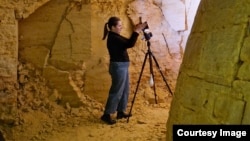

An online museum launched on February 18 aims to make Ukraine's heritage accessible to the public, while many of the featured treasures remain impossible to view in person.
The virtual exhibition, titled Our Land, Our Story: Crossroads of History, will display 25 3-D scans of historic objects, many of which are currently packed away in secret safehouses to shelter them from the war.
The Our Land exhibition splits the country into five regions and showcases some of the most consequential artifacts from each, including a terracotta figure from the infamous Snake Island that was captured by Russia in the early days of the full-scale invasion, then recaptured by Ukraine in the summer of 2022.
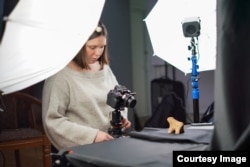
Scans are made by taking scores of overlapping photos from multiple angles under uniform lighting that are then fed into a software program rendering them into one highly detailed 3-D image.
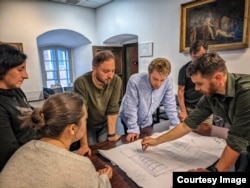
Oleksandra Ivanova, a historian and archaeologist with the Ukrainian research organization Archaic, was one of 32 experts who traveled to Poland for training in 3-D imaging and produced some of the scans for the virtual museum. She says 3-D image files of even small artifacts can run up to hundreds of gigabytes, meaning the public-facing website is limited in the resolution it can display the images. But the multi-gigabyte original scans the project has compiled are already being used by foreign researchers.
"They're not coming to Ukraine, they're just getting these files and then studying them and publishing articles," she told RFE/RL, adding that the exquisitely detailed 3-D images are "a useful tool in times of war when scientists from other countries are prohibited to come to Ukraine and it's very dangerous to transport artifacts abroad."
According to UNESCO, 39 of Ukraine's museums and four archaeological sites have been damaged in the ongoing Russian invasion.
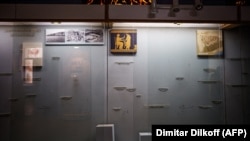
Maria Lobanova has experienced the threat to her country's historical treasures firsthand. The curator at the Odesa Archaeological Museum sheltered in her apartment bathroom on July 20, 2023, as a barrage of Russian missiles and drones rained down on the port city. The following morning she arrived at her museum to find its windows blown out and a crack in one room's ceiling, which later collapsed.
She says she put her hand up to be trained in 3-D imagery capture for the virtual museum because, she says, nearly four years of war has reinforced the harsh lesson that "heritage can be lost or damaged at any moment." Additionally, with Odesa currently seen as a risky destination for foreign tourists and experts, the curator says, "I see how many unique objects remain invisible to the world."
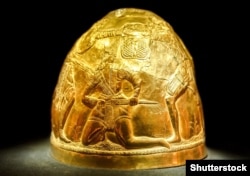
The virtual museum will be only the latest initiative to immortalize Ukraine's physical heritage through digital scanning. Volunteers and experts have compiled terabytes of data through projects that have included scanning state archives and even entire historic buildings since the 2022 invasion. The Our Land project was funded by various groups, including the Iron Mountain Living Legacy Initiative, the US Department of State Ambassadors Fund for Cultural Preservation, and Krakow's Jagiellonian University. The museum initiative was implemented by Archaic and CyArk, an organization mapping much of the world's heritage with 3D scanning technology.
Lobanova says despite most museum treasures throughout Ukraine being locked away in safe houses, there has been a resurgence of interest in Ukrainian heritage since the war.
"I noticed that a lot of people want to come to the [Odesa] museum. They have become more talkative, they're asking questions." The phenomenon she says, is shared by other cultural institutions. "It's quite visible everywhere right now in Ukraine, not only museums, people also want to visit Ukrainian theaters, and listen to Ukrainian music, just to know more about their heritage," she says.

