



Here's another Saakashvil update from our news desk:
Police Serve Saakashvili With Notice On Border Breach
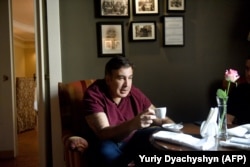
LVIV, Ukraine -- Ukrainian security forces have formally read out a protocol to Mikheil Saakashvili on his illegal entry into Ukraine two days earlier.
Saakashvili was served the notice in front of a group of journalists and lawmakers outside of a hotel in Lviv, with police and border guards on hand.
Security forces arrived at the Leopolis hotel earlier in the morning and initially blocked access to the building.
The State Border Guard Service confirmed the operation was aimed at serving Saakashvili with the document.
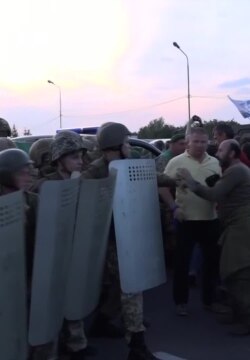
Saakashvili has been staying at the hotel in central Lviv since he and supporters broke through a line of Ukrainian border guards to cross from Poland to Ukraine on September 10.
Saakashvili said on September 12 in Lviv -- whose mayor, Andriy Sadovyi, has clashed in the past with Ukrainian President Petro Poroshenko -- that the protocol should have been delivered to him earlier.
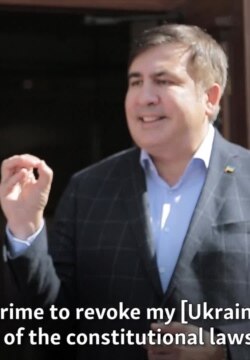
"If they brought this protocol within three hours when we crossed the border ... they could not say that I was hiding somewhere. I was on the main square of Lviv, along with thousands of [people], I would have taken this protocol without question. But what they bring now is a violation of the law, "Saakashvili said.
He also said he would travel to Kyiv "within days, or weeks" after visiting "towns and villages" across Ukraine.
A day earlier, Saakashvili said he wanted to unite Ukraine's opposition against Poroshenko and that he planned to campaign for support.
Poroshenko had appointed Saakashvili to govern Ukraine's Odesa region in 2015. But Saakashvili resigned from the post last November after falling out with Poroshenko, complaining his reform efforts were being blocked.
In July, as their relations deteriorated, Poroshenko stripped Saakashvili of his Ukrainian citizenship.
The left the former Georgian president essentially stateless because Georgia stripped him of Georgian citizenship in 2015 when he obtained Ukrainian citizenship in order to take the Odesa post.
On September 11, Ukrainian Interior Minister Arsen Avakov said Saakashvili faced "serious" criminal charges for his border breach, which Avakov described as "an attack on the state's basic institutions."
Sixteen security personnel were injured in clashes with Saakashvili's supporters during the incident on the Polish-Ukrainian border.
Two Saakashvili supporters -- Oleksandr Burtsev and Andriy Kotichenko -- were detained by police on September 12 for their alleged role in the border violence, according to the Ukrainian Interior Ministry.
Saakashvili, who is wanted in Georgia on allegations of corruption and abuse of power, claims to have UNHCR recognition as being "stateless."
He says he wants to challenge the revocation of his citizenship before a court in Ukraine.
With on reporting by RFE/RL's Russian Service and UNIAN
We're going to point you in the direction of a few interesting Ukraine articles that have been doing the rounds:
The Washington Post reports on how Hungary says Ukraine’s new school law hurts minority rights
Forbes looks at how Russia's Gazprom rediscovers it needs Ukraine
And Deutsche Welle talks to Oksana Lyniv, the conductor of Ukraine's youth orchestra who says her country is experiencing a rebirth.
Here's an item from our news desk that will be of interest to Ukraine watchers:
Poland Drops Passport Plan That Angered Ukraine, Lithuania
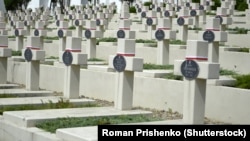
Poland's government says it is abandoning a plan to include images in Polish passports of landmarks that are now within the borders of Ukraine and Lithuania.
The passport plan had angered both Ukraine and Lithuania, with the government in Kyiv calling it an "unfriendly step that will have a negative impact on the development of the Ukraine-Polish strategic partnership."
The Polish government's proposal appeared to break a longstanding practice of not making any claim, even symbolic, to territories Poland lost in the redrawing of borders during the 20th century.
The disputed images were of a Polish military cemetery in Lviv, Ukraine, and the 16th century Gate of Dawn in Vilnius -- one of the most important religious, historical, and cultural monuments in the Lithuanian capital.
Polish Interior Minister Mariusz Blaszczak says his ministry has picked other images to include in place of the two disputed ones.
The new passports are due to be introduced in 2018 to mark the 100th anniversary of Poland regaining its independence after more than a century of foreign rule.
The pages of the new passports will feature background images of 26 national symbols.