


Here's another language-bill update from RFE/RL's news desk:
Hungary Threatens 'Pain' For Ukraine Over Controversial Language Law
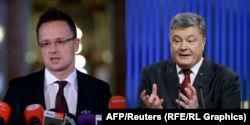
Hungary has pledged to block Ukraine's further integration with Europe after Kyiv enacted a controversial education law that critics say will restrict the study of minority languages in schools.
Foreign Minister Peter Szijjarto said on September 26 that the consequences for Kyiv would be "painful" after Ukrainian President Petro Poroshenko signed the measure making Ukrainian the required language of study in state schools from the fifth grade on.
"Hungary will block all steps within the European Union that would represent a step forward in Ukraine's European integration process," Szijjarto said in comments to the Hungarian news agency MTI that were also posted on the Hungarian government's website. http://www.kormany.hu/en/ministry-of-foreign-affairs-and-trade/news/this-will-be-painful-for-ukraine
"We can guarantee that all this will be painful for Ukraine in future," Szijjarto added.
His comments come two months ahead of the Eastern Partnership summit in Brussels. A draft statement seen by RFE/RL last week suggests the summit will be dominated by the issue of the EU's ties to Ukraine and two other ex-Soviet states, Georgia, and Moldova.
The new Ukrainian law does not outlaw instruction in other languages; students can still learn their native languages as a separate subject. Poroshenko said it "raises the role of Ukrainian as a state language in the education process" and "ensures equal opportunities for all."
ALSO READ: Ukrainian Language Bill Facing Barrage Of Criticism From Minorities, Foreign Capitals
But that hasn't assuaged the fears of sizable ethnic communities in Ukraine, including Poles, Romanians, and Hungarians. And the law has incensed officials in other countries neighboring Ukraine as well.
Romanian President Klaus Iohannis has said that the legislation "drastically limits" minority groups' access to their respective native languages, and he canceled a previously planned trip to Kyiv.
Russia has been particularly harsh in its criticism, saying this month that the legislation was designed to "forcefully establish a mono-ethnic language regime in a multinational state."
Hot-Button Issue
Language has become a hot-button issue across Ukraine, particularly in eastern regions where the majority of the population speaks Russian as its first language.
The new law's language requirement overturns a 2012 law passed under then President Viktor Yanukovych, a Kremlin ally who fled to Russia two years later amid mass street protests.
That law allowed for minorities to introduce their languages in regions where they represented more than 10 percent of the population.
Kyiv has sought greater integration with the EU under the pro-Western government that took power following Yanukovych's ouster. That was followed by Russia's seizure of Ukraine's Crimean Peninsula and backing of armed separatists in eastern Ukraine.
In June, it secured visa-free travel for its citizens to most EU countries in what Poroshenko called a "final exit of our country from the Russian Empire."
On September 1, an Association Agreement strengthening ties between Ukraine and the EU entered into force.
Yanukovych's decision not to sign that agreement in 2013 helped trigger the street protests that preceded his fall from power.
With reporting by AFP
ICYMI: Russia-backed separatists from Ukraine's eastern Donetsk region have opened up a new representative office in the southern French city of Marseille, but the French government said it will not recognize it. (RFE/RL's Ukrainian Service)


Statement by EU spokeswoman Maja Kocijancic on the Ukrainian education law:
In our contacts with the Ukrainian authorities, we have always underlined that the relevant legislation has to be in line with the international commitments to which Ukraine has subscribed, in particular the Council of Europe's Framework Convention for the Protection of National Minorities and the European Charter of Regional and Minority Languages. As stated in the previous opinions of the Venice Commission, the role of Ukrainian as state language and the need to protect minority and regional languages need to be carefully balanced. We welcome the stated intention of the Ukrainian authorities to request an expert opinion from the Council of Europe, and call for this to be submitted as soon as possible. This opinion should be duly taken into account, both as regards its provisions and in advance of implementation of the legislation.
Belarusian sentenced for fighting alongside separatists:
By RFE/RL's Belarus Service
VITEBSK, Belarus -- A court has sentenced a Belarusian man to a two-year suspended sentence for fighting alongside Russia-backed separatists in eastern Ukraine.
The court in the eastern city of Vitebsk on September 26 found Alyaksey Yarshou, 29, guilty of illegally participating in armed conflicts abroad.
The trial was held behind closed doors.
The prosecution is the first known case involving a Belarusian citizen found to be fighting alongside separatists, whom Russia has backed with irregular forces and heavy weaponry.
In two earlier cases, two Belarusian men were found guilty of fighting alongside Ukraine's armed forces in the conflict, which has killed at least 10,000 people since erupting more than three years ago.
Large-scale fighting in the region, known as the Donbas, has mainly ebbed, though outbreaks of intense fighting have periodically broken out.