



Artillery warehouses explode, evacuations ordered around Vinnytsya:
By RFE/RL's Ukrainian Service
Artillery warehouses on a Ukrainian military installation have exploded overnight in Kalynivka, near the city of Vinnytsya, forcing an evacuation of residents, police and local residents said.
Witnesses said the sound of explosions could be heard as far away as Kyiv, which is 260 kilometers to the northeast. Local media said that in Kalynivka, officials turned off the lights and disconnected gas and electricity supplies and told people to leave their homes.
Shortly after the explosions, the chief of the General Staff of the Armed Forces of Ukraine, General Viktor Muzhenko, and Ukrainian Prime Minister Volodymyr Hroysman arrived in Vinnytsya, authorities said.
The national police said police were evacuating people from Kalynivka and were working to ensure the protection of their property from looters. The deputy head of the national police, Oleksandr Fatsevych, was dispatched to Vinnytsya.
Deputy Minister of Information Policy Dmytro Zolotukhin said the explosion was an apparent accident and the authorities were working to bring the situation under control while evacuating residents.
Zoryan Shkiryar, an adviser to the head of the Interior Ministry, said on Facebook that he was "convinced that this is a hostile Russian sabotage," and said it was the seventh fire at military warehouses in Kalynivka.
He said a state commission of inquiry will be set up to investigate the cause of the explosions.
A volunteer of the Avtoevrozile organization of Vinnytsya, Ihor Rumyantsev, told RFE/RL that he saw about 10 buses arrive to evacuate people. He said he was helping to evacuate residents, giving priority to women and children.
Early on September 27, Rumyantsev said the explosions started to increase, doubling in size, prompting people to hide in their cellars.
Rumyantsev said the railway connection in the area had completely stopped. Ukrzaliznytsya reported a change in railroad routes due to the explosions.
An employee of the Vinnytsya Oblast Council, Iryna Yaroshynska, confirmed the rerouting of trains going through Kalynivka.
Ukraerocenter closed the airspace within a radius of 50 kilometers from the zone of explosions in the military warehouses, Deputy Infrastructure Minister Yuriy Lavrenyuk said on Facebook.
Residents posted video online showing what appeared to be a fire burning, lights flashing, and smoke billowing into the night sky.
U.S. military chief says recommends providing Ukraine with lethal defensive aid:
By RFE/RL
The top U.S. military commander has said he recommended that the White House provide lethal defensive aid to Ukraine so it can better defend itself against any possible further Russian military advances into the country.
General Joseph Dunford, chairman of the Joint Chiefs of Staff, said in testimony before the Senate Armed Services Committee on September 26 that his proposal to increase lethal aid to Ukraine was pending at the White House for a decision.
U.S. President Donald Trump's predecessor, Barack Obama, provided nonlethal military aid such as radar and goggle equipment to Ukraine, but had refused to provide lethal aid out of concern that it might escalate the war with Russia-armed separatists in eastern Ukraine.
But Dunford said, "In my judgment, from the military perspective, Ukraine needs additional capabilities to protect their sovereignty."
In particular, Dunford said, "we felt [an] ability to stop armored vehicles would be essential for them to protect themselves."
Ukrainian leaders have urged the United States to send weapons and have asked in particular for portable Javelin antitank missiles, which soldiers in the conflict say are needed to fend off attacks from tanks and self-propelled artillery.
Dunford said the Pentagon in reviewing Ukraine's defenses against fighters equipped by Russia detected what he called a "gap" between Ukraine's defensive capabilities and its needs.
"We just looked at it as a military gap that existed, and if that gap was filled, it would increase the probability the Ukrainians could defend themselves," he said.
The White House's new U.S. special envoy for efforts to end the conflict in eastern Ukraine, Kurt Volker, has also advocated providing lethal aid to Ukraine, saying in an interview in July with RFE/RL it was needed to counter Russia's "large, large military presence" in eastern Ukraine. (w/Reuters)
We are now closing the live blog for today, but we'll be back again to follow all the latest developments tomorrow morning. Until then, you can keep up with all our other Ukraine coverage here.
Here's another language-bill update from RFE/RL's news desk:
Hungary Threatens 'Pain' For Ukraine Over Controversial Language Law
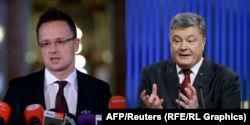
Hungary has pledged to block Ukraine's further integration with Europe after Kyiv enacted a controversial education law that critics say will restrict the study of minority languages in schools.
Foreign Minister Peter Szijjarto said on September 26 that the consequences for Kyiv would be "painful" after Ukrainian President Petro Poroshenko signed the measure making Ukrainian the required language of study in state schools from the fifth grade on.
"Hungary will block all steps within the European Union that would represent a step forward in Ukraine's European integration process," Szijjarto said in comments to the Hungarian news agency MTI that were also posted on the Hungarian government's website. http://www.kormany.hu/en/ministry-of-foreign-affairs-and-trade/news/this-will-be-painful-for-ukraine
"We can guarantee that all this will be painful for Ukraine in future," Szijjarto added.
His comments come two months ahead of the Eastern Partnership summit in Brussels. A draft statement seen by RFE/RL last week suggests the summit will be dominated by the issue of the EU's ties to Ukraine and two other ex-Soviet states, Georgia, and Moldova.
The new Ukrainian law does not outlaw instruction in other languages; students can still learn their native languages as a separate subject. Poroshenko said it "raises the role of Ukrainian as a state language in the education process" and "ensures equal opportunities for all."
ALSO READ: Ukrainian Language Bill Facing Barrage Of Criticism From Minorities, Foreign Capitals
But that hasn't assuaged the fears of sizable ethnic communities in Ukraine, including Poles, Romanians, and Hungarians. And the law has incensed officials in other countries neighboring Ukraine as well.
Romanian President Klaus Iohannis has said that the legislation "drastically limits" minority groups' access to their respective native languages, and he canceled a previously planned trip to Kyiv.
Russia has been particularly harsh in its criticism, saying this month that the legislation was designed to "forcefully establish a mono-ethnic language regime in a multinational state."
Hot-Button Issue
Language has become a hot-button issue across Ukraine, particularly in eastern regions where the majority of the population speaks Russian as its first language.
The new law's language requirement overturns a 2012 law passed under then President Viktor Yanukovych, a Kremlin ally who fled to Russia two years later amid mass street protests.
That law allowed for minorities to introduce their languages in regions where they represented more than 10 percent of the population.
Kyiv has sought greater integration with the EU under the pro-Western government that took power following Yanukovych's ouster. That was followed by Russia's seizure of Ukraine's Crimean Peninsula and backing of armed separatists in eastern Ukraine.
In June, it secured visa-free travel for its citizens to most EU countries in what Poroshenko called a "final exit of our country from the Russian Empire."
On September 1, an Association Agreement strengthening ties between Ukraine and the EU entered into force.
Yanukovych's decision not to sign that agreement in 2013 helped trigger the street protests that preceded his fall from power.