

Another news item, this time from RFE/RL's Washington bureau:
Ex-U.S. Army Commander Warns Of Russian Drone, Artillery Capabilities In Ukraine

WASHINGTON -- The former top U.S. Army commander in Europe said Russian battlefield tactics in eastern Ukraine show sophisticated integration of drones, electronic warfare, and mortar and artillery, posing major challenges for Ukrainian forces.
Retired Lieutenant General Ben Hodges also said on January 24 that U.S. and European allies should do more to publicize Russia's capabilities on the ground in eastern Ukraine, including the region historically known as the Donbas.
Hodges, who retired as commander of the U.S. Army’s European forces last year, made the comments in Washington, at the Helsinki Commission, a U.S. government agency charged with monitoring human rights in Europe and elsewhere.
The United States and its NATO allies have helped train and supply the Ukrainian armed forces since the outbreak of fighting in eastern Ukraine in April 2014. About 250 U.S. soldiers are helping in the training, Hodges said, plus Canadians and other NATO allies.
'Diplomatic Solution'
In all, more than 10,000 people have been killed and more than 1 million displaced in the conflict pitting Ukrainian forces against Russia-backed separatists.
Russia has repeatedly denied its forces have been involved, or that it has supplied weaponry or equipment, assertions that independent observers and journalists have largely debunked.
Hodges said the recent U.S. decision to supply Ukraine with more sophisticated weaponry, including Javelin antitank weapons was important for persuading the Russians to negotiate an end to the conflict.
"There has to be a diplomatic solution to this," he said. "Russia has to at some point agree to stop supporting the separatists or pull out to allow the re-establishment" of Ukrainian control of its border with Russia.
Electronic Warfare Capability
In eastern Ukraine, Hodges said, there are about 35,000-40,000 Russia-backed fighters, and around 4,000-5,000 are actual Russian military officers or commanders.
He said many of the tanks and vehicles operated by both Ukrainian and Russia-backed forces are now covered with reactive armor, a specialized type of plating designed to protect against rocket-propelled grenades and weapons other than small arms.
He also said Russia-backed commanders have honed tactics that include using drones, artillery, and electronic warfare. That's allowed Russians forces, for example, to eliminate Ukrainian mortars and artillery units. He said one Ukrainian unit that was using a U.S.-supplied radar was taken out by Russian rocket fire with surprising speed.
“The [Russian] electronic warfare capability; again that’s something we never had to worry with that in Afghanistan and Iraq. The Ukrainians live in this environment,” he said. “So you cannot speak on a radio or any device that’s not secure because it’s going to be jammed or intercepted or worse, it’s going to be found and then it’s going to be hit.”
“Certainly we have the capability to show everybody what Russia is specifically doing in the Donbas, that would be helpful to keep pressure on Russia, to live up to what they've said they're going to do,” he said.
Here's an item from RFE/RL's news desk:
Exiled Crimean Tatar Leaders Urge More EU Sanctions Against Russia
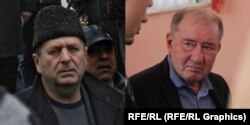
BRUSSELS -- Exiled Crimean Tatar leaders Akhtem Chiygoz and Ilmi Umerov have urged the European Union to keep and expand sanctions imposed on Russia after its 2014 annexation of Ukraine's Crimea region.
The EU imposed economic sanctions that hit Russia's oil and military industries in response to the annexation of Crimea as well as Moscow's backing of separatists in fighting against Ukrainian government troops in eastern Ukraine.
Speaking to the European Parliament's subcommittee on human rights on January 24, Umerov told EU lawmakers that no economic sanctions on Moscow should be lifted and that "there should be new reports and resolutions, cultural events should be banned and boycotted, and we should expand economic sanctions so that Russia is so affected that they leave Crimea and [the eastern Ukrainian region of] Donbas.”
The bloc has also introduced asset freezes and visa bans on more than 200 people in Crimea and Russia and enacted an EU investment ban for the peninsula.
Although sanctions have been renewed on a regular basis, some EU member states have questioned the bloc's sanctions policy, arguing that their removal would improve EU-Russia relations.
Chiygoz said the EU sanctions regime had been "mild" and asked the EU to "be united just like when you helped us ... help other prisoners, save our people and our motherland."
Chyigoz and Umerov were released from Russian custody in Crimea in October after being handed down prison sentences by Russian-controlled courts a month earlier.
Chiygoz had been convicted of organizing an illegal demonstration and was sentenced to eight years in prison whereas Umerov received two years for separatism for his opposition to the Russian annexation of Crimea.