



Good morning. We'll start the live blog today with this news item that RFE/RL filed late last night:
U.S. Envoy: Lack Of Political Will In Moscow Thwarting Ukraine Peace
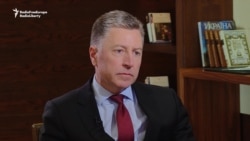

KYIV -- The U.S. special envoy for Ukraine said the country's new law on reintegrating its conflict-torn regions has "regularized" the country's military operation against Russia-backed separatists, but doesn't change anything on the ground.
In an interview on January 24 with RFE/RL's Ukrainian Service, Volker also said the new law does not contradict the Minsk accords, a 2015 deal aimed at ending the fighting in eastern Ukraine that has killed more than 10,300 people since 2014.
Volker, who was appointed in July as the U.S. special representative for negotiations to end the war, spoke two days ahead of a closely-anticipated meeting with Russia's lead envoy on the dispute, Vladislav Surkov.
In his meeting with Surkov, set for January 26 in the Persian Gulf city of Dubai, Volker said he was planning to reiterate the U.S. position on the Ukraine conflict: that Moscow withdraw its forces and its "proxy entities," allow for a UN peacekeeping force, help create security on the ground, and then help fulfil the Minsk accords.
"I think the Minsk agreements contain all the elements necessary for this to be resolved. What is lacking is not the content, what's lacking is political will," he said.
Key Legislation
Ukraine's parliament last week passed key legislation that President Poroshenko has said should help Kyiv restore control over eastern districts that are held by Russia-backed separatists
Among other things, the law labels Russia the aggressor in the nearly four-year-old conflict and labels the separatist-held parts of the Donetsk and Luhansk provinces -- part of what is known as the Donbas -- as "temporarily occupied territories."
"I don't think it changes anything on the ground. The situation is the same as it was," Volker told RFE/RL. "It has been a Russian command and control of forces there. It's not incorrect to call that at least informally an occupation invasion…. I don't think that changes anything. It just is saying what we can see with our own eyes."
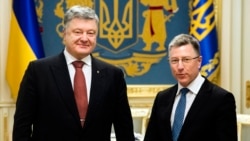 Ukrainian President Petro Poroshenko (left) with Kurt Volker in Kyiv on January 23.
In an earlier media roundtable held in Brussels, Volker said that Moscow's military actions have "produced the opposite" of what he said was Russian President Vladimir Putin's objective: maintaining a "Russia-friendly Ukraine" that is "part of Russia's orbit."
Volker said he believes Putin ultimately wants "a Ukraine that is pro-Russian, part of Russia's broader family."
"That's the irony because they have created the opposite" by "invading and taking over...territory" in Ukraine, he said.
"It has produced a Ukraine that is more unified, more nationalist, more Western-oriented than ever before," Volker said, adding that the Kremlin does not "need to have this territory to pursue Russia's objective."
"This is an issue where people are still dying every week right on Europe's doorstep, and it is involving Russia conducting warfare, taking territory by force, which is something that really challenges the basis of European security as a whole," he said.
The United States and the European Union have imposed an array of sanctions on Russia over its March 2014 seizure of Ukraine's Crimean Peninsula and its role in the war in eastern Ukraine.
Fresh Sanctions
In the coming days, the U.S. Treasury Department is due to release a report that is expected to name hundreds of Kremlin-connected insiders and business leaders who could later be hit with a fresh wave of U.S. sanctions.
In an article published on January 22, The Wall Street Journal cited unnamed U.S. officials as saying that if peace negotiations fail to make progress in the coming months, Washington plans to push for more economic pressure on Russia.
Volker said he supported a proposal to have a United Nations peacekeeping force deployed to eastern Ukraine. Moscow and Kyiv have argued whether the force should be allowed to patrol the two countries' border, or simply the so-called line of conflict where the fighting has occurred.
"That would create time and space where the other pieces of Minsk could be implemented," Volker said.
The last time Volker and Surkov met was in November. At that time, Surkov said that the U.S. side had presented 29 proposals on the peacekeeping plan but that Russia had found only three of them "acceptable."
While in Kyiv, Volker also met with Poroshenko, whose office released a statement saying they discussed ways of "boosting international efforts to restore Ukraine's sovereignty and territorial integrity" and voiced concern about Russia's failure to fulfill obligations under the Minsk agreements.
With reporting by RFE/RL correspondent Rikard Jozwiak in Brussels; The Wall Street Journal, Kommersant, and Interfax
Another news item, this time from RFE/RL's Washington bureau:
Ex-U.S. Army Commander Warns Of Russian Drone, Artillery Capabilities In Ukraine

WASHINGTON -- The former top U.S. Army commander in Europe said Russian battlefield tactics in eastern Ukraine show sophisticated integration of drones, electronic warfare, and mortar and artillery, posing major challenges for Ukrainian forces.
Retired Lieutenant General Ben Hodges also said on January 24 that U.S. and European allies should do more to publicize Russia's capabilities on the ground in eastern Ukraine, including the region historically known as the Donbas.
Hodges, who retired as commander of the U.S. Army’s European forces last year, made the comments in Washington, at the Helsinki Commission, a U.S. government agency charged with monitoring human rights in Europe and elsewhere.
The United States and its NATO allies have helped train and supply the Ukrainian armed forces since the outbreak of fighting in eastern Ukraine in April 2014. About 250 U.S. soldiers are helping in the training, Hodges said, plus Canadians and other NATO allies.
'Diplomatic Solution'
In all, more than 10,000 people have been killed and more than 1 million displaced in the conflict pitting Ukrainian forces against Russia-backed separatists.
Russia has repeatedly denied its forces have been involved, or that it has supplied weaponry or equipment, assertions that independent observers and journalists have largely debunked.
Hodges said the recent U.S. decision to supply Ukraine with more sophisticated weaponry, including Javelin antitank weapons was important for persuading the Russians to negotiate an end to the conflict.
"There has to be a diplomatic solution to this," he said. "Russia has to at some point agree to stop supporting the separatists or pull out to allow the re-establishment" of Ukrainian control of its border with Russia.
Electronic Warfare Capability
In eastern Ukraine, Hodges said, there are about 35,000-40,000 Russia-backed fighters, and around 4,000-5,000 are actual Russian military officers or commanders.
He said many of the tanks and vehicles operated by both Ukrainian and Russia-backed forces are now covered with reactive armor, a specialized type of plating designed to protect against rocket-propelled grenades and weapons other than small arms.
He also said Russia-backed commanders have honed tactics that include using drones, artillery, and electronic warfare. That's allowed Russians forces, for example, to eliminate Ukrainian mortars and artillery units. He said one Ukrainian unit that was using a U.S.-supplied radar was taken out by Russian rocket fire with surprising speed.
“The [Russian] electronic warfare capability; again that’s something we never had to worry with that in Afghanistan and Iraq. The Ukrainians live in this environment,” he said. “So you cannot speak on a radio or any device that’s not secure because it’s going to be jammed or intercepted or worse, it’s going to be found and then it’s going to be hit.”
“Certainly we have the capability to show everybody what Russia is specifically doing in the Donbas, that would be helpful to keep pressure on Russia, to live up to what they've said they're going to do,” he said.