
Here's a new item from RFE/RL's Ukrainian Service:
Poroshenko Says Polish Bill On Nazi-Era Crimes 'Unacceptable'
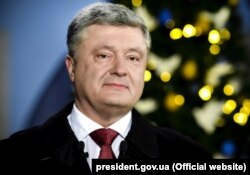
Ukrainian President Petro Poroshenko says he is "deeply concerned" by a Polish bill that accuses some Ukrainians of collaborating with Nazi Germany, calling it "categorically unacceptable."
Poroshenko made his comments on Facebook on February 1, hours after the Polish Senate passed legislative amendments regulating speech related to the Holocaust and to other Nazi-era crimes.
The United States, Israel, and others have sharply criticized the bill, which subjects anyone who accuses Poland or its people of complicity in Nazi crimes to criminal prosecution and a possible prison sentence of up to three years.
In addition to Nazi and "communist" crimes, the bill also refers to "crimes committed by Ukrainian nationalists and members of Ukrainian units collaborating with the Third Reich."
It defines those alleged crimes as "acts committed by Ukrainian nationalists between 1925 and 1950 which involved the use of violence, terror or other human rights violations against individuals or population groups."
"Participating in the extermination of the Jewish population and genocide of citizens of the Second Polish Republic in Volhynia and Eastern Malopolska...also constitute a crime committed by Ukrainian nationalists and members of Ukrainian units collaborating with the Third Reich," it says -- a reference that includes a period between the two World Wars when parts of what is now western Ukraine were in Poland.
The Polish bill is aimed at "protecting the reputation" of Poland and its people, according to the language in the legislation. But Poroshenko suggested that it unfairly tarnishes the reputation of Ukraine and Ukrainians, saying that the "judgments" it contains are "absolutely biased and categorically unacceptable."
"Historical truth requires frank conversation and dialogue, not prohibitions," Poroshenko wrote. He said the bill "does not correspond to the declared principles of the strategic partnership between Ukraine and Poland.
He said that Ukraine and Poland must remember what he called "our common victories in the fight against totalitarian regimes" -- apparently a reference to both Nazi Germany and the Soviet Union. "No political decision can replace the historical truth."
Many officials and citizens in Poland, a former Warsaw Pact member, and Ukraine, a former Soviet republic, share deeply negative feelings about Nazi Germany and about Moscow's Soviet-era dominance of Eastern Europe. But relations between the neighboring countries themselves have also been strained by violence and disputes over the centuries.
To become law, the Polish bill must be signed by President Andrzej Duda, who has supported it.
With reporting by AP, AFP, Reuters, dpa, and the Times of Israel, and Unian.
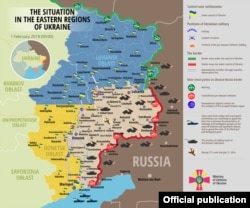
Here is today's map of the latest situation in the Donbas conflict zone, according to the Ukrainian Defense Ministry. (CLICK IMAGE TO ENLARGE)
In today's Daily Vertical, Brian Whitmore looks at how the upper house of Russia's parliament is considering legislation that would precisely define Russia's sovereignty and criminalize violations against it. Whitmore argues, however, that the Putin regime clearly doesn't seem to see Russia's annexation of Crimea and intervention in the Donbas as a violation of Ukraine's sovereignty.