



Ukraine Moves Closer To Anticorruption Court, But Doubts Remain
By RFE/RL's Ukrainian Service
Ukraine's parliament has approved the first reading of legislation creating an anticorruption court demanded by protest groups and the country’s external backers, although critics charge the effort does not go far enough.
The draft law, which was presented by President Petro Poroshenko in December, won the support of 282 of the 450 deputies on March 1 in the parliament, known as the Verkhovna Rada.
In an apparent response to demands from Western allies as well as protesters camped outside parliament in Kyiv, Poroshenko last year vowed to push for legislation creating an anticorruption court.
However, some reformers within Ukraine and allies in Europe have expressed concerns the legislation does not meet standards set by the Council of Europe’s Venice Commission, a group of independent experts in constitutional law, and the requirements of the International Monetary Fund (IMF).
In January, the IMF said that "several provisions [of the bill] are not consistent with the commitments of the authorities."
"In its current form…we would not be able to support the draft law," the IMF added.
Critics have charged that the current legislation does not ensure the selection of independent anticorruption judges.
Ahead of the vote, Verkhovna Rada speaker Andriy Parubiy called on the lawmakers to support the proposed law, saying its text could be amended before the second and final reading.
Maksym Burbak, the head of the People's Front faction in the ruling coalition, said that "between the first and second readings, we will take into account all recommendations of the Venice Commission."
After the vote in parliament, Poroshenko said in a televised speech that a final reading of the law “should be definitively approved in the spring.”
"I call on MPs not to delay adoption as a whole," the president wrote on his Facebook page.
Leaders of the European Union and International Monetary Fund (IMF) have demanded anticorruption reforms in Ukraine, which last year ranked 130th out of 180 countries rated by Transparency International's Corruption Perception Index.
On February 28, the European Commission moved closer to approving a 1 billion euro ($1.22 billion) financial package to Ukraine, although officials said they were awaiting further signs by Kyiv that the reform process remained on track before the funds would be delivered.
The IMF has called the establishment of an anticorruption court a "benchmark" of Ukraine's progress toward Western legal standards and has said it would help ease the release of its loans in the future.
With reporting by Reuters and AFP
In case you missed it ...
'Let Us Know When He Dies': Nursing Home Struggles On Ukraine's Front Lines
The separatist conflict in eastern Ukraine has displaced thousands, including some of the region's most vulnerable. One small, volunteer-run nursing home in the Donetsk region takes in elderly residents who have nowhere else to turn.

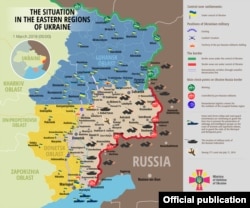
Here's today's map of the security situation in eastern Ukraine, according to the National Security and Defense Council (click to expand):
Russian authorities "scared," says convicted Crimean Tatar activist:
By the Crimea Desk of RFE/RL's Ukrainian Service
FEODOSIA, Ukraine -- A court in Russian-controlled Crimea has handed a suspended sentence of two years to a Crimean Tatar activist who opposes Moscow's rule over the Ukrainian region.
The Feodosia city court on March 1 found Suleyman Kadyrov guilty of publicly calling for the violation of Russia's territorial integrity.
The court also barred Kadyrov from "public activities" for one year, a sentence that prevents him from taking part in demonstrations.
Kadyrov vowed to appeal the verdict, which he said was "yet another proof that [the Russian authorities] are scared."
The charge stems from Kadyrov's 2016 Facebook post of a video about a pro-Ukrainian volunteer military unit and a comment in which he wrote, "Crimea was, is, and will always be Ukraine!"
Kadyrov pleaded not guilty, arguing that he has the right to express his opinion.
He said on March 1 that he expected the sentence against him.
"This is Russia. Its justice system has always been and will be dependent on the special services," Kadyrov said.
"It is not only about me; it is about all other political prisoners. We will go through all levels of this Russian 'injustice' system and turn to the European Court of Human Rights," he added.
Rights groups and Western governments have denounced what they call a campaign of oppression targeting members of the Turkic-speaking Crimean Tatar minority and others who opposed Moscow's seizure of the Black Sea peninsula in March 2014.
The majority of Crimean Tatars opposed the Russian takeover of their historic homeland.
In March 2017, the European Parliament called on Russia to free more than 30 Ukrainian citizens it said were in prison or other conditions of restricted freedom in Russia, Crimea, and parts of eastern Ukraine that are controlled by Russia-backed separatists.