


Here's another item from our news desk:
Putin Visits Annexed Crimea Days Before Election
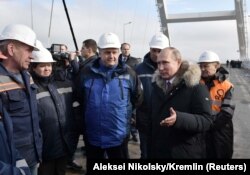
President Vladimir Putin arrived in Crimea on March 14, four days ahead of Russia's presidential election, and is expected to attend public events to mark the anniversary of the March 16, 2014, referendum in the peninsula used by Moscow to justify the annexation of the region from Ukraine.
Before arriving in Crimea, Putin visited the construction site of a bridge that is expected to link the annexed peninsula with Russian territories across the Kerch Strait. The construction of the bridge started in 2016.
Kremlin spokesman Dmitry Peskov said earlier that Putin's trip to Crimea would be his last major campaign event before the March 18 vote.
In reaction to Putin's visit, Ukrainian President Petro Poroshenko said the move was "an extremely dangerous provocation" and called on the European Union to impose sanctions against "those who organized Russian presidential elections events on a Ukrainian territory."
Putin's government moved swiftly to seize control of Crimea in March 2014 after Moscow-backed Ukrainian President Viktor Yanukovych fled the country following months of street demonstrations by pro-Western Ukrainians.
Russia sent troops without insignia to Crimea and orchestrated the takeover of government bodies, before holding the referendum on March 16, 2014.
In March last year, Russian lawmakers moved the date of the presidential election from March 11 to March 18 -- the fourth anniversary of what Moscow describes as the formal accession of Crimea into the Russian Federation.
Eight candidates are on the ballot in the presidential vote. But Putin -- who has been president or prime minister of Russia since 1999 -- appears certain to win another six-year term as president.
Based on reporting by Interfax, TASS, and UNIAN
From the Lithuanian foreign minister:
Here's a new item by RFE/RL's Brussels correspondent Rikard Jozwiak:
Ukraine's Main Backers In EU Put Pressure On Kyiv Over Reforms
BRUSSELS -- Thirteen of Ukraine's most enthusiastic backers in the European Union have piled pressure on Kyiv by warning that the implementation of important reforms are "just beginning or lagging behind," according to a document seen by RFE/RL.
In a discussion paper titled Keeping Ukraine On The Reform Path, the countries called the presidential and parliamentary elections next year "a test for Ukraine."
The document, shown to RFE/RL by diplomats who were not authorized to release it publicly, was signed by representatives of Croatia, the Czech Republic, Denmark, Estonia, Finland, Ireland, Latvia, Lithuania, Poland, Slovakia, Slovenia, Sweden, and Britain.
It will be debated when EU foreign ministers gather in Brussels on 19 March to discuss EU-Ukraine relations. The meeting also follows the EU foreign policy chief Federica Mogherini's March 12-13 trip to Ukraine, and while no concrete decisions are expected at the gathering, it will indicate how the EU views the reform process and the political situation in its eastern neighbor.
The paper states that "against the backdrop of the Russian aggression, we commend the Ukrainian leadership for its considerable achievements in a number of key areas of reform, including energy, the banking sector, public procurement and decentralization." It says that "we remain fully committed to supporting Ukrainians' desire for change and a future of their own choosing. For Europe, the success of Ukraine is of strategic importance."
But it also includes considerable criticism of the Ukrainian government as well as other political forces in the country. In a key paragraph, the document stresses that "the government is not fully delivering on EU and IMF [International Monetary Fund] benchmarks. Civil society activists and experts warn of the risk of backsliding. Incomplete reforms threaten to undermine the credibility of the reform process and lead to reform fatigue and disillusionment among Ukrainians. Indeed some are already deploying populist arguments that a prosperous and well-functioning society can be realized without painful reforms."
'Vital' Anticorruption Bureau
The group of 13 is demanding that Ukraine pays particular attention to the fight against corruption by underlining that it is "vital" that the National Anticorruption Bureau (NABU) remain able to "operate effectively and independently in investigating corruption" and that the establishment of an independent High Anticorruption Court was "essential to complete the anticorruption chain."
The document also sets out how the group of countries should ensure that Ukraine remains on the reform path in the upcoming months. Among the initiatives outlined is a pledge that "we should not shy away from speaking up when needed" and should "help promote a positive narrative of those Ukrainian reforms that have been a success."
Other ideas set out in the document include stepping up people-to-people contacts, more conditionality, greater support for civil society and especially anticorruption activists, and offering Ukraine "our support in building resilience and countering Russian disinformation, cyber-attacks and other hybrid activities in the run up to Ukrainian elections in 2019."