


U.S. Slams Russia, Iran As 'Morally Reprehensible' For Continued Rights Violations
By RFE/RL
A new U.S. State Department report has labeled the governments of Russia, Iran, China, and North Korea as "morally reprehensible" with human rights violations on a daily basis, making them "forces of instability."
While releasing the Country Reports on Human Rights Practices for 2017, an annual examination of human rights practices of nearly 200 countries, acting Secretary of State John Sullivan said on April 20 that while some governments are not able to maintain security and meet the basic needs of their people, others "are simply unwilling."
"States that restrict freedoms of expression and peaceful assembly; that allow and commit violence against members of religious, ethnic, and other minority groups; or that undermine the fundamental dignity of persons are morally reprehensible and undermine our interests," he said.
"The governments of China, Russia, Iran, and North Korea, for example, violate the human rights of those within their borders on a daily basis and are forces of instability as a result."
The report sharply chided Moscow in the Russia section of the report, saying it continues to “arm, train, lead, and fight alongside pro-Russian forces in eastern Ukraine and that human rights in Russia continue to be "significantly and negatively" affected by Moscow's "purported annexation" of Ukraine's Crimea Peninsula and its support for separatist fighters in eastern Ukraine.
Read more here.
Bolton, New U.S. National Security Adviser, Tells Russia Conditions For Better Ties
By RFE/RL
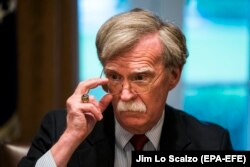
WASHINGTON -- The new U.S. national security adviser has told Russia’s U.S. ambassador that Moscow must address U.S. concerns on election meddling, the "reckless" nerve-agent attack in Britain, and the situations in Ukraine and Syria before relations can substantially improve.
A White House statement on April 19 said John Bolton, who took over from H.R. McMaster on April 9, made the remarks in a meeting with Russia’s ambassador to Washington, Anatoly Antonov.
"At the first meeting between the two in their current roles, they discussed the state of the relationships between the United States and Russia," the statement said.
"Ambassador Bolton reiterated that it is in the interest of both the United States and Russia to have better relations, but that this will require addressing our concerns regarding Russia's interference in the 2016 election, the reckless use of chemical weapons in the United Kingdom, and the situations in Ukraine and Syria," it added.
Several global issues have raised tensions between Washington and Moscow despite President Donald Trump’s stated goal of improving relations between the two countries.
The U.S. intelligence community has accused Russia of a widespread cyberhacking-and-propaganda campaign aimed at influencing the 2016 presidential election vote.
The United States and Europe have slapped sanctions on Russia for its 2014 annexation of Ukraine’s Crimea Peninsula and its support for separatists in eastern Ukraine.
The U.S. military has assailed Russia for its support of Syrian President Bashar al-Assad and says it holds Moscow responsible for an alleged chemical weapons attack.
Meanwhile, the United States has said it supports Britain in a dispute with Russia over the March 4 poisoning of former Russian double agent Sergei Skripal and his daughter, Yulia, in Salisbury. Britain has blamed Russia for the attack.
Moscow has denied it interfered in the U.S. election, said it had nothing to do with the Skripal poisonings, and claimed the allegations of a chemical attack in Syria are false.
The 69-year-old Bolton, a former UN ambassador, has served as a hawkish voice in Republican foreign-policy circles for decades. Among his more controversial stands, he has advocated for preemptive military strikes against North Korea and war with Iran.