
From RFE/RL's Central Newsroom
By Mike Eckel
WASHINGTON -- U.S. authorities have indicted a Russian man who was a key associate in Ukraine for President Donald Trump's ex-campaign chief on obstruction of justice and other charges.
The indictment, brought by Special Counsel Robert Mueller and unsealed in U.S. District Court on June 8, is the first time that Konstantin Kilimnik has been named in court papers, and comes after months of mounting evidence that he was a target for Mueller’s investigators.
The allegations were contained in a superseding indictment that brought new charges against Paul Manafort, who was Trump's campaign manager during the 2016 presidential election and who already faces a raft of charges in federal courts in Washington, D.C., and Virginia.
Prosecutors alleged that Manafort tried to tamper with witnesses ahead of his upcoming trial on felony charges related to foreign lobbying in the United States, charges that date back to before his time with the Trump campaign.
The new witness-tampering allegations, which were first detailed in June 4 court filings, relate to a group of unnamed European politicians known in court documents as the Hapsburg Group. According to the court filings, Manafort enlisted to lobby on behalf of a pro-Russia political party in Ukraine several years ago.
In the new indictment, prosecutors charged that Manafort and Kiliminik contacted the European politicians between February and April 2018 seeking to persuade them to lie about the scope of the Hapsburg Group lobbying.
The new indictment signals that Mueller's prosecutors are seeking to have a judge revoke Manafort's bail and order him jailed pending trial.
Manafort, who has denied all allegations, was fired from the campaign in August 2016 after revelations of a secret financial ledger in Ukraine that documented payments to him from the pro-Russia political party of Ukrainian President Viktor Yanukovych.
Kilimnik, whom U.S. authorities suspect of having ties to Russian intelligence, served as Manafort's point man in Ukraine. He is now believed to be in Russia and has told RFE/RL on two separate occasions that he had no links to Russian intelligence.
He did not respond to phone calls or text messages from RFE/RL seeking comment.
While most of the charges against Manafort predate his work for Trump, some relate to activities that took place into 2017, including alleged bank fraud and money laundering, according to prosecutors.
Mueller has been tasked with investigating interactions between Trump associates and Russian officials. In all, his criminal probe has brought indictments against 20 people and three companies on various related charges.
In addition to Manafort, Trump's first national security adviser, Michael Flynn, has also been charged.
Five people have pleaded guilty to date, including Flynn and Manafort’s former business associate, Rick Gates.
In recent months, Trump has stepped up his attacks against Mueller's efforts, calling the investigation a "witch hunt" and asserting that the investigators were biased against him. Mueller has sought to interview Trump, but his lawyers appear to have persuaded him not to, fearing he might incriminate himself.
RFE/RL Correspondent Christopher Miller contributed to this report from Kyiv.
From RFE/RL's central news desk:
NATO’s Eastern Flank Seeks Increased Alliance Presence In Region
Member countries of NATO’s eastern flank, known as the “Bucharest Nine,” are calling on the alliance to bolster its presence in their region at the upcoming summit in the face of what they see as Russian “aggression.”
"The 2018 NATO summit should further strengthen the alliance's unity and, in the spirit of the 360-degree approach, deliver a comprehensive response to the current security challenges, including against the hybrid threats the allies are confronted with," the grouping said on June 8 after a meeting in Warsaw.
Polish President Andrzej Duda said what the countries are specifically looking for is an “increased presence" by the alliance in their region.
Standing alongside Romanian counterpart Klaus Iohannis, Duda said the group believes it is necessary to supplement NATO's current ground forces "with aerial and naval components" to "achieve the full spectrum."
They also called on the Western military alliance to provide defenses against Russian "hybrid warfare" techniques that include military, financial, and political manipulation, often utilizing computer hacking and propaganda.
In the final declaration, the group said Russia’s actions "threaten our longstanding vision of a Europe whole, free, and at peace."
NATO increased its assets in Central and Eastern Europe following Russia's annexation of Ukraine’s Crimea region in 2014. Last year, it deployed four multinational battalions to Poland and the Baltic states as tripwires against possible Russian adventurism, while the U.S. military sent a Patriot battery to Lithuania for drills.
The Warsaw gathering came as NATO foreign ministers were meeting separately in Brussels ahead of the July 11-12 summit of alliance leaders.
The group, known as the B9, first held talks in Romania in 2015. It consists of Romania, Bulgaria, the Czech Republic, Estonia, Hungary, Latvia, Lithuania, Poland, and Slovakia, all once in the Soviet sphere of influence.
Eight presidents and one parliament speaker attended the meeting.
With reporting by AP and AFP
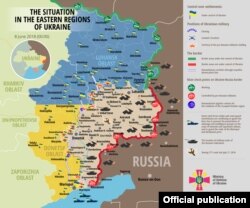
Here is today's map of the security situation in eastern Ukraine, according to the National Security and Defense Council (click to enlarge):