

EU Leaders Agree To Extend Sanctions On Russia
By RFE/RL
BRUSSELS -- European Union leaders have agreed to extend the bloc’s economic sanctions penalizing Russia for its aggression in Ukraine.
The green light came during a dinner at an EU summit in Brussels early on June 29, and it will now be up to EU ambassadors to rubber stamp the decision in the weeks to come.
Both French President Emmanuel Macron and German Chancellor Angela Merkel urged the leaders to agree to roll over the sanctions after giving an update on the state of implementation of the Minsk peace accords.
Despite many efforts at establishing a lasting cease-fire in Ukraine, the pact reached in the Belarusian capital in 2015 outlining a path to peace has never been fully carried out by either side.
The sanctions, which mainly hit Russia's banking and energy sectors, were first imposed in the summer of 2014 after Russia illegally annexed Ukraine's Crimean Peninsula and began fueling the conflict in eastern Ukraine by backing separatists fighting government forces there.
More than 10,300 people have been killed in the conflict, and EU leaders have said the sanctions won't be lifted unless Russia and other parties to the conflict make progress toward carrying out the Minsk deal.
The sanctions have been renewed every six months since 2014.
In a summit statement, the EU leaders also reiterated their "full support" for a UN resolution on the downing of MH17 over eastern Ukraine in 2014, killing over 200 people on board.
An official investigation concluded that a Russian Buk missile system that was based at a Russian military base was used to shoot down the aircraft. Russia denies any responsibility.
The EU statement calls on Russia to "accept its responsibility and fully cooperate with all efforts to establish truth, justice, and accountability" in response to the incident.
With reporting by AFP
That concludes our live-blogging of the Ukraine crisis for Thursday, June 28, 2018. Check back here tomorrow for more of our continuing coverage. Thanks for reading and take care.
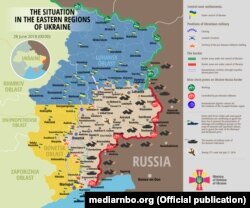
Here is today's map of the security situation in eastern Ukraine, according to the National Security and Defense Council (CLICK TO ENLARGE):
Ukraine Cyberpolice Chief Alleges Russian Hackers Preparing Massive Strike
The head of Ukraine's cyberpolice has claimed that Russian hackers are infecting computer systems of Ukrainian firms with malware to establish "back doors" for a large-scale coordinated attack.
Serhiy Demedyuk told Reuters news agency that banks and energy infrastructure firms are among the targets of the alleged hackers, and added that Ukrainian police are working with foreign authorities to identify the culprits.
Kremlin spokesman Dmitry Peskov denied the allegations. "No, that is not true," Peskov said in comments sent to Reuters by his office.
Law enforcement and private security firms throughout the world are carefully monitoring threats in Ukraine, because the country was at the origin of some of the most serious cyberattacks in history.
Some attacks have occurred on major Ukrainian holidays, and Demedyuk said another one could be launched on June 28 -- Constitution Day -- or on Independence Day in August.
"Analysis of the malicious software that has already been identified and the targeting of attacks on Ukraine suggest that this is all being done for a specific day," Demedyuk said.
In June 2017, a virus dubbed NotPetya hit the country and disabled government departments and state companies before spreading to corporate networks around the globe, inflicting losses of billions of dollars.
The United States and Britain joined Ukraine in blaming Russia for the NotPetya attack.
Relations between Kyiv and Moscow are at an all-time low after Russia seized the Crimea region in 2014 and fomented separatism in eastern Ukraine, where more than 10,300 people have been killed in the ensuing war.
Kyiv has accused Russia of being behind large-scale cyberattacks as part of a "hybrid war" against Ukraine. Moscow denies the accusations.