


Crimean Tatar close to Dzhemilev says tortured by FSB:
By the Crimean Desk of RFE/RL's Ukrainian Service
KYIV -- A driver for the wife of veteran Crimean Tatar leader Mustafa Dzhemilev says he was tortured by officers of the Russian Federal Security Service (FSB) in Crimea.
Akhtem Mustafayev told journalists in Kyiv on July 10 that FSB officers detained him near Dzhemilev's house in the Crimean city of Bakhchysaray on June 28 and held him in custody for more than four hours.
"They handcuffed me, threw me into a Mercedes-Sprinter car and put a sack over my head," Mustafayev said.
He said the officers took him to an unknown location where they beat him, striking him on the chest and head, forced him to stand on his knees with his hands cuffed behind his back, and tightly covered the top of his head with tape.
"They threatened me, saying that they can make sure that nobody will find me," Mustafayev said.
Mustafayev also said the officers asked him questions about his regular trips from Crimea to Kyiv, his ties with Mustafa Dzhemilev and his associates, and other issues related to Crimean Tatars in general.
He said the officers used a polygraph during the questioning and forced him to sign a document saying that no physical force was used during the questioning.
"They then brought me to the FSB office in Simferopol and later released me," Mustafayev said.
Mustafayev works as a driver for Dzhemilev's wife, Safinar.
Dzhemilev, 73, is a member of the Ukrainian parliament.
He was the chairman of the Crimean Tatar Mejlis, or council, until it was banned by pro-Moscow representatives in Crimea.
Dzhemilev was a leading human rights activist during the Soviet era and was jailed several times.
He has been banned from Crimea since Russia occupied and seized control of the peninsula in 2014.
Rights groups and Western governments have denounced what they call a campaign of oppression targeting members of the Turkic-speaking Crimean Tatar minority and others who opposed Moscow's rule.
The majority of Crimean Tatars opposed the Russian takeover of their historic homeland.
In March 2017, the European Parliament called on Russia to free more than 30 Ukrainian citizens it said were in prison or other conditions of restricted freedom in Russia, Crimea, and parts of eastern Ukraine that are controlled by Russia-backed separatists.
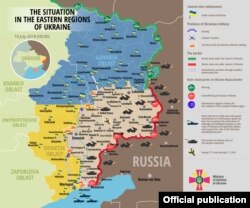
Here is today's map of the latest situation in the Donbas conflict zone according to the Ukrainian Defense Ministry. (CLICK TO ENLARGE)
Yet another twist to this story:
A story from RFE/RL's Belarus Service that's also bound to be of interest to Ukraine-watchers:
Belarusian Journalist Is Tried On Charge Of Assaulting Police Officer
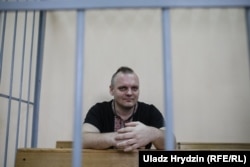
MINSK -- A Belarusian journalist known for his reports on the war in eastern Ukraine, where he was held by Russia-backed separatists in 2014, is being tried on a charge of assaulting a police officer.
Dzmitry Halko's trial began on July 10 at a court in Minsk.
Halko was arrested in April when entering Belarus from Ukraine, where he had been living for a few months.
Investigators say that Halko assaulted a police officer in December, breaking his mobile phone, when the officer came to his apartment in Minsk after neighbors complained about loud noises.
Halko denies the allegation, saying he did not assault the officer.
Halko, 38, came to the courtroom wearing a black short-sleeve shirt adorned with traditional Belarusian-Ukrainian embroidery patterns. The "vyshyvanka" has become a symbol of patriotism and resistance to Russia in Ukraine.
Halko is known for articles he wrote for a number of independent media outlets in Belarus and Ukraine.
After Russia seized control of Crimea and fomented separatism in the Donbas in 2014, Halko traveled to Ukraine and covered the conflict between Russia-backed separatists and government forces in the Donetsk and Luhansk region.
He was held for a time by the separatists and released later the same year.