


Russia, Ukraine In EU-Backed Talks To Avoid New 'Gas Wars'
Officials from Moscow and Kyiv are due to gather in Berlin on July 17 for EU-backed talks on the future of the transit of Russian gas through Ukraine.
Russian gas giant Gazprom has already dramatically reduced the volume of gas transiting via Ukraine, as Moscow and Kyiv remain at loggerheads over Russia's annexation of Ukraine's Crimea region and its support for separatists in eastern Ukraine.
Kyiv is concerned about the loss of revenue from transit taxes and being left out of routes for new gas pipelines.
The talks will focus on Gazprom's plan to build the Nord Stream 2 gas pipeline and put it into operation by the end of next year. Nord Stream 2 would bring gas to Germany via the Baltic Sea, bypassing Ukraine.
The pipeline will follow the course of the existing Nord Stream 1 and will double the quantity of Russian gas imported by Germany -- the European Union's most powerful economy -- via this route.
The meeting will bring together delegations from Gazprom and its Ukrainian counterpart, Naftogaz, which have been locked in legal battles for years.
Russian Energy Minister Aleksandr Novak and Ukrainian Foreign Minister Pavlo Klimkin will also attend.
The Nord Stream 2 project has been criticized by U.S. President Donald Trump.
Germany has long insisted this is a purely "commercial" project and in March lifted the final obstacles to its construction.
The United States has an interest in selling liquefied natural gas (LNG) to Europe via ships.
Last winter, Gazprom raised exports to the continent to a record high thanks to cold weather.
Based on reporting by AFP and Interfax
Poroshenko: Russia Must Be Held Accountable For 'Terrorist Act' Of MH17 Disaster
By RFE/RL
Ukrainian President Petro Poroshenko says Russia "must be held accountable" for downing Malaysian Airlines Flight 17 in 2014 over the war zone in eastern Ukraine.
Poroshenko wrote on Facebook on July 17, the fourth anniversary of the tragedy, that Ukraine "has been providing investigators with all necessary assistance."
MH17 was shot down over the conflict zone in Ukraine's Donetsk region on July 17, 2014, killing all 298 people on board.
"A joint investigative group consisting of representatives of Australia, Belgium, Malaysia, Netherlands, and Ukraine has established that the aircraft was shot down by a Buk missile complex that belonged to Russia's armed forces and brought [to the territory controlled by Russia-backed separatists] from the Russian Federation. Therefore, Russia must be held accountable for that terrorist act," Poroshenko wrote.
MH17 TIMELINE: A history of the disaster (click to view)
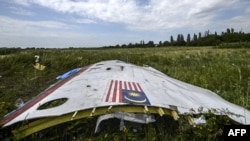
Earlier in May, the Dutch-led Joint Investigative Team said in a statement that the international criminal investigation had concluded that the Buk missile that shot down the plane came from Russia's 53rd Antiaircraft Missile Brigade.
Russia denies any responsibility.
In late June, European Union leaders called on Moscow to "accept its responsibility and fully cooperate with all efforts to establish truth, justice, and accountability" in response to the incident, and extended the bloc’s economic sanctions penalizing Russia for its aggression in Ukraine.
The sanctions, which mainly hit Russia's banking and energy sectors, were first imposed in the summer of 2014 after Russia illegally annexed Ukraine's Crimean Peninsula and began fueling the conflict in eastern Ukraine by backing separatists fighting government forces there.
More than 10,300 people have been killed in the conflict, and EU leaders have said the sanctions won't be lifted unless Russia and other parties to the conflict make progress toward carrying out agreements aimed at solving the conflict.
That concludes our live-blogging of the Ukraine crisis for Monday, July 16, 2018. Check back here tomorrow for more of our continuing coverage. Thanks for reading and take care.
ICYMI: