

Russia 'Disappointed' After Bosnia Denies Entry To Writer, Citing Security Concerns
By RFE/RL's Balkan Service
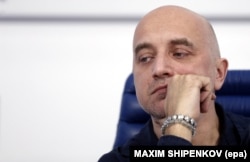
Authorities in Bosnia-Herzegovina have barred Russian writer Zakhar Prilepin from entering the country, triggering an angry reaction from Bosnian Serb leaders and Russia’s embassy in Sarajevo.
In a statement on August 23, the embassy expressed “concern and deep disappointment” after Prilepin was turned back at the Raca border crossing between Serbia and Bosnia, adding that it has requested an explanation from the Bosnian Foreign Ministry.
Bosnian Serb leader Milorad Dodik said the ban on Prilepin was "shameful, inadmissible, and directed against friends of Republika Srpska,” Bosnia's predominantly Serb entity.
Prilepin said he had been due to attend a literary event on August 24 in Banja Luka, the administrative center of Republika Srpska.
He told Russia's state-run Sputnik news agency that when he tried to cross the border at Raca, he was presented with a document saying he was barred from entering Bosnia because he "represents a threat for the security and international relations” of the country.
Prilepin is associated with Russia-backed separatists that are fighting against Ukrainian government forces in eastern Ukraine.
The Russian writer said he thinks the entry ban may be linked to his involvement in the ongoing conflict in eastern Ukraine.
Bosnia’s Intelligence and Security Agency reportedly issued an entry ban against Prilepin in March, citing security concerns.
Fighting between Russia-backed separatists and Ukrainian government forces in Ukraine’s eastern regions of Luhansk and Donetsk has killed more than 10,300 people since April 2014.
Bosnia is split into two entities: the ethnic Serb-dominated Republika Srpska and the Muslim-Croat Federation of Bosniaks and Croats. The two entities are linked by joint state-level institutions, including a tripartite presidency.
With reporting by Reuters and N1
Pompeo Calls On Russia To Free Hunger-Striking Sentsov
By RFE/RL
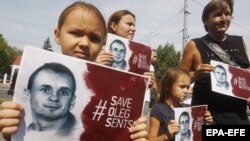
WASHINGTON -- Secretary of State Mike Pompeo has repeated U.S. calls for Russia to “immediately release” jailed Ukrainian writer and filmmaker Oleh Sentsov, who has been on hunger strike for more than 100 days and is reported to be critically ill.
"The secretary noted our concerns about Sentsov's health and urged Russia to immediately release Sentsov and all Ukrainian political prisoners," State Department spokeswoman Heather Nauert said in a readout of Pompeo’s phone call with Russian Foreign Minister Sergei Lavrov on August 23.
The Russian Foreign Ministry acknowledged that Pompeo raised the issue of Sentsov in the call and that Lavrov “explained the situation,” without providing specifics.
A vocal opponent of Russia's 2014 takeover of Ukraine's Crimean Peninsula, Sentsov was sentenced to 20 years in prison after being convicted by a Russian court in 2015 of conspiring to commit terrorist acts.
The 42-year-old has been on a hunger strike at a penal colony in Labytnangi in Russia's northern region of Yamalo-Nenets since May. He is demanding that Russia release 64 Ukrainian citizens that he considers political prisoners.
Russian authorities have refused to free Sentsov, despite reports of a dramatic decline in his health and pressure from Western governments and human rights groups, which have backed the film director's contention that the charges against him were politically motivated.
On August 21, the State Department marked Sentsov’s 100th day on hunger strike by saying it was “deeply concerned” by his detention and renewed calls for his immediate release.
The Russian Foreign Ministry also said that Lavrov in the phone call demanded that the United States end the prosecution and “immediately” release Russian citizen Maria Butina, who is being held on charges of acting as an agent for Moscow.
She has pleaded not guilty to the charges, which include attempting to infiltrate political groups such as the powerful National Rifle Association, to advance Russian interests while reporting back to a high-ranking official in Moscow.
Lavrov also told Pompeo that Washington's "destructive" approach to ties with Moscow is responsible for impeding bilateral cooperation.
Relations between Moscow and Washington have sunk to a post-Cold War low over issues including Russia's seizure of Crimea in March 2014, its role in wars in Syria and eastern Ukraine, and its alleged meddling in the 2016 U.S. presidential election.
With reporting by AFP and dpa
Serbian Paramilitary Chief Arrested For Allegedly Joining Separatist War In Ukraine
By RFE/RL's Balkan Service
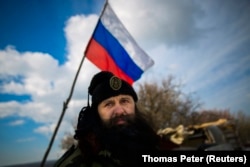
Bratislav Zivkovic, the commander of the Chetnik paramilitary force in Serbia, has been arrested on suspicion of organizing a group of Serbs who joined Russia-backed separatists in their war against Ukraine's government, Serbia's Interior Ministry said on August 23.
"The suspect will be detained for up to 48 hours and he will be brought to the competent prosecutor's office along with the criminal charges,” the ministry told RFE/RL.
Zivkovic is under investigation in Ukraine for participating with six Serbians on the side of the separatists.
Zivkovic, 42, is also reported to have joined Russian forces that took control of Crimea when Moscow illegally annexed Ukraine's peninsula in 2014.
Ukraine's prosecutor-general is investigating charges that the Serbians participated in separatist attacks on government forces in the regions of Donetsk and Luhansk as part of an extreme right-wing organization called Unité Continentale.
Amendments to Serbia's criminal law in 2014 made it a crime for Serbian nationals to participate in foreign wars, with violations drawing penalties ranging from six months to five years in prison.
An individual who participates in a foreign conflict as part of a group faces imprisonment of one to eight years, according to the law.
Someone convicted of organizing participation in a foreign conflict faces a prison sentence of two to 10 years.
In February, the Higher Court in Belgrade announced 28 convictions against Serbian citizens who participated in the war in Ukraine.
All but two of them pleaded guilty and agreed to settle with the prosecutor's office. Four people were sentenced to prison, while others were sentenced to parole.
The Chetnik paramilitary group gained notoriety in the 1990s when its units committed atrocities against non-Serbs in Croatia, Bosnia, and Kosovo.
That concludes our live-blogging of the Ukraine crisis for Thursday, August 23, 2018. Check back here tomorrow for more of our continuing coverage. Thanks for reading and take care.