



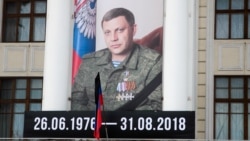
That concludes our live-blogging of the Ukraine crisis for Friday, August 31, 2018. Check back here tomorrow for more of our continuing coverage.
Separatist Leader Zakharchenko Was A Thorn In the Side Of Both Kyiv And Moscow
By Christopher Miller
He was a local boy from coal-dusted Donetsk who grew up to be a mine engineer. Aleksandr Zakharchenko quit that life to become a separatist warlord whose Russia-backed insurgents carved out a “republic” roughly the size of the state of Delaware.
On August 31, a bomb ripped through a popular Donetsk cafe, killing Zakharchenko as he dined with several others. The cafe where he was dining was called Sepa, or Separatist. He was survived by a wife and four sons.
The killing was at least the ninth targeted assassination of a senior Ukrainian separatist figure in the nongovernment-controlled territories of Donetsk and Luhansk since the conflict between Ukrainian government forces and Russia-backed separatists broke out in April 2014.
More than 10,300 people have been killed in the conflict, including those separatists. More than 1 million people have fled.
Zakharchenko, 42, graduated from a local technical college and studied at the Interior Ministry’s law institute before landing a job as an engineer in one of the region's many mines, according to Russian state media.
He rose to the leadership of the so-called Donetsk People’s Republic on August 8, 2014, with full-scale fighting under way through the region. He replaced Aleksandr Borodai, a Russian citizen from Moscow with close ties to the Kremlin, in a thinly veiled attempt by the Kremlin to show a semblance of self-government on the part of the separatist “republic.”
Three months later, Zakharchenko won an election that was meant to cement his rule but which was viewed by Kyiv and the West as a sham.
Brutal, unruly, and divisive, Zakharchenko was never fully accepted, not even by his own separatist supporters.
He always carried a loaded sidearm and traveled with security and was never comfortable leading the government, known by its acronym, the DNR. He preferred camouflage fatigues and front-line trenches to a suit and tie in a stuffy office or appearing in front of TV cameras.
Kyiv despised him because he had Ukrainian blood on his hands and was notorious for using torture on Ukrainian prisoners of war. Moscow kept him on a short leash because he wanted more autonomy than it was willing to give him.

Still, he was little more than a figurehead, since Moscow had run the show in the so-called separatist republics from the very beginning -- as shown by an overwhelming amount of evidence compiled by journalists, Kyiv, and Western intelligence agencies.
In one instance illustrating this, as the conflict flared in January 2015, Zakharchenko announced a large-scale offensive aimed at capturing the strategic port city of Mariupol. Two hours later, he walked back the order in a rushed press conference that had just one Russia state news outlet present.
At the time, sources in Donetsk told RFE/RL that he had received a call from Moscow shortly after his announcement.
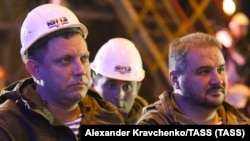
Zakharchenko was twice wounded on the battlefield: once in the arm during a battle in July 2014 and a second time in the leg during a fight in February 2015. He underwent several surgeries and never fully recovered from the leg wound. Some reports indicated the wound had flared up again in the months before his death, sidelining him for several weeks.
In July 2015, on the first anniversary of the downing of Malaysia Airlines Flight 17, he appeared in the village of Hrabove, where much of the plane’s wreckage had fallen. All 298 people on board the jet died.
Zakharchenko wore a leg brace and leaned heavily on a cane for support as he hobbled to a memorial plaque. Despite overwhelming evidence showing that the missile that downed the jet was transported from Russia and fired from territory under his control, he repeated Russian propaganda and blamed the downing on Kyiv.
There had long been rumors that Zakharchenko would be replaced. Much of that stemmed from his insubordination but also from the difficulties local residents endured, not least of which was actual war. But there was also the dire economic situation and an unpopular curfew.
One of the leading contenders to replace him is Denis Pushilin, another Donetsk native who was involved in a notorious Ponzi scheme in Russia before joining the separatists’ ranks. For now, however, the DNR government appointed as its acting head Dmitry Trapeznikov, who previously was the deputy chief of the DNR cabinet and reportedly worked for the Donetsk Shakhtar soccer club before the war.
In the immediate aftermath of Zakharchenko’s death, Kyiv and Moscow traded blame. Russia blamed Ukrainian security agents; Ukraine blamed internal rivalries, or even criminal groups.
The separatists’ deputy defense minister, Eduard Basurin, claimed -- without any evidence -- that the United States “was directly involved” in killing Zakharchenko, Russia’s state-run Sputnik news agency reported.
In comments to Bloomberg, another notorious former fighter, Igor Girkin, summed up the theories surrounding the killing.
“He could have been taken out because of criminal schemes or maybe his Kremlin curators grew tired of him or the Ukrainians may have done it,” said Girkin, a former militia commander who was favored by the Kremlin before his maverick ways became too costly. “He was a problem for everyone.”
Russian President Vladimir Putin, who has rarely even mentioned Zakharchenko by name, sent his condolences to Zakharchenko’s family shortly after his death was confirmed.
He “was a true people’s leader, a brave and resolute person, a patriot of Donbas,” he said in a statement posted on the Kremlin’s website. “In a difficult time for his native land, he stood up for his defense, took on a huge personal responsibility, led the people.”
The Ukrainian response was much more critical. The country’s main security agency, the SBU, immediately denied responsibility.
In some cases, the response from Ukrainians was darkly comical.
“We’ll have to go to TripAdvisor and leave a review about” the bombed cafe, Taras Berezovets, a Ukrainian political analyst and TV host, said in a post to Twitter. “The [dumplings] are simply the bomb!”
Washington Operative Who Lobbied For Ukrainian Party Charged With Foreign-Agent Violation
By Mike Eckel
WASHINGTON – Samuel Patten, a longtime Washington operative and associate of a Russian-Ukrainian man indicted by Special Counsel Robert Mueller, has been charged with failing to register as a foreign agent in the United States.
The U.S. attorney for the District of Columbia said in a criminal complaint filed on August 31 that Patten worked on behalf of the Ukrainian political party Opposition Bloc between 2014 and 2018, without disclosing the work to the U.S. government as required under the Foreign Agents Registration Act.
News reports said he entered a guilty plea at his initial appearance at D.C. federal court on August 31. Reuters reported that he also agreed to cooperate with prosecutors.
Earlier this week, he declined an interview request from RFE/RL.
Notably, the charges were not brought by Mueller, whose sweeping investigation into Russia interference in the 2016 presidential election resulted in the conviction earlier this month of Paul Manafort, the former campaign chairman for President Donald Trump.
Manafort was convicted by a federal jury in Virginia on tax and bank fraud stemming from his work between 2010 and 2014 for the pro-Russia Ukrainian political party Party of Regions and then-President Viktor Yanukovych.
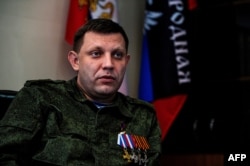
Ukrainian Separatist Leader Zakharchenko Killed In Cafe Blast
By RFE/RL
The leader of the Russia-backed separatists in Ukraine's eastern Donetsk region, Aleksandr Zakharchenko, was killed in an explosion at a cafe in Donetsk on August 31.
The news was confirmed by the official media outlet of the separatists.
Images of what appeared to be the blast site were posted on social media.
The Donetsk News Agency said in a statement on its website that Zakharchenko had been killed in an explosion in central Donetsk, citing the separatist leader's administration.
Earlier, a source said another separatist figure, Aleksandr Timofeyev, was injured in the blast at the Separ (Separatist) cafe.
Few other details were immediately available.
Moscow was quick to blame Kyiv for the killing.
Russia's Foreign Ministry said Kyiv had decided to engage in a "bloody fight."
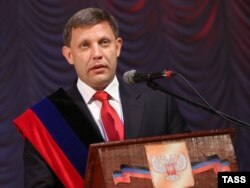
Since April 2014, more than 10,300 people have been killed in fighting between Kyiv's forces and the pro-Russia separatists who control parts of Ukraine's Donetsk and Luhansk regions.
Moscow has denied providing the separatist forces with weapons despite what Kyiv and NATO say is evidence proving that it has done so.
Cease-fire deals announced as part of the Minsk accords -- September 2014 and February 2015 pacts aimed at resolving the conflict -- have regularly failed to hold.
Russia in 2014 also seized and annexed Ukraine's Crimean Peninsula.
The United States and European condemned Russia’s actions and have slapped a series of sanctions against Moscow in reaction.
Zakharchenko, who was born in Donetsk in 1976, was sworn into office as the head of the so-called Donetsk People's Republic on November 4, 2014.
At one point, Zakharchenko announced plans to create a country called Malorossia -- Little Russia -- encompassing all of Ukraine with its capital in Donetsk.
However, in August 2017, Zakharchenko called off the plan, saying it "was rejected by many" after it was met with derision and criticism Kyiv and the West and did not receive the Kremlin's support.