



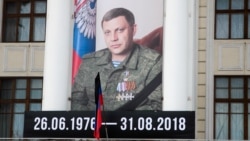
Here is more from RFE/RL's Ukrainian Service on Rafael Lusvarghi being apprehended by nationalists:
Ukrainian Nationalists Seize Brazilian Man Who Fought For Separatists
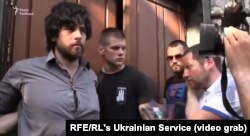
KYIV -- A mob of Ukrainian nationalists has seized a Brazilian man who fought for Russia-backed separatists and had been living secretly in a Kyiv monastery since being abruptly released from prison pending a retrial in Ukraine.
The group frog-marched 33-year-old Rafael Lusvarghi to the doors of the Ukrainian Security Service (SBU), apparently set on returning him to custody despite a court decision.
The May 4 incident was the latest dramatic twist in the case of Lusvarghi, who had been convicted by Ukrainian authorities on terrorism charges but released in December after 14 months in prison.
Since his release, Lusvarghi had been living secretly at a monastery in Kyiv of the Ukrainian Orthodox Church of the Moscow Patriarchate.
An RFE/RL reporter discovered his location and interviewed him last month for stories that were published on May 3 in English and Ukrainian.
A group of men appearing to be members of a far-right militia known as the Azov Batalion barged into the Svyato-Pokrovskyy Holosiivskyy Monastery on May 4, live-streaming as they searched his room, taking documents and a journal. They also spat at the feet of a priest, and chanted: "Glory to the nation, death to enemies!"
They later dragged him through Kyiv’s streets to the SBU's headquarters, on Volodymyrska Street. He did not appear to have been beaten. The group later tried to force him to repeat what appeared to be anti-Russian slogans.
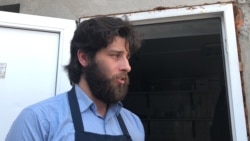 Brazilian citizen Rafael Lusvarghi had earlier told RFE/RL that he was learning the ascetic ways of a monk.in a Kyiv monastery since his release from prison.
Lusvarghi left eastern Ukraine via Russia and returned to Brazil in the summer of 2016, with the battle lines in Donbas mostly frozen but skirmishes creating casualties almost daily.
Then he decided to return to Ukraine later in the year, following what he would soon discover was a false job offer from the SBU.
He was arrested upon arrival at Kyiv's Boryspil International Airport that October and soon put on trial.
Speaking to RFE/RL at the monastery on April 30, after initially denying his identity, the first non-Russian convicted in Ukraine for crimes related to the war said he was unclear on the reasons for his sudden release in December but added that his passport remained in the hands of Ukrainian authorities as they continued to investigate his case.
The Ukrainian Justice Ministry, the Prosecutor-General's Office, and the SBU did not respond to requests at the time to clarify his status and that of the investigation.
Here is a natural-sound video of Ukrainian nationalists apprehending Rafael Lusvarghi today and frogmarching him to the SBU's headquarters. (Courtesy of RFE/RL's Ukrainian Service)


Another item from RFE/RL's news desk:
UNICEF Says War In Eastern Ukraine Takes 'Devastating Toll' On Education
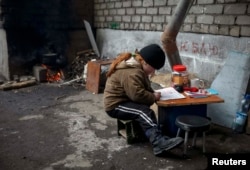
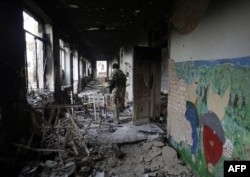
The United Nations Children's Fund (UNICEF) says the war between government forces and Russia-backed separatists in eastern Ukraine has taken a "devastating toll" on the region’s educational system, forcing more than 200,000 children to learn in "militarized environments."
"Children are learning in schools with bullet holes in the walls and sandbags in windows, bomb shelters in the basements, and shrapnel in school yards," UNICEF Ukraine Representative Giovanna Barberis said in a May 4 statement.
"The children are extremely nervous of shelling, and teachers try to calm them down, but it's hard for them...because they are nervous and stressed," Barberis said.
The UN agency did not directly name a particular side in the war, a conflict that has killed more than 10,300 people since March 2014.
It said that "all sides of the conflict must respect international humanitarian law and ensure that schools are safe places for children to learn."
'Forgotten' Crisis
UNICEF also said schools and kindergartens on both sides of the tense "contact line" are in danger due to the proximity of military sites, including bases, storage facilities, and security check points.
The contact line divides areas controlled by the government and Russia-backed separatists in and around parts of the Donetsk and Luhansk provinces, and it is where fighting is the fiercest.
UNICEF said it and its partners have monitored instances in which military and armed groups are based within 500 meters of a kindergarten or school.
It added that it has monitored six former school buildings that have been occupied or used by military forces or armed groups since the start of the current school year.
The European Union and United States back Kyiv in the conflict and have imposed sanctions on Russia for its support of the separatists and for its illegal annexation of Ukraine's Crimea Peninsula.
Moscow has denied providing the separatist forces with weapons despite what Kyiv and NATO say is irrefutable evidence proving that it has done so.
In previous reports, UNICEF has said that more than 1 million children are in need of urgent humanitarian aid in eastern Ukraine.
Barberis in 2017 described the war as "a crisis most of the world has forgotten."