




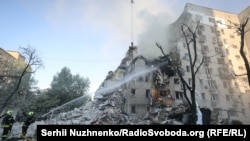
WASHINGTON -- Russia carried out one of its largest attacks on Ukraine's capital this year, reigniting demands in the United States and Europe for tougher military and economic measures against Moscow.
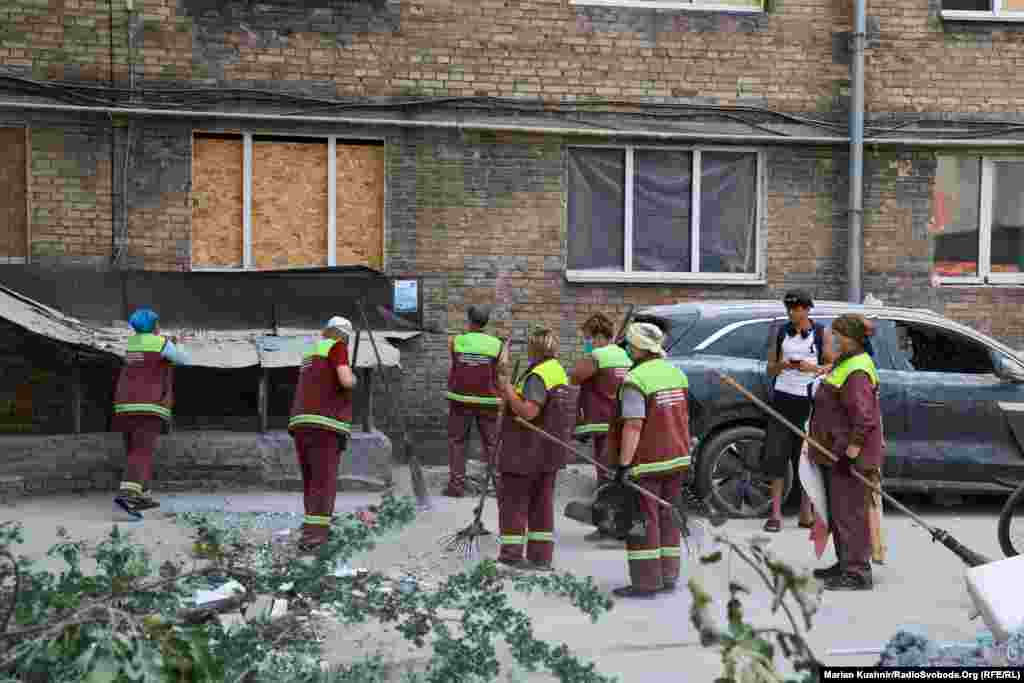
Ukrainian officials said at least 30 people were killed and scores of others wounded in the large-scale attack on Kyiv on July 2, which caused fires and extensive damage to civilian infrastructure and residential buildings across several districts.
The scale of the assault drew swift condemnation from lawmakers in Washington, where debate over future aid to Ukraine remains politically fraught.
Kyiv Mourns Victims Of Major Russian Drone And Missile Attack






Lawmakers Push For More Military Aid
Republican Joe Wilson of South Carolina, a longtime backer of US support for Ukraine, called the strikes further proof that the Kremlin is faltering militarily.
"This horrible war crime is yet more evidence that Russia is badly losing its war," Wilson told RFE/RL. "The USA and its allies should do even more of what it's doing. The strategy is working. Russia is losing."
Russia launched a full-scale invasion of neighboring Ukraine in 2022 expecting to take Kyiv in a matter of weeks. But Ukraine, with backing from the West, has fought Russian forces to a near stalemate.
Wilson also framed the July 2 attack as a signal ahead of next week's NATO summit in Turkey, where support for Ukraine is expected to be high on the agenda.

"[Russian President Vladimir] Putin is desperate. He is a pathetic loser who murders women and children," Wilson said. "We must fully back Ukraine and push for victory and a just resolution to the war."
Don Bacon of Nebraska, a senior Republican on the House Armed Services Committee, sharply criticized what he described as insufficient urgency from the Trump administration.
"We should be helping Ukraine with missile and air defenses, and we should be putting on tough sanctions on Russia," Bacon told RFE/RL.
Bacon said there was growing unease in Congress over the Pentagon's strategic posture on Russia and NATO.
"The civilian leadership in the Pentagon has been weak on Russia and NATO," he said, adding that "silence on Russian war crimes" and "moral ambiguity" would leave a lasting stain on US policy.


In a joint statement shared with RFE/RL, leaders of the Congressional Ukraine Caucus -- including Democrats Marcy Kaptur of Ohio and Mike Quigley of Illinois as well as Republicans Brian Fitzpatrick of Pennsylvania and Wilson -- urged immediate action.
"The House has spoken -- the United States should immediately arm Ukraine with the tools it needs to defend its people and end Russia's war," the statement said.
Their statement came as Ukrainian President Volodymyr Zelenskyy, in the aftermath of the strikes, renewed his appeal for expanded air defense cooperation, focusing on local production of the Patriot surface-to-air missile defense system.
Ukraine currently operates US-made MIM-104 Patriot batteries -- the only systems in its arsenal capable of intercepting Russian ballistic missiles -- but Kyiv wants to build them domestically.
"To reliably protect lives, we need our own production," Zelenskyy said.
In a video posted on social media, Zelenskyy said talks with the US administration on the issue had been underway "for a long time already," and urged President Donald Trump to move forward.
He argued that European co-production of Patriot systems inside Ukraine or with allied countries could also strengthen US industrial capacity.

European Conservatives Signal Continued Backing
In Washington, senior members of the European Conservatives and Reformists Group (ECR) met Trump administration officials and lawmakers ahead of the NATO summit.
The delegation -- including Patryk Jaki, Adam Bielan, Assita Kanko, and Stephen Bartulica -- said they "strongly condemn" Russia's latest attack.
Speaking after meetings at the White House, State Department, and major conservative policy institutions, ECR officials said they sensed cautious optimism among US officials about a possible cease-fire in the four-year war.
"We heard from our interlocutors that they are quite optimistic that we can achieve a cease-fire this year," they said in a statement.
But despite those diplomatic hopes, European lawmakers emphasized that continued military support for Kyiv remained essential.
For many in Eastern Europe, Russia's latest assault has reinforced the urgency of maintaining transatlantic unity as NATO leaders prepare to meet amid mounting questions over the alliance's long-term strategy toward Moscow.

