




Latest from our news desk:
Ukraine's state-run railway company has suspended cooperation with a cargo branch of Russian Railways as part of a wave of sanctions against Russia over its support for separatists in the country’s east.
Ukrzaliznytsya said on September 29 that it "is not handling cargo and (rail) cars operated by Russia's freight railway operator Freight One or its daughter company."
On September 25, Ukraine banned Russian airlines, including Aeroflot, from flying to Ukraine from October 25, prompting Russia to impose similar restrictions on Ukrainian airlines flying in Russian airspace.
Kyiv-Moscow relations are extremely poor due to Russia's annexation of Ukraine's Crimean Peninsula in March last year and support for pro-Russian separatists in the ongoing crisis in Ukraine's eastern regions of Luhansk and Donetsk.
Earlier this month, Kyiv expanded a list of sanctions against Russian companies and individuals, targeting 400 officials and 90 firms.
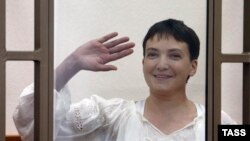
The Donetsk, Russia, court where Nadia Savchenko is being tried has refused her request to be questioned using a "lie detector."
"I want to testify using a polygraph. The investigation is probably afraid that the case would fall apart when a polygraph shows that I am not lying," Savchenko said in court.
The judge, however, stated that interrogation with a polygraph specialist is not statutory.
The Ukrainian pilot, who is now jailed in Russia, is facing 25 years in prison for alleged participation in the killing of two Russian journalists in Donbas last year.
Today Savchenko is being questioned in court as part of the proceedings.
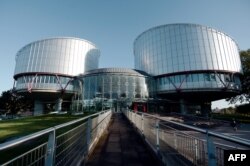
The European Court of Human Rights (ECHR) has extended Russia’s deadline to December 31 to provide an official explanation on claims that deal with Crimea’s annexation in 2014 and ongoing aggression in Donbas, according to a government delegate to the ECHR, Borys Babin, in an interview with the Ukrainian News agency.
"We think that it may not be Russia's last request to postpone this matter, because they have a sole and very simple interest -- Russia will try to drag these cases out for as long as it can. Because they know they can't win," Babin said.
He said that as of July, the ECHR had received more than 500 individual claims.
"The majority of these cases are related to the events in Donbas, the minority, in Crimea. Most of the cases are filed against two countries simultaneously, Russia and Ukraine," Babin said.
He explained that cases are filed against Ukraine too, due to its reluctance to help its citizens in filing complaints to the ECHR.
Babin said he didn't know when the ECHR will eventually make decisions.
"As for individual cases, the terms are reasonable -- two-three years, five years maximum, meaning, not decades," he said.
The main news this morning:
A court in Kyiv has started preliminary hearings into the case against two alleged Russian soldiers detained in Ukraine's east.
Aleksandr Aleksandrov and Yevgeny Yerofeyev were brought to the Holosiiv District Court on September 29.
They have been charged with involvement in "terrorist activity."
In a video published in May, Aleksandrov and Yerofeyev said they were on active duty with the Russian military in eastern Ukraine when they were captured on May 16.
Moscow says Yerofeyev and Aleksandrov were no longer employed by the state when they were captured.
Russia denies accusations by Kyiv and the West that it is providing weapons, training, and personnel to pro-Russian rebels in eastern Ukraine who are involved in a conflict that has killed thousands since April 2014.
We are now closing the live blog for today. Until we resume again tomorrow morning, you can keep up with all our ongoing Ukraine coverage here.
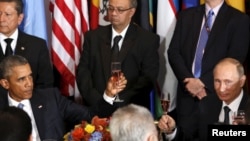
U.S. President Barack Obama and his Russian counterpart Vladimir Putin have traded barbs about Ukraine (among other things) at the UN General Asembly. Here is an excerpt from our report on the two men's speeches in New York:
Obama and Putin also clashed over Russia's annexation of the Crimea peninsula from Ukraine in March 2014.
Obama said the land grab could fuel expansionism elsewhere in the world if the international community did not respond decisively to Moscow's actions.
"We recognize the deep and complex history between Russia and Ukraine. But we cannot stand by when the sovereignty and territorial integrity is flagrantly violated. If that happens without consequence in Ukraine, it could happen to any nation gathered here today," he said.
Kyiv and the West also say Russia has sent troops and weapons to fuel the separatist conflict that has killed more than 7,900 people in Ukraine's east since April 2014. Moscow denies the charges.
Ukrainian and rebel forces have blamed each other for repeated breaches of a cease-fire agreement reached in Minsk in February, but both sides are now broadly respecting a renewed truce that came into effect on September 1.
Obama said Washington does not want to isolate Russia. U.S. sanctions targeting Moscow in response to the Ukraine crisis are intended to deter the redrawing of borders and are "not part of a desire to return to a Cold War," he said.
He added that Russia's actions have driven Ukrainians into seeking deeper integration with Europe and harmed its own interests.
"Sanctions have led to capital flight, a contracting economy, a falling ruble and the emigration of more educated Russians," Obama said. "Imagine if instead Russia had engaged in true diplomacy and worked with Ukraine and the international community to ensure its interests were protected. That would be better for Ukraine but also better for Russia and better for the world."
Putin, meanwhile, echoed the Kremlin's longstanding accusations that the United States is exporting revolutions in countries of the former Soviet Union.
He blamed NATO and its expansion into Eastern Europe and former Soviet states for creating tensions that led to the mass upheaval in Ukraine that culminated in the ouster of President Viktor Yanukovych in February 2014.
"They offered the poor Soviet countries a false choice: either to be with the West or the East," Putin said. "Sooner or later this logic of confrontation was bound to spark a grave geopolitical crisis. This is exactly what happened in Ukraine, where the discontent of the population with the current authorities was used and a military coup was orchestrated from outside that triggered a civil war as a result."
Read the entire report here