




And, in case your memory needs jogging, here's a Daily Vertical from Brian Whitmore earlier this year on the Novorossia project and its rapid demise:


Good morning. We'll start the live blog today with this long piece from our news desk on the importance of Ukraine's mayoral and municipal elections, which are taking place today over most of the country:
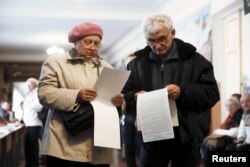
Ukrainians are voting in local elections seen as a survival test for pro-Western President Petro Poroshenko's fragile ruling coalition amid the country's deep economic crisis and ongoing conflict in the east.
Voters are choosing mayors and representatives to municipal councils in all parts of Ukraine except eastern areas controlled by Russian-backed separatists and in Russian-annexed Crimea.
Polling stations also remained closed in the southeastern city of Mariupol, located near rebel-held areas, following a dispute over the ballots, which were printed at a company controlled by influential tycoon Rinat Akhmetov, prompting fears of fraud.
"The election must be delayed because some of the ballots had serious problems," said Natalya Kachtchi, a member of the local electoral commission.
Poroshenko's Solidarity party said the polls "were aborted... due to the improper preparation of election ballots, the absence of control over their printing and number, and reliable storage."
The statement said it still hoped to conduct mayoral and regional council votes in the city in the coming weeks.
Solidarity is projected to take the biggest number of mayoral seats and local legislatures.
But the president's approval rating has slipped to 26 percent, or less than half of what it was when he became president in May 2014.
Prime Minister Arseniy Yatsenyuk, whose approval ratings reportedly have plunged to just a few percentage points above zero, is not even fielding candidates from his party in the polls.
One beneficiary could be Ukraine's Opposition Party, largely made up of former members of ousted President Viktor Yanukovych's Party of Regions.
In many parts of eastern Ukraine -- a stronghold for the former Party of Regions – pro-Russian politicians have remained in local power positions despite the Euromaidan protest that chased the Moscow-backed Yanukovych into exile in February 2014.
The Opposition Party, which currently holds about 10 percent of the seats in the national parliament, rejects Poroshenko's goal of bringing Ukraine into NATO and favors nonalignment.
It advocates ending the war in the east peacefully by negotiating with Russia and seeks a return to Ukraine's 1991 borders, reestablishing Crimea and parts of eastern Ukraine currently under rebel control as Ukrainian territory.
Another beneficiary of the October 25 local elections could be the Batkivshchyna Party, or Fatherland Party, of Yulia Tymoshenko -- the 2004 pro-democracy Orange Revolution leader and former prime minister who is now demanding a “professional army and fair tariffs” in Ukraine.
Tymoshenko and her allies are expected to do better than their disappointing sixth place finish in the October 2014 parliamentary elections.
Political analysts also are closely watching Andriy Sadovyy's Self-Help (Samopomich) faction, which finished in third place in last year's parliamentary elections after rising from relative obscurity in western Ukraine.
Sadovyy himself is fighting for a third term as mayor of Lviv amid critics' charges that he has become too distracted by national politics to lead the city.
Meanwhile, in Odesa, reformists are battling to oust incumbent Mayor Hennady Trukhanov in what is seen as a direct challenge to Ukraine's oligarchic elite.
Challenger Sasha Borovik, an aide to Odesa's regional Governor Mikheil Saakashvili, is running with the support of Poroshenko's bloc.
Altogether, there are more than 130 political parties that have candidates in the different elections around the country.
Separatists in control of portions of the Luhansk and Donetsk regions have blocked holding the October 25 elections there.
The separatists originally threatened to hold their own local elections on October 18 but later postponed the date to February next year -- reportedly under pressure from Moscow.
In addition to those living in the separatist-controlled areas, some 1.5 million people who have fled from eastern Ukraine and Crimea and now live scattered across government controlled areas of the country have been disenfranchised from the voting.
The local elections are intended to set the stage for a planned devolution of more power from Kyiv to municipal bodies in the future.
The new powers could include keeping more locally collected tax money at home instead of sending it to Kyiv to be reapportioned by the central government.
However, change could come slowly because devolution includes demands for greater autonomy in the east.
Demands put forth by pro-Russian separatists are part of the Minsk peace process and are the subject of hot debate in the Ukrainian legislature as it discusses amendments to the constitution that would be necessary for any new decentralization of power.
Ukraine's local elections are not supposed to impact the implementation of the Minsk accords, which created a roadmap for a cease-fire and political settlement to the conflict between Ukrainian government forces and pro-Russian separatists in eastern Ukraine.
That's because implementation of the Minsk accords is the responsibility of the central government in Kyiv.
But political analysts say a strong showing by the Opposition Bloc and for Tymoshenko's Batkivshchyna Party could weaken Poroshenko's political clout and ability to win the votes in Ukraine's parliament that are needed to implement the Minsk agreements.
(with reporting by RFE/RL's Charles Recknagel in Prague, Reuters, AP, AFP, dpa, Kyiv Post, TASS, and Interfax)
We are now closing the live blog for today, but don't forget to join us tomorrow morning, when we'll start bringing you all the latest election developments as they happen. In the meantime, you can keep up with all our ongoing Ukraine coverage here.
A potentially big story, if it has legs:
Christian Borys has also been writing for RFE/RL about the run-up to the elections in Mariupol:
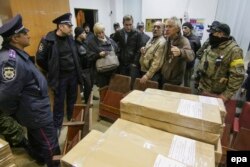
Six days before Ukraine holds its most extensive local elections since the Euromaidan revolution and the start of a war with Russia-backed rebels, antitank grenades slammed into an apartment house in the heart of this port city.
Nobody was hurt, but the attack was a startling reminder of the conflict that raged for months close to Mariupol, a major target that was hit by shelling several times but eluded the grasp of separatists who hold a large swath of southeastern Ukraine.
With the Kremlin's gaze turned to Syria, a cease-fire has held shakily since September, freezing the conflict in place and creating a faint chance for a settlement -- along with fears that violence could erupt again.
"I'm worried about some terrorist attacks during the actual election," says Olga Illuhena, 18, who plans to go to the polls with a group of friends "to feel safer."
Across the country, voter interest in the October 25 elections is high. After the promise of the Euromaidan protests, which drove President Viktor Yanukovych from power in February 2014 and raised hopes for a decisive turn toward Europe, the war with pro-Russian separatists, Russia's seizure of Crimea, and dire economic troubles have been a bitter disappointment for many.
But fears of war are just one of the worries hanging over Mariupol, undermining hopes that the city of sprawling steelworks and seedy docklands can escape a cycle of corruption and economic struggle that has gripped it since the Soviet era, when it was called Zhdanov, after a henchman of Josef Stalin.
Read the entire article here