


And here's a Ukraine-related item from our Washington desk:
WASHINGTON -- A State Department official has said U.S. efforts to counter misinformation and propaganda generated by the Kremlin will be a long-term effort that includes bolstering independent media in Eastern Europe and Eurasia.
Benjamin Ziff, deputy assistant secretary of state for European and Eurasian affairs, told a Senate Foreign Relations subcommittee that the Obama administration had proposed a 26 percent increase -- to $83 million -- in funding for the coming fiscal year for civil society groups and independent media “in countries most vulnerable to Russian pressure.”
"The free flow of reliable information is our best defense," Ziff testified in the November 3 hearing.
"We view this work against the Kremlin propaganda as not necessarily a short term effort; this is a medium- and long-term effort to make sure there is no fertile ground in Europe or Eurasia for the kind of efforts they are doing," he said.
Ziff also said the U.S. administration has not ruled out supplying lethal weaponry and military equipment to Ukraine's military.
He added that the administration was considering prolonging economic sanctions again Russia if the provisions of the Minsk cease-fire agreement aren't fully implemented in eastern Ukraine. That agreement, signed by Ukrainian and separatist officials, called for the withdrawal of heavy weaponry and greater access to humanitarian aid, among other things.
Fighting in eastern Ukraine has largely ebbed, though Ziff said since that, September 1, there have been 17 deaths and 50 wounded due to sporadic violence in parts of that region.
He did not specify whether the casualties were regular Ukraine soldiers, volunteer militias or Russian-backed separatists.
The conflict between Ukrainian government forces and Russian-backed separatists has killed more than 7,900 people since it erupted in April 2014.
Caution: Tanks Crossing -- we're not sure about the authenticity of this image, but Twitter is saying it's a photo of a street sign in eastern Ukraine:
Not directly related to Ukraine's crisis, but this sort of stuff doesn't portray the country in a good light (particularly in the West):
Good morning. We'll start the live blog today with this item that came off our news desk overnight:
Ukrainian authorities said they will buy natural gas from Russia until the end of the year, but will purchase all Ukraine's gas from Europe in the first quarter of 2016 if Russia does not offer a competitive price.
"We expect and hope that Russian gas sellers will be rational and propose competitive prices to us," Naftogaz Chief Executive Andriy Kobolev said at a company briefing in Kyiv on November 3.
"If there is no such offer we will be purchasing all gas from Europe," he said.
Kobolev said that no additional agreement needs to be signed on first-quarter gas purchases, as it is possible for Ukraine to act within the framework of documents signed earlier this year.
He added that Naftogaz Ukrainy is expecting "a serious fall" in gas prices, starting in the second quarter of next year.
(Reuters, Interfax, TASS)
We are now closing the live blog for today, but until we resume again tomorrow morning, you can keep up with all our ongoing Ukraine coverage here.
Former NATO Secretary-General Anders Fogh Rasmussen has written an interesting opinion piece for Project Syndicate on what he see's as Russia's "tragic miscalulation" in Ukraine:
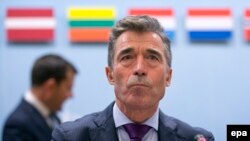
COPENHAGEN -- Russia’s aggression against Ukraine is one of the great tragedies of our time, not only because of the tremendous human cost, but also because it is utterly pointless. Indeed, Russia’s leaders fundamentally misjudged the West’s intentions and created an entirely unnecessary confrontation that undermines both sides’ interests.
Russia and the West – with their closely interlinked economies and many overlapping political objectives in Europe and beyond – have much to gain from peaceful cooperation. But instead of working with Western powers to enhance shared prosperity, the Kremlin turned on its partners abroad.
The reason was simple: Russia viewed the gradual enlargement of the European Union and NATO – achieved through their “neighborhood” and “open door” policies, respectively – as carefully orchestrated attempts to encircle and threaten it. According to Kremlin rhetoric, by welcoming former Soviet countries, the EU and NATO were explicitly attempting to weaken Russia. This interpretation ultimately drove Russia to respond to Ukraine’s plans to sign an association agreement with the EU by annexing Crimea and attempting to create a “frozen conflict” in eastern Ukraine.
But Russia’s interpretation was patently wrong – and I can say so with full authority. As Prime Minister of Denmark, I chaired the 2002 EU summit in Copenhagen, where European leaders agreed on the bloc’s most expansive enlargement ever. And as Secretary General of NATO, I spent five years chairing the NATO-Russia Council to build cooperation with our largest neighbor.
The truth is that the young democracies of Central and Eastern Europe sought to join the EU and NATO – and worked hard to gain membership – because they longed for peace, progress, and prosperity. It was those countries’ ambitions, not some vendetta against Russia, that drove EU and NATO enlargement.
Russia should not bemoan its neighbors’ decision to engage with the EU and NATO, which, after all, paved the way for economic progress and security improvements. The EU and NATO supported the construction of strong democratic institutions based on the rule of law and respect for minorities, the emergence of viable and dynamic economies, and the peaceful resolution of border disputes.
A secure and prosperous Central and Eastern Europe benefits everyone – especially Russia. Today, the EU is Russia’s largest foreign market, with a major share of its exports going to the member states that joined in 2004. And Russia’s border with the EU, far from posing a threat, is the most stable and secure of all its frontiers.
Read the entire article here