



Good morning. Some Ukraine news from last night. On the stolen Dutch paintings.
Ukraine's police chief invited the Netherlands to help find a trove of Dutch 17th century paintings that was stolen from a Dutch museum.
Khatia Denakoidze told reporters December 10 that her office is waiting for an official request from Dutch prosecutors and that Ukraine welcomes Dutch investigators to join the police hunt.
The Westfries Museum in the northern town of Hoorn said that 24 Dutch Golden Age paintings snatched in a burglary in January 2005 had been found in a villa in a Ukrainian-controlled part of Donbass and are being offered for sale.
The museum said men from an Organization of Ukrainian Nationalists battalion fighting Russian-backed separatists showed the Dutch embassy a picture of one of the stolen works and demanded 50 million euros for the paintings' return -- a sum that they later reduced considerably.
The nationalist group denied holding the artworks and Ukraine's chief prosecutor launched an investigation.
We had a feature yesterday looking the case's connection with the Dutch referendum.
We are now closing the live blog for today. Until we resume again tomorrow morning, you can keep up with all our other Ukraine coverage here.
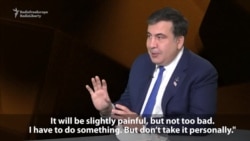
Here's a video from Vitaly Portnikov of RFE/RL's Russian Service who was speaking with Mikheil Saakashvili. The fomer Georgian President, who now governs the Odesa region in Ukraine, says Kremlin animosity toward his country was driven by the success of his pro-Western reforms.

What's Behind Italy's Step Back On Extending Sanctions Against Russia?
By Rikard Jozwiak
BRUSSELS -- It was supposed to be a done deal: European Union envoys had been expected to approve a six-month extension of sanctions against Russia over its interference in Ukraine, as agreed by EU leaders last month.
But the Italian ambassador upended that plan at a meeting on December 9, telling the others that Rome wanted more debate on the matter.
A high-ranking EU diplomat told RFE/RL that EU ambassadors would not discuss the sanctions at their December 10 meeting. That means the issue is unlikely to be resolved this week, dragging the discussion closer to an EU summit on December 17-18, the holiday recess, and the January 31 deadline for a final agreement to prolong the sanctions through July 31, 2016.
So far only Rome has spoken out, but diplomats suspect countries such as Hungary, Austria, Greece, and Cyprus may be in the same camp.
Italian Prime Minister Matteo Renzi was among the leaders who agreed on the sanctions extension at a meeting on the sidelines of a G20 summit in Turkey on November 16 -- so why the unexpected change of heart?
EU sources say that Renzi may have been driven by one of the following motives, or a combination of all three:
1. He wants to put pressure on EU member states from the east to be more helpful on another crucial issue facing the 28-member grouping -- migrants -- in the run-up to the EU summit next week.
2. He wants to show the Italian business community and Russia -- whose foreign minister, Sergei Lavrov, is visiting Italy on December 10-11 -- that he is fighting to the end, not just giving in to the EU majority.
3. He dislikes European Council President Donald Tusk and wants to annoy him, knowing that the former Polish prime minister cares deeply about the issue and is determined to keep sanctions against Russia in place.