

We are now closing the live blog for today. Until we resume again tomorrow morning, you can keep up with all our other Ukraine coverage here.
Viktoria Veselova and Oleksandra Melnykova from RFE/RL's Ukrainian Service look at how the annual kitch fest that is the Eurovision song contest could have serious political overtones this year, at least as far as Ukraine is concerned:
Crimean Tatar Singer Hopes To Take People's Tragedy To Eurovision

KYIV -- The leading contender to represent Ukraine in this year's Eurovision song contest is a 32-year-old Crimean Tatar with a heart-rending song recalling how Soviet dictator Josef Stalin ordered the mass deportation of her entire nation to Central Asia in 1944.
Singer Jamala won the national quarterfinal competition with her song 1944, receiving the highest scores both from the judges and from the text-message voting -- even though the vast majority of Crimean Tatars were unable to cast ballots because they live in Crimea, which was forcibly annexed by Russia in 2014. (Ukrainian telecom companies were kicked out of the region following the Russian takeover, and now their equipment is being used there by Russian firms.)
"It makes me very sad," Jamala told RFE/RL's Ukrainian Service. "I know that many of my supporters are in Crimea. Many people wrote to me that they would send texts anyway, because they support me. I tell them they are wasting their money and their votes don't count, but they tell me they are sending them anyway."
Nonetheless, Jamala's performance at the February 6 quarterfinals in Kyiv produced an outpouring of support on social media.
"Your music today made me understand the pain of our loss of Crimea," wrote a user identified as Ruslan. "I simply wept along with you."
WATCH: Jamala Sings 1944
Read more here
From the Interfax-Ukraine news agency:
Ukrainian law enforcement agencies have opened criminal investigations under two articles of Ukraine's Criminal Code after Russian officers from the Joint Center for Control and Coordination (JCCC) were found in possession of methodical materials of a military nature, as well as symbols of illegal armed units
"On February 2 of this year, our investigation registered a criminal case opened under Article 333 of the Penal Code of Ukraine – a violation of the rules for transporting commodities subject to state control, as well as under Article 258, Point 3 – abetment to terrorist activity," Ukrainian Security Service chief Vasyl Hrytsak told a press briefing in Kyiv on Tuesday.
From RFE/RL's Washington bureau:
U.S. Intelligence Chief: 'Assertive' Russia Will Keep Pressure On Ukraine
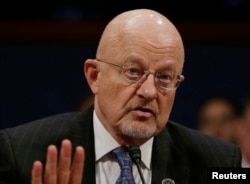
U.S. National Intelligence Director James Clapper says that Russia remains intent on pursuing an "assertive foreign policy" in 2016, including hampering Ukraine's Western aspirations.
Clapper said in prepared testimony to Congress on February 9 that despite reduced violence between Ukrainian forces and Russia-backed separatists in eastern Ukraine, the Kremlin will continue to maintain "long-term influence over Kyiv" and frustrate "Ukraine’s attempts to integrate with Western institutions."
"Events in Ukraine raised Moscow's perceived stakes for increasing its presence in the region to prevent future regime change in the former Soviet republics and for accelerating a shift to a multipolar world in which Russia is the uncontested regional hegemon in Eurasia," Clapper said.
The United States and the European Union have targeted Russia with several rounds of sanctions following Moscow's annexation of Ukraine's Crimea territory in March 2014 and the subsequent war in eastern Ukraine that has killed more than 9,000 since April 2014.
Clapper added that Russia in 2016 will raise pressure on neighboring states to join the Moscow-led Eurasian Economic Union, which former Soviet republics Armenia, Belarus, Kazakhstan, and Kyrgyzstan have already joined.