



IMF chief Lagarde warns Ukraine over rescue program
Washington, Feb 10, 2016 (AFP) -- An IMF program helping to prop up cash-strapped Ukraine's stricken economy cannot continue without reform by the authorities in Kiev, International Monetary Fund chief Christine Lagarde warned Wednesday.
"Without a substantial new effort to invigorate governance reforms and fight corruption, it is hard to see how the IMF-supported program can continue and be successful," Lagarde said in a statement.
The IMF is the main source of rescue financing for Ukraine as the hard-up country battles with crises ranging from falling commodity prices to a new trade embargo by Russia.
The Fund has a $17.5 billion rescue program for Ukraine on condition the government enacts economic reforms and fights corruption.
"I am concerned about Ukraine's slow progress in improving governance and fighting corruption, and reducing the influence of vested interests in policymaking," said Lagarde.
"Ukraine risks a return to the pattern of failed economic policies that has plagued its recent history," she added.
"It is vital that Ukraine's leadership acts now to put the country back on a promising path of reform."
Caspian Flotilla Ships Join Huge Russian Military Exercises
Russia says more than 20 warships and support vessels have departed from their bases in the Caspian Sea and begun training as part of massive combat readiness exercises across the country's southwest.
The military says the snap drill, which kicked off on February 8, will involve up to 8,500 troops and 200 aircraft.
Defense Minister Sergei Shoigu said the maneuvers are intended to check the troops' ability to respond to extremist threats and other challenges.
They involve forces stationed in the Southern Military District, which includes southwestern regions near the border with Crimea -- the Ukrainian peninsula which was annexed by Russia in 2014 -- the North Caucasus, the Black Sea, and the Caspian Sea.
The exercises are the latest in a series of major drills conducted in the past two years amid an increase of tension between Russia and the West.
Based on reporting by Interfax and AP
Between mines and mortars: stranded lives in eastern Ukraine
By Sergey Volskiy
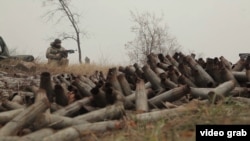
Zaitseve, Ukraine, Feb 10, 2016 (AFP) -- Imagine picking your way through a minefield to go to work every day. Or even to go shopping for basic supplies.
That is what faces 42-year-old Irina, ever since one of the main crossing routes in eastern Ukraine was shuttered by a recent upsurge in attacks in the war-scarred former Soviet state.
Like thousands of other locals, the water plant employee can no longer make a living because she lives on land seized by pro-Russian insurgents but works in a government-run part of eastern Ukraine.
"After they closed the checkpoint, they starting shelling this place not only at night, but also during the day," says Irina, lugging heavy bags of provisions.
- Bypassing roadblocks -
"I had to make my way around both the rebel roadblock and the Ukrainian one, too," she adds, as the sound of rocket and mortar fire rolls in from the barren fields.
Monitors from the Organisation for Security and Cooperation in Europe (OSCE) said at least two civilians were recently hurt by mines laid here by separatist and government forces during the 21-month war.
The contested village of Zaitseve -- and its 4,000 destitute inhabitants lies -- just 35 kilometres (20 miles) north of the rebels' de facto capital Donetsk.
The deadlocked conflict has seen Kiev's troops dig themselves in just to the north and west.
The guerrillas are spread within easy shooting distance to the south and east of Zaitseve, which happens to lie at the war's epicentre.
"The situation here has gotten a lot worse in the past week," 33-year-old government soldier Andriy Miroshnichenko told AFP.
The insurgents "have started staging around 100 mortar attacks a night," he said. "And a road that is being used by thousands of people has become a target."
- Saving hundreds of lives -
One of Europe's deadliest conflicts since the Balkans wars of the 1990s has killed more than 9,000 people and driven an estimated 1.5 million from their homes.
But many in Ukraine feel abandoned by EU leaders who are more worried by a recent influx of Middle Eastern migrants, a crisis closer to home for the 28-nation-bloc.
The war itself also appears to have lost much logic or reason. Russia continues to dismiss growing evidence of its tanks and heavy weapons being used by the insurgents to capture patches of the industrial heart of Ukraine.
Periodic truces and spells of relative calm are often broken without warning.
Ukraine decided to close a 14-kilometre stretch of a road running between Zaitseve and neighbouring settlements on February 3 as a precaution.
Kiev had then accused the rebels of staging a new wave of unprovoked shellings that threatened the lives of civilians.
"If we had kept this place open, we would have seen hundreds die," says Miroshnichenko.
The insurgents counter that Ukrainian forces had decided to shut the crossing in advance of an offensive that could take them to the very edge of Donetsk and its seat of separatist power.
"We used to let up to 6,000 cars through a day," said a 48-year-old pro-Moscow fighter who uses the nom de guerre "Yakut" -- a word applied to natives of Russia's eastern Arctic Sakha Republic.
"I think they closed the crossing in order to intensify their attacks," he added.
- 'Civilians trapped' -
The United Nations' humanitarian coordinator for Ukraine has already taken the unusual step of condemning the pro-Western leadership in Kiev for closing the road.
"Closure of checkpoints has an immediate impact on people's lives, directly increasing hardship and humanitarian need," Neal Walker said immediately after the road was blocked off.
"If hostilities increase, civilians may be trapped in unsafe areas, at the mercy of violence, mines and unexploded munitions. We urge the government to keep checkpoints open."
But neither Kiev nor the insurgents can predict when passage for people like Irina might once again become safe.
Irina herself says she now feels like a hostage caught in the crossfire of two irreconcilable foes.
"The people of the rebel and government regions live their own separate lives," she says with a sigh.
"And we are caught in the middle and paying for it all."