

We are now closing the live blog for today. Until we resume again tomorrow morning, you can keep up with all our other Ukraine coverage here.
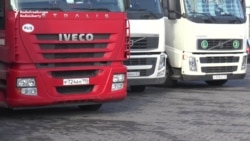

Russia, Ukraine Give Banned Truckers Period To Return Home
Russia and Ukraine have reached an agreement to allow long-haul trucks a grace period to return home after forbidding transits by each others' freight haulers.
Over 600 Ukraine-registered trucks that are currently on Russian territory will now be allowed to leave, and approximately 600 Russia-registered trucks will be allowed to exit Ukraine before the borders are closed again, Ukraine's Transport Ministry said. The grace period will last through February 25.
Russian cargo haulers are having an increasingly difficult time reaching Europe. Moscow's transit agreement with Poland -- another key mainland route to the EU -- lapsed at the beginning of February and Russia-registered cargo trucks are no longer allowed to enter Poland.
Until this problem is resolved, many Russian truckers have been switching to Belarusian vehicles so they can continue their trek through Poland, the Transport Ministry said.
Russia's Transport Ministry closed its borders to Ukrainian trucks on February 16 after Ukraine announced that Russian trucks would not be allowed to enter Ukraine.
Relations between Moscow and Kyiv have soured since Moscow's annexation of Crimea in 2014. The tit-for-tat ban on truck transits follows similar bans on food sales between the two countries.
Based on reporting by AP and Interfax

Yatsenyuk: Ukraine's Unlikely Firebrand
Kiev, Feb 16, 2016 (AFP) -- Arseniy Yatsenyuk once said that taking the job of Ukrainian prime minister was an act of "political suicide" and on Tuesday he was almost proven right.
Facing charges he has been unable to deliver on a pledge to tackle corruption and fix the economy, the bespectacled pro-Western premier was asked to step down by the president "in order to restore trust in the government".
Parliament later failed to garner the votes required to oust Yatsenyuk's team, leaving Ukraine in the peculiar position of its two top leaders at seeming odds over how to proceed.
The 41-year-old former lawyer and banker has endured a rollercoaster ride in office after taking power in February 2014 at a pivotal moment in his country's history.
Only two weeks after he took the oath, Russia annexed Crimea and a bloody pro-Moscow insurgency soon raged in the industrial east.
The war-torn country was also in dire economic straits and Yatsenyuk openly admitted that dragging the former Communist republic from the brink of collapse would mean pushing through wrenching austerity measures.
Yatsenyuk's considerable economic experience proved a boon as he took on the task of negotiating a massive multi-billion-dollar loan from the International Monetary Fund, European Union, World Bank and allied countries to keep Ukraine afloat.
Although he did not have an image as a tough politician, he became known for his vitriolic condemnations of Moscow and he won plaudits for standing up to Russia as it cut off vital gas supplies to Ukraine over a bitter price dispute.
But that image has faded in recent months, with two top reformist officials resigning in protest against alleged state graft, and Yatsenyuk's closest allies becoming embroiled in corruption charges.
- Tough talking, shrewd operator -
Yatsenyuk, the protege of ex-prime minister Yulia Tymoshenko, rose to prominence as one of the main protest leaders on Kiev's Independence Square, shedding his intellectual image with stormy speeches from the podium.
For all his fighting talk to the crowds, he is also a skilled behind-the-scenes political operator who had held top posts under previous governments including economy minister and central bank deputy governor.
A former speaker of parliament, he came fourth in the 2010 presidential election won by pro-Kremlin Viktor Yanukovych, winning just seven percent of the vote.
He came to power pledging to root out Ukraine's endemic corruption but ended up facing allegations that he was backing the interests of the very billionaires he had vowed to sideline.
- Political prodigy -
When he was made premier, Yatsenyuk was one of Europe's youngest government chiefs, a post made more powerful since parliament voted to return to a 2004 constitution that handed a raft of powers from the president to lawmakers.
Originally from Chernivtsi in western Ukraine, Yatsenyuk began his political career in 2001 as economy minister of the Crimean peninsula.
Following the so-called Orange Revolution in 2004, he began pushing a more pro-Western agenda and became a close ally of Tymoshenko, the prime minister from 2007 to 2010 who was jailed under Yanukovych for abuse of power.
Yatsenyuk served as foreign minister under another president, Viktor Yushchenko, in 2007 and became a compromise figure when a personal conflict between Yushchenko and Tymoshenko began to spiral out of control.
Unusually for government officials in post-Soviet countries, Yatsenyuk travelled on regular passenger flights while he was minister. He also speaks fluent English.
Yatsenyuk and Tymoshenko later had a bitter falling-out, although they eventually reconciled and he became the parliamentary leader of the party she founded.
He was born on May 22, 1974, into a family of professors.
While still at university in the 1990s he set up a student law firm and later worked at a Kiev bank.