


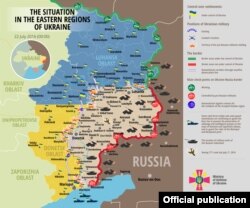
Here is today's map of the security situation in eastern Ukraine, according to the National Security and Defense Council (CLICK TO ENLARGE):
Night Fighting In Eastern Ukraine
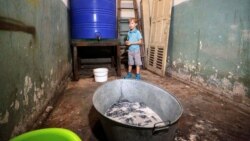
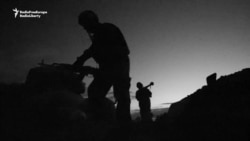
Ukrainian government forces and Russia-backed separatists exchanged mortar and machine-gun fire for two hours, amid a sharp increase in fighting. (RFE/RL's Ukrainian Service)

Thousands Stand In Line To Mourn Slain Journalist Pavel Sheremet In Kyiv
By Christopher Miller
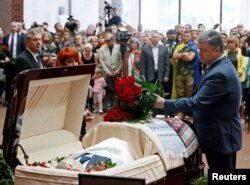
KYIV -- Thousands of mourners strode in a solemn procession through Kyiv’s Ukrainian House on July 22 to honor journalist Pavel Sheremet, who was killed in a car bombing that has shaken Ukraine’s media community and sent shock waves into Russia and Belarus.
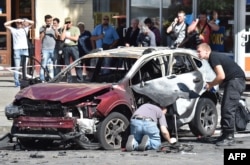
Sheremet, a journalist at news website Ukrayinska Pravda, was driving to a radio station to do a morning show two days earlier when the bomb exploded. The Interior Ministry said the explosives were “skillfully” planted underneath the car and that the blast may have been set off by a “remote-controlled or delayed-action” detonator.
Surveillance footage showing what media reports said was the placement of a bomb under the car the night before the blast was posted on the Internet, but there was no word on suspects or a specific motive. Colleagues believe Sheremet was targeted for his work as a journalist.
Europol and the FBI are assisting Ukraine in investigating Sheremet’s slaying.
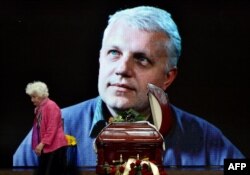
“We never thought something like this would happen,” Nataliya Humenyuk, co-founder of the independent Hromadske.tv channel and a friend of Sheremet, told RFE/RL as she stood beneath a giant photograph of him smiling and flashing a peace sign.
Most of those paying their last respects to Sheremet were Ukrainians, but there were also Russian and Belarusian citizens in attendance. The 44-year-old had previously worked in Russia and his native Belarus, where he faced pressure from the authorities for his reporting.
Mourners included family, friends, colleagues, lawmakers, and government officials, among them President Petro Poroshenko. Members of Ukraine’s military and volunteer battalions set up to fight against Russia-backed separatists in the east also came out to bid him farewell.
Some carried carnations of yellow and blue -- Ukraine’s national colors. Others brought red and white roses. Mourners brought the flowers in even numbers, as is customary for grieving and funerals, and mounds of them spilled off a table.
Tears flowed as people approached Sheremet’s open casket. Many stopped momentarily to cross themselves and say a little prayer. Some laid a gentle hand atop the coffin. They choked up as they looked down at the body of the journalist, dressed in a dark suit and tie and resting atop a bed of red and white roses.
Before walking away, mourners embraced Sheremet’s longtime partner and colleague, Ukraynska Pravda editor Olena Prytula, and whispered their condolences in her ear. Prytula was accompanied by members of Sheremet’s family and close friends.
Nearby, a candle flickered beside a bunch of golden sunflowers and a black-and-white photograph of Sheremet smiling. A digital screen played a slideshow of scenes from his life: speaking at a protest in Minsk in the 1990s before a poster of a scowling President Alyaksandr Lukashenka; looking over the shoulder of a colleague typing away in one of the many newsrooms he worked in over the years; wearing a wide smile and curly wig at a costume party; strumming a guitar.
Addressing mourners, lawmaker and former journalist Mustafa Nayyem said that Sheremet’s legacy would live on despite his death.
“He will always be with us,” he said.
Anatoliy Hrytsenko, an independent member of parliament and former defense minister, recalled Sheremet as a “brave and honest man.” He said his killing was a “terrorist act” and the investigation into the crime would be a “test” for Ukrainian law enforcement and, in particular, Interior Ministry Arsen Avakov.
Because the car Sheremet was driving belonged to Prytula, law enforcement are investigating the possibility that she was the target of the attack, among other theories. She has been provided a security detail for protection.
But the ZN.ua and Ukrayinska Pravda news sites cited an unidentified law-enforcement source as saying, based on a preliminary examination of the evidence, that Sheremet appears to have been the intended target of the bombing.
The source told the news outlets that a surveillance camera near the home of Sheremet and Prytula recorded the moment an unidentified person placed an explosive device under Prytula’s car the night before the blast.
A blurry video posted on the Internet later on July 22 shows at least two figures, one possibly female, walking near parked cars with what looks like a suitcase. One figure appears to lean over a car.
Sheremet drove Prytula’s car to the Radio Vesti office at the same time each morning five days a week, a routine that was likely known to attackers, the ZN.ua and Ukrayinska Pravda reports cited the source as saying.
The source also said that an examination of the remains of the car, as well as an autopsy of Sheremet’s body, indicate that the bomb was intended solely to target the driver.
“If the blast of the explosion had gone downward, it would have been essentially extinguished in the ground, but it blew upward and to the left,” the source was quoted as saying. “This was an attack meant exclusively for the victim of the killing.”
An autopsy showed that Sheremet suffered “incompatible with life,” the source said. He died because of a “rapid and critical” loss of blood in about one to two minutes.
Sheremet's body was to be repatriated to Belarus, where a funeral service will be held in the capital, Minsk, on July 23. Sheremet will be laid to rest beside his father.
Reupping Christopher Miller's excellent profile of Nadia Savchenko:
Good morning.
Big news from yesterday:
By RFE/RL
Nadia Savchenko, the Ukrainian military officer who became a national hero after spending nearly two years in a Russian prison, called for reconciliation to end the conflict in eastern Ukraine, sparking outrage among some lawmakers.
Savchenko, who was elected to parliament while in prison, said in an interview broadcast July 21 on Ukraine’s Channel Five that Ukrainians must “ask for forgiveness.” Otherwise, she said, the violence that has gripped the country’s Donbas region since April 2014 would continue.
Her comments infuriated nationalist lawmakers and others, including Anton Herashchenko who also serves as an aide to the Interior Ministry.
“You, Nadia, are able to ask for forgiveness of …. Russians who came to our lands to kill and rape, but we will never ask forgiveness of the occupiers and terrorists,” he wrote on his Facebook page. “We will, through clenched teeth, hold on and achieve the emancipation of our lands by any means!”
Savchenko, who worked with a Ukrainian military air unit, was captured in June 2014, and put on trial in Russia, charged with the killing of two Russian reporters covering the war.
Freed in May as part of a prisoner swap, she returned to a hero's welcome, and has spoken out regularly, calling for direct peace talks with Russia-backed separatists in the east.
More than 9,400 people have been killed in the fighting, according to United Nations figures.