



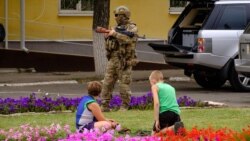
Another uptick in violence?
The new U.S. secretary of state has been meeting with the Russian foreign minister. Our news desk has this report:
Tillerson Tells Lavrov U.S. Expects Russia To Meet Ukraine Commitments
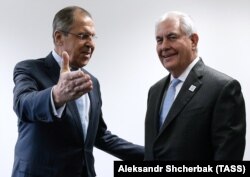
U.S. Secretary of State Rex Tillerson has told his Russian counterpart that the Kremlin must adhere to its commitments on Ukraine if there is to be cooperation between Moscow and President Donald Trump’s administration.
Speaking on February 16 after talks in Bonn with Foreign Minister Sergei Lavrov, Tillerson said the United States was ready to work with Russia "when we can find areas of practical cooperation that will benefit the American people."
But the U.S. secretary of state said "where we do not see eye-to-eye, the United States will stand up for the interests and values of America and her allies."
Tillerson also said that amid the "search for new common ground" by the Kremlin and Washington, Trump's administration expects Russia "to honor its commitment to the Minsk agreements on eastern Ukraine and work to de-escalate violence in Ukraine."
Moving Ahead 'Where Interests Coincide'
Tillerson and Lavrov's February 16 talks were on the sidelines of a Group of 20 (G20) meeting of foreign ministers in Bonn, Germany.
Lavrov said after the meeting that the two spoke about issues related to Syria, Ukraine, and Afghanistan -- and that they agreed they "must move ahead" where interests coincide.
But he said that "all disagreements cannot be settled at once."
Lavrov also said he and Tillerson did not discuss the issue of sanctions imposed against Russia by the United States over the Kremlin's intervention in eastern Ukraine and its annexation of Ukraine's Crimean Peninsula.
The Russian foreign minister said he assumes there will be a meeting soon between Trump and Russian President Vladimir Putin.
But Interfax quoted an aide to Putin as saying that there was "no agreement or clear understanding" about a Putin-Trump meeting.
While the top diplomats from Moscow and Washington were meeting in Bonn, the top two military officers from the United States and Russia got together for face-to-face talks in Baku, Azerbaijan.
The meeting between General Joseph Dunford, the chairman of the U.S. Joint Chiefs of Staff, and his counterpart, Russian General Valery Gerasimov, focused on what Dunford’s office described as "the current state of U.S.-Russian military relations and the importance of consistent and clear military-to-military communication to prevent miscalculation and potential crises."
'Restoring Dialogue'
Russia’s Defense Ministry said after the Baku talks that the two generals had agreed on a course aimed at easing tensions between their countries.
It also said Gerasimov and Dunford had agreed to continue contacts.
Russian President Vladimir Putin said earlier on February 16 that Russia and the United States would benefit from restoring communications between their intelligence agencies to bolster the fight against terrorism.
"It's in everyone's interest to restore dialogue between the intelligence agencies of the United States and other members of NATO," Putin told Russia's Federal Security Service (FSB), in televised remarks at a meeting of the service in Moscow.
"It's absolutely clear that in the area of counterterrorism all relevant governments and international groups should work together," Putin said.
Relations between the United States and Russia sunk to post-Cold War lows and many ties were broken after Russia's illegal annexation of Crimea in 2014 and as a result of Moscow's ongoing support of separatist fighters in eastern Ukraine.
U.S. Defense Secretary Jim Mattis said on February 16 after a Brussels meeting of NATO defense ministers that the United States is not "in a position right now to collaborate on a military level" with Russia.
Mattis said "political leaders will engage and try to find common ground or a way forward where Russia is living up to its commitments, will return to a partnership of sorts here with NATO. But Russia is going to have to prove itself first and live up to the commitments they have made in the Russia-NATO agreement."
With reporting by RFE/RL correspondents Mike Eckel in Washington and Rikard Jozwiak in Brussels, Reuters, AP, AFP, Interfax, and TASS
Here's a new item from RFE/RL's news desk:
Ukraine President Vows To Resume Coal Supply From East

Ukrainian President Petro Poroshenko has pledged to resume coal supplies from separatist-controlled parts of the country after they were blocked by volunteer fighting battalions, threatening the country's power supply.
Ukraine declared a state of emergency in its energy sector on February 15, with Energy Minister Ihor Nasalyk calling on all residents and industries to immediately try to save electricity.
Russia-backed separatists control areas of the Donetsk and Luhansk regions in eastern Ukraine nearly three years after the start of their fight against Kyiv’s forces that has killed more than 9,750 people.
Despite the hostilities, Kyiv continued to buy coal from areas controlled by separatists as power stations in Ukraine are mostly designed to run on the specific type of coal that is produced there.
Sales were suspended when volunteer battalions and some lawmakers blocked a railroad that brings coal across the front line late last month.
Poroshenko said the lack of coal from the Donbas risks leaving entire towns without heating and he pledged to resume the supply's flow.
Prime Minister Volodymyr Groysman said about nine out of the 24 million tons of coal that Ukrainian power stations require every year are imported from the separatist-controlled areas.