



Quite a bit of news from Ukraine this morning. Let's start with this story from our News Desk:
Ukraine's Suspended Tax Chief Released On $3.7 Million Bail
By RFE/RL's Ukrainian Service
Ukraine's suspended tax and customs service chief, Roman Nasirov, has been released on bail from his two-month pretrial detention on embezzlement charges.
Nasirov's wife paid 100 million hryvnyas ($3.7 million) bail for Nasirov's release. He should now be transferred to house arrest.
In a rare attempt to prosecute a high-level official in Ukraine over alleged corruption, Nasirov is being investigated on suspicion of defrauding the state of 2 billion hryvnyas ($74 million).
Nasirov was suspended from his post on March 3 and a district court in Kyiv on March 7 ordered him placed in pretrial detention for two months.
Ukraine’s National Anticorruption Bureau says Nasirov signed off on grace periods for a number of taxpayers, including companies linked to a former lawmaker who fled the country in 2016 while facing a corruption investigation.
President Petro Poroshenko and Ukraine’s government are under pressure from Ukrainians and Western countries to fight corruption.
Critics say corruption runs so deep in Ukraine that it hurts the country’s chances of throwing off the influence of Russia, which seized the Crimean Peninsula in 2014 and backs separatists in eastern Ukraine.
That concludes our live-blogging of the Ukraine crisis for Thursday, March 16, 2016. Check back here tomorrow for more of our continuing coverage. Thanks for reading and take care.
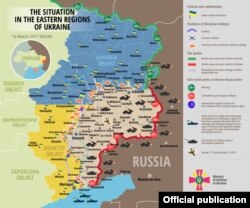
Here is today's map of the security situation in eastern Ukraine, according to the National Security and Defense Council:
'We Should Never Trust Russia,' Warns U.S. Ambassador To UN
By RFE/RL
WASHINGTON -- The U.S. ambassador to the United Nations says Washington should "never trust Russia," the latest in a series of hawkish statements that have made her a leading Russia critic in President Donald Trump's administration.
The statement by Nikki Haley in a television interview broadcast on March 16 came on the same day that the U.S. State Department issued a stern condemnation of Russia's 2014 annexation of Ukraine’s Crimea territory, which Haley has also publicly denounced.
Haley's comments also came amid the ongoing furor over what U.S. intelligence calls a Kremlin-directed campaign to meddle in last year's presidential election aimed at helping Trump defeat Democratic rival Hillary Clinton.
The Kremlin denies the charge.
After expressing initial skepticism, Trump conceded that he believes Russia was behind a hacking-and-propaganda effort to interfere in the election but that the operation did not influence the outcome of the vote.
Asked by the U.S. television network NBC what Trump should do about Russia's actions, Haley said: "Take it seriously."
"We should never trust Russia," she said, while adding that the United States needs "all the facts" in order to formulate a proper response to Moscow.
NBC asked whether Haley was on the same page with Trump "in terms of your level of distrust for Russia and [President] Vladimir Putin."
"I would not say that,” Haley replied. "I'm not going to talk about where the president is, because I don't know."
Throughout his campaign, Trump spoke positively about Putin and pledged to seek better relations with Russia.
Both Republicans and Democrats in Congress expressed concerns that a potential softer U.S. line on Russia under Trump could effectively give Moscow a pass for its expansionism in Ukraine.
U.S. Denounces Russia's Crimea Annexation On Referendum Anniversary
By Carl Schreck
WASHINGTON -- The United States on March 16 issued a sharp condemnation of Russia’s seizure of Crimea and the referendum that Moscow staged there and later held up as justification for its annexation of the Black Sea peninsula.
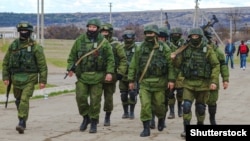
The denunciation by the U.S. State Department came on the third anniversary of the referendum organized following the seizure of key government buildings in Crimea by Russian special forces without insignia after former Ukrainian President Viktor Yanukovych fled to Russia amid mass street protests across the country.
It was also the latest example of the continuation of Washington’s tough public stance on Crimea that President Donald Trump, who has pledged to seek better ties with Moscow, inherited from his predecessor, Barack Obama.
"The United States does not recognize Russia's 'referendum' of March 16, 2014, nor its attempted annexation of Crimea and continued violation of international law," State Department spokesman Mark Toner said in a statement. "We once again reaffirm our commitment to Ukraine's sovereignty and territorial integrity."
Trump said during his campaign that he would like to boost cooperation with Russia on a range of issues, including counterterrorism, and that he would seek to make a deal a "that's great -- not good, great -- for America, but also good for Russia."
Trump’s stated desire for rapprochement with Moscow -- and his suggestion that he could consider lifting sanctions imposed by the Obama administration on Russia in response to the Crimea annexation -- has rattled European allies who fear he could turn a blind eye to Russian expansionism.
Less than two months into Trump’s presidency, however, there is no public indication that his administration is giving ground on Crimea. Senior members of his cabinet -- most notably his ambassador to the UN, Nikki Haley -- have publicly denounced Russian "occupation of the peninsula."
In his March 16 statement, Toner said Washington "again condemns the Russian occupation of Crimea and calls for its immediate end."
"Our Crimea-related sanctions will remain in place until Russia returns control of the peninsula to Ukraine," he said.
Speaking to reporters in Moscow the same day, Kremlin spokesman Dmitry Peskov dismissed the possibility that Crimea could be returned to Ukraine under some sort of deal with the United States.
The Trump administration has also continued the Obama administration’s stiff opposition to Russia’s backing of armed separatists in eastern Ukraine in a conflict that has killed more than 9,750 since April 2014.
Earlier on March 16, the European Parliament called on Moscow to free more than two dozen "illegally and arbitrarily detained" Ukrainian citizens, "both in Russia and in the temporarily occupied territories of Ukraine, and to provide for their safe return."