



Latest from our news desk on Nasirov:
KYIV -- Ukraine's suspended tax and customs service chief, Roman Nasirov, was summoned to the National Anti-Corruption Bureau (NABU) for questioning on March 17.
In a rare attempt to prosecute a high-level official in Ukraine over alleged corruption, Nasirov is being investigated on suspicion of defrauding the state of 2 billion hryvnyas ($74 million).
The summons came a day after he was released from pretrial detention when his family paid his 100-million-hryvnya ($3.7 million) bail -- a record high in Ukraine.
NABU said on March 17 that it has lodged an official request with the State Service for Fiscal Monitoring to find out where his relatives came up with the money.
Upon his release on March 16, Nasirov told journalists that the case against him is "politically motivated" and said he would fight to prove his innocence. http://www.radiosvoboda.org/a/28374256.html
"I am thankful to my family that they somehow managed to find this crazy amount of money," he said. "Now I have a better opportunity to quickly and fully prove my absolute innocence and the absolute groundlessness of the allegations."
Nasirov was suspended from his post on March 3, and a district court in Kyiv on March 7 ordered him placed in pretrial detention for two months.
NABU says that Nasirov signed off on grace periods for a number of taxpayers, including companies linked to a former lawmaker who fled the country in 2016 while facing a corruption investigation.
During earlier court hearings related to Nasirov's pretrial arrest, dozens of activists rallied in Kyiv to ensure Nasirov does not escape trial. That was not the case when Nasirov's was released long after dark on March 16.
Officials had said that Nasirov would be placed under house arrest if he made bail, but the Specialized Anti-Corruption Prosecutor's office (SAP) said on March 16 that he would not be confined to his home.
It said that he had been fitted with an electronic monitoring device. and he will be allowed to move around the city of is residence -- Kyiv.
https://www.facebook.com/sap.gov.ua/photos/a.836519139784604.1073741828.836354983134353/877575582345626/?type=3&theater
He is barred from leaving the city without investigators' permission, hand in travel documents so that he cannot leave Ukraine, and contact or communication with people involved in the probe.
President Petro Poroshenko’s government is under pressure from Ukrainians, Western governments, and groups such as the International Monetary Fund (IMF) to fight corruption.
Observers say corruption harms the economy and hurts Ukraine's chances of throwing off the influence of Russia, which seized Crimea in 2014 and backs separatists whose war against government forces has killed more than 9,900 people in eastern Ukraine.
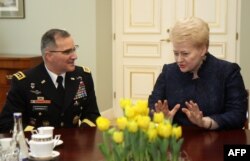
Lithuania Wants NATO Command To Move Closer To Eastern Borders
Lithuania’s president says NATO should move its command centers closer to the alliance’s eastern borders to deter the "growing threat from Russia."
President Dalia Grybauskaite on March 16 said NATO’s current location in Western Europe is a relic of the Cold War and that more forces should be redeployed.
"The current NATO command structures and military forces were positioned according to the Cold War logic -- in Europe's west and south," Grybauskaite said after talks with U.S. General Curtis Scaparrotti, NATO's supreme allied commander.
With the "growing threat from Russia, it is necessary to redeploy allied forces to the eastern flank," she said.
She said NATO has been "too slow" to redeploy its command structure from Western Europe.
Scaparrotti told reporters that advanced technologies enable the Western military alliance "to command and control from different locations."
Since World War II, U.S. and NATO forces have been stationed in Western Europe, mainly in Germany, Britain, and Italy.
But NATO is beefing up its presence in Eastern Europe, deploying four multinational battalions to the Baltic states and Poland on a rotational basis in an effort to reassure Eastern members in the face of Russia's military support for separatists in eastern Ukraine and its illegal annexation of Ukraine's Crimean Peninsula.
Hundreds of NATO troops and heavy equipment have been moved to Lithuania as part of that process.
Based on reporting by AFP and dpa
EU Releases 600 Million Euros In Aid To Shore Up Shaky Ukraine Economy
The European Commission has agreed to send Ukraine 600 million euros to shore up its deteriorating economy, ending months of delays over conditions linked to the loan.
With Ukraine in a third year of war, the European Union softened demands that Kyiv first lift a ban on Ukrainian wood exports, saying the money could now be sent because the government had submitted a bill to change that policy.
"Ukraine has done a remarkable job of stabilizing and reforming its economy, despite the armed conflict unfolding on its soil," Commission Vice President Valdis Dombrovskis said on March 16.
The conditions the EU has attached to the aid are aimed at modernizing the economy and ridding Kyiv of entrenched corruption.
The aid payment takes the total of EU loans to Ukraine to 2.8 billion euros since 2014. Kyiv badly needs the money. It estimates that a blockade of trade with eastern areas held by Russia-backed separatists that was announced this week would cause the economy to shrink by 2 percent.
In February, European Commission President Jean-Claude Juncker promised to release the aide to Ukrainian Prime Minister Volodymyr Hroysman. A final 600 million euro disbursement is still available under an aid package that expires next January.
Based on reporting by AFP and Reuters
OSCE Prolongs Mission In Ukraine By One Year, Amid Rising Tensions
The Organization for Security and Cooperation in Europe on March 16 prolonged its monitoring mission in Ukraine by one year -- until March 2018.
Three years after Moscow illegally annexed the Crimean region, tensions between Ukraine and Russia-backed separatists are still high and a 2015 cease-fire agreement is violated regularly.
Fighting has claimed the lives of at least 20 civilians since the start of the year and wounded almost 100 more, according to the United Nations. In recent weeks, the observers have reported a deteriorating security situation in eastern Ukraine and an increase in the number of cease-fire violations.
The unarmed, civilian OSCE mission, with more than 700 international observers, seeks to reduce tensions and report on the situation on the ground. The 57 member states of the OSCE, which include Ukraine, Russia, and the United States, decided by consensus to extend the mandate of the mission until March 31, 2018, the OSCE said.
The mission was first deployed in 2014 and this was its third extension. It will have a budget of 105.5 million euros for the year, enabling the staff to upgrade monitoring equipment.