



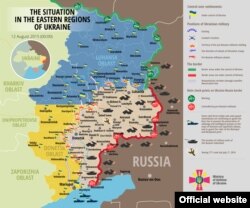
Here is today's map of the security situation in eastern Ukraine, according to the National Security and Defense Council (CLICK TO ENLARGE):
Increased NATO, Russian Military Drills Raising Tensions
By RFE/RL
The increase in the scale and number of military exercises by NATO and Russia is making armed conflict in Europe more likely, a think tank has warned.
Ian Kearns, director of the London-based European Leadership Network, said that war games "are contributing to a climate of mistrust" that have "on occasion become the focal point for some quite close encounters between the NATO and Russian militaries."
Kearns is one of the co-authors of a study which looks in detail at two military exercises held this year by Russia and the North Atlantic Treaty Organization. He found signs that "Russia is preparing for a conflict with NATO, and NATO is preparing for a possible confrontation with Russia."
The exercises "can feed uncertainty" and heighten the risk of "dangerous military encounters," the study said.
Relations between Russia and the West have been in the deep freeze since Russia's annexation of Crimea from Ukraine last year. The war in Ukraine has prompted NATO to create command units across Eastern Europe, while Russia has recalibrated its military goals toward the transatlantic alliance, which it accuses of approaching its borders.
The study said NATO is planning around 270 exercises this year, while Russia has announced 4,000 drills at all levels.
The Russian exercise in March involved 80,000 personnel, while NATO's Allied Shield in June mobilized 15,000 people from 19 NATO countries and three partner states.
The study said NATO and Russia should communicate better on plans to hold military drills to lessen the risk of incidents. It recommended limiting exercises in border areas.
The study said the exercises showed what each side views as its most vulnerable points. For NATO, it's Poland and the Baltic states, while for Russia concerns are more numerous and include the Arctic, Crimea, and border areas with NATO members Estonia and Latvia.
The think tank offered a few ideas to try to defuse tensions, including for governments to examine the need for more restraint in the size and scenarios of future exercises.
"History is full of examples of leaders who think they can keep control of events, and events have a habit of taking on a momentum and dynamic of their own," said Kearns.