



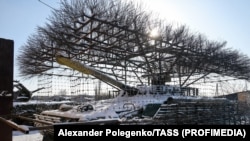

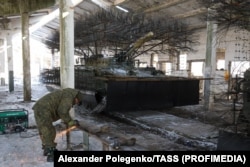
Photos from a workshop in the Russian-occupied Zaporizhzhya region offer the clearest images yet seen of "hedgehog armor" and reveal the real-time evolution of anti-drone adaptations in Ukraine.
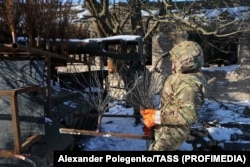
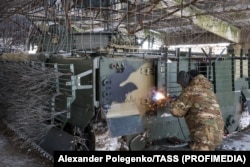
The photos, released on January 22 by the Russian state-owned TASS news agency, show lengths of steel cable cut and frayed into what Russian mechanics describe as "daisies" being welded onto armored vehicles.
Yevhen, a Ukrainian drone operator currently in the Donbas region who fights under the call sign "Krym," explained in a voice message on January 26 that the metal spikes of hedgehog armor can twist incoming drones in a different direction on impact.

"When a drone targets the vehicle, there's a high probability the shaped charge jet [of the armor-piercing warhead] will miss its mark," Yevhen said. The hypersonic blast of a shaped charge is most effective when it hits armor square-on, rather than at an angle.
Additionally, Yevhen, who has fought for Ukraine since 2022, says that a drone impacting the spiky armor "detonates at a distance [from the vehicle skin], which causes the shaped charge to lose its effectiveness."
Other iterations of hedgehog armor featured denser coverings than those seen in the Zaporizhzhya images. One such Russian tank (below) was captured by Ukraine's 92nd Assault Brigade in January.
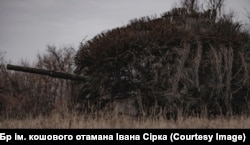
Yevhen says that for densely covered tanks such as these the hedgehog armor "pulls double duty: It shields the vehicle from FPV drone strikes while providing excellent camouflage" from reconnaissance drone pilots scanning the tree line for manmade shapes.
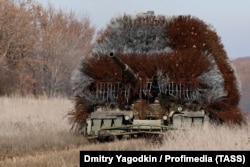
But such heavy coverings have reportedly led to breakdowns due to the strain on the mechanical operation of vehicles. One Russian tanker told a reporter a hedgehog tank "didn't even make it 10 kilometers before one of the [drivetrain components] failed."

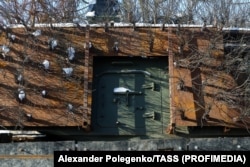
The January workshop photos show vehicles being fitted with a combination of hedgehog armor that is less dense than earlier versions, and lightweight netting.

Hedgehog armor has been adopted on both sides of the Ukraine conflict and reports of Russian hedgehog tanks absorbing dozens of hits from FPV drones were confirmed to RFE/RL in December by a Ukrainian press officer.

