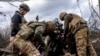
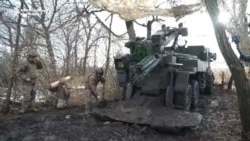
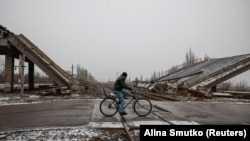
The eastern Ukrainian city of Pokrovsk has been largely emptied of civilians as Russian forces have approached. It's unclear whether Russia intends to assault the city or simply bypass it.
Outflanked, overwhelmed, and almost overrun, Ukrainian forces are struggling to hold back a Russian army that has more men, more firepower, and overall momentum across frozen fields and muddy trenches in eastern Ukraine.
“The war has tilted in Russia’s favor, and Russia is pressing its armaments and manpower advantage relentlessly,” Max Bergmann, director of the Europe, Russia, and Eurasia Program at the Center for Strategic and International Studies in Washington, wrote last month. “There is now little reason for Russia to negotiate, as [Putin] likely believes he can win the war -- which, in his view, means the subjugation of Ukraine under Russian control.”
Here’s a look at where things stand on the battlefield at the start of the New Year.
Pokrovsk
In more tranquil times, the city on the western edges of Donetsk Oblast was known for its coal mines, coke factories, and metallurgical plants, as well as being home to a key railway juncture, and at the crossroads of several major roads. (It’s also known as the place where, in the early 20th century, composer Mykola Leontovychwrote the Christmas song known as Shchedryk in Ukrainian, but as the Carol of the Bells around the world.)
After capturing Avdiyivka to the east earlier this year, Russian forces moved west and northwest in a bid to cut Ukrainian logistics lines. Running west, the E50 highway links Pokrovsk to the larger urban center of Dnipro, Ukraine’s fourth largest city. Running east and northeast, the T0504 highway links Pokrovsk to Kostyantynivka, another major railway junction that Russia is gunning for.
“The Pokrovsk direction…remains one of the most intense and contested areas of the theater,” Frontelligence Insight, an analytic organization run by a former Ukrainian reserve officer, said in a battlefield report. “Following Russian inability to seize the city directly…Russian forces have turned to a familiar tactic: flanking maneuvers.”
"The enemy is not counting on fighting in Pokrovsk right now, but is trying to bypass the city and break the supply chains," Viktor Trehubov, a spokesman for Ukraine’s Khortytsia command group, told a state-run TV broadcast on January 2.
Fear And Hope As Battle For Ukraine’s Pokrovsk Looms
1/17A woman walks through a suburb of Pokrovsk in early December.
In the early days of the full-scale Russian invasion my colleagues and I had based ourselves in Pokrovsk, where cafes, restaurants, and shopping centers offered a respite from the front lines. Now we are watching it die. Since 2022, I’ve seen many cities overtaken by war. Some fall quickly and disappear from the headlines, others hold on to the bitter end: Syevyerodonetsk, Lysychansk, Soledar, and others familiar only to the military and journalists. Now Pokrovsk is on that list.
Russian forces have neared the outskirts of Pokrovsk, a strategically important transportation and logistics hub in Ukraine’s eastern Donetsk region. Once home to more than 60,000 people before Russia's full-scale invasion of Ukraine in February 2022, only a fraction of this population now remains in the embattled city. Photojournalist Serhiy Nuzhnenko recently visited Pokrovsk with a colleague from RFE/RL's Donbas.Realities and talked to some residents who are still living there.
Show moreShow less
2/17A woman rides past a cinema with a banner declaring “Pokrovsk -- the strength of the Cossack clan.”
A curfew is in place in Pokrovsk from three in the afternoon until 11 a.m. the next day. As soon as the curfew is lifted we park our car and walk through the city streets. Only a handful of people are out and about. In the background, artillery can be heard working to the south and east, where Russian forces are advancing from both directions.
Russian forces have neared the outskirts of Pokrovsk, a strategically important transportation and logistics hub in Ukraine’s eastern Donetsk region. Once home to more than 60,000 people before Russia's full-scale invasion of Ukraine in February 2022, only a fraction of this population now remains in the embattled city. Photojournalist Serhiy Nuzhnenko recently visited Pokrovsk with a colleague from RFE/RL's Donbas.Realities and talked to some residents who are still living there.
Show moreShow less
3/17Many shops here are closed and apparently abandoned. Svitlana Yaroslavovna (pictured) operates one that is still open, selling sweets, milk and sausage. “When it’s quiet, I get nervous. It feels like maybe the military are surrendering us. I hope they don’t,” she confides after making us coffee. “Because [the nearby settlements of] Novohrodivka and Selydove were both surrendered very quickly even though there were fortifications there. I’m not a soldier, but I wish they hadn’t allowed them to fall."
Russian forces have neared the outskirts of Pokrovsk, a strategically important transportation and logistics hub in Ukraine’s eastern Donetsk region. Once home to more than 60,000 people before Russia's full-scale invasion of Ukraine in February 2022, only a fraction of this population now remains in the embattled city. Photojournalist Serhiy Nuzhnenko recently visited Pokrovsk with a colleague from RFE/RL's Donbas.Realities and talked to some residents who are still living there.
Show moreShow less
4/17"Dragon's teeth" anti-tank obstacles in Pokrovsk.
Suppliers for Yaroslavovna's grocery shop still come every weekday, she tells us, but some drivers are afraid to come into the city center. “We meet them behind the bridge and transfer the products, then drive them in ourselves.”
If Russian troops keep pushing closer, Yaroslavovna says, “I’ll close the shop and flee with the dogs and cats that I’m looking after here. I definitely won’t live here under the Russians, if the front gets any closer. But for now, I’ll be here for as long as I can."
Russian forces have neared the outskirts of Pokrovsk, a strategically important transportation and logistics hub in Ukraine’s eastern Donetsk region. Once home to more than 60,000 people before Russia's full-scale invasion of Ukraine in February 2022, only a fraction of this population now remains in the embattled city. Photojournalist Serhiy Nuzhnenko recently visited Pokrovsk with a colleague from RFE/RL's Donbas.Realities and talked to some residents who are still living there.
Show moreShow less
5/17The city slowly comes to life as we continue walking, people are appearing, carrying water and food. A makeshift market is operating nearby. It feels almost like any normal winter morning in a provincial eastern town, only the booming of nearby explosions offers a constant reminder of the situation in Pokrovsk.
Russian forces have neared the outskirts of Pokrovsk, a strategically important transportation and logistics hub in Ukraine’s eastern Donetsk region. Once home to more than 60,000 people before Russia's full-scale invasion of Ukraine in February 2022, only a fraction of this population now remains in the embattled city. Photojournalist Serhiy Nuzhnenko recently visited Pokrovsk with a colleague from RFE/RL's Donbas.Realities and talked to some residents who are still living there.
Show moreShow less
6/17In some suburbs there is still electricity and gas, but central heating no longer operates in Pokrovsk. People warm their apartments with electric heaters or gas burners.
Russian forces have neared the outskirts of Pokrovsk, a strategically important transportation and logistics hub in Ukraine’s eastern Donetsk region. Once home to more than 60,000 people before Russia's full-scale invasion of Ukraine in February 2022, only a fraction of this population now remains in the embattled city. Photojournalist Serhiy Nuzhnenko recently visited Pokrovsk with a colleague from RFE/RL's Donbas.Realities and talked to some residents who are still living there.
Show moreShow less
7/17The still smoldering remains of a building in Pokrovsk that was wiped out by a Russian glide bomb.
Donetskoblhaz JSC, the company that supplies gas and electricity to Pokrovsk says it is becoming increasingly difficult for their repair crews to work amid frequent shelling. The company announced that, as of December 12, it would suspend gas supplies due to “the consequences of hostilities on the gas distribution system.”
Russian forces have neared the outskirts of Pokrovsk, a strategically important transportation and logistics hub in Ukraine’s eastern Donetsk region. Once home to more than 60,000 people before Russia's full-scale invasion of Ukraine in February 2022, only a fraction of this population now remains in the embattled city. Photojournalist Serhiy Nuzhnenko recently visited Pokrovsk with a colleague from RFE/RL's Donbas.Realities and talked to some residents who are still living there.
Show moreShow less
8/17A Pokrovsk resident collects water from one of a handful of supply points in the city.
One of the biggest challenges for Pokrovsk's residents is sourcing water. Locals say that Russian forces destroyed water pumping stations outside the city in August 2022, and since then most water has been sourced from tankers organized by local government and aid organizations.
Russian forces have neared the outskirts of Pokrovsk, a strategically important transportation and logistics hub in Ukraine’s eastern Donetsk region. Once home to more than 60,000 people before Russia's full-scale invasion of Ukraine in February 2022, only a fraction of this population now remains in the embattled city. Photojournalist Serhiy Nuzhnenko recently visited Pokrovsk with a colleague from RFE/RL's Donbas.Realities and talked to some residents who are still living there.
Show moreShow less
9/17Anton, who came to collect water on his day off.
The local man evacuated his family but has remained to work at a mine in Pokrovsk that was still in operation in early December. “I think everyone is considering leaving. Only those who are waiting [for a Russian takeover] are not," he says. "I hope [Ukraine's military] will drive them away, and we can continue to live here."
Russian forces have neared the outskirts of Pokrovsk, a strategically important transportation and logistics hub in Ukraine’s eastern Donetsk region. Once home to more than 60,000 people before Russia's full-scale invasion of Ukraine in February 2022, only a fraction of this population now remains in the embattled city. Photojournalist Serhiy Nuzhnenko recently visited Pokrovsk with a colleague from RFE/RL's Donbas.Realities and talked to some residents who are still living there.
Show moreShow less
10/17Vasyl, an elderly local crossing an empty street in Pokrovsk.
“My friends have gone to the Dnipropetrovsk region,” he tells us. “The poor are suffering everywhere. No one needs people. This is a fight for territory, not people. I am 81 years old. I think if [the Russians] restore order there will be heat, gas, and so on. I am being very frank, but, people will have one hell of a time surviving [until then].”
Russian forces have neared the outskirts of Pokrovsk, a strategically important transportation and logistics hub in Ukraine’s eastern Donetsk region. Once home to more than 60,000 people before Russia's full-scale invasion of Ukraine in February 2022, only a fraction of this population now remains in the embattled city. Photojournalist Serhiy Nuzhnenko recently visited Pokrovsk with a colleague from RFE/RL's Donbas.Realities and talked to some residents who are still living there.
Show moreShow less
11/17A printed sign announces “pharmacy working” in Pokrovsk.
Along with pharmacies, cafes, and a bookstore, the biggest surprise was an Apple Store that was still operating in early December. Though perhaps as I’m writing this it has already closed down.
Russian forces have neared the outskirts of Pokrovsk, a strategically important transportation and logistics hub in Ukraine’s eastern Donetsk region. Once home to more than 60,000 people before Russia's full-scale invasion of Ukraine in February 2022, only a fraction of this population now remains in the embattled city. Photojournalist Serhiy Nuzhnenko recently visited Pokrovsk with a colleague from RFE/RL's Donbas.Realities and talked to some residents who are still living there.
Show moreShow less
12/17Bells in the cathedral begin to ring, calling the faithful to prayer and momentarily drowning out the sounds of war. The bells frighten a flock of pigeons which flap into the air then settle on the Soviet-era apartment block whose windows are boarded up with chipboard.
Russian forces have neared the outskirts of Pokrovsk, a strategically important transportation and logistics hub in Ukraine’s eastern Donetsk region. Once home to more than 60,000 people before Russia's full-scale invasion of Ukraine in February 2022, only a fraction of this population now remains in the embattled city. Photojournalist Serhiy Nuzhnenko recently visited Pokrovsk with a colleague from RFE/RL's Donbas.Realities and talked to some residents who are still living there.
Show moreShow less
13/17A local woman walking her dog.
Even after covering the war for years, moments like this, showing hope for life amid destruction and death are always surprising. The animals seem to be accustomed to the backdrop of explosions and show no signs of fear.
Russian forces have neared the outskirts of Pokrovsk, a strategically important transportation and logistics hub in Ukraine’s eastern Donetsk region. Once home to more than 60,000 people before Russia's full-scale invasion of Ukraine in February 2022, only a fraction of this population now remains in the embattled city. Photojournalist Serhiy Nuzhnenko recently visited Pokrovsk with a colleague from RFE/RL's Donbas.Realities and talked to some residents who are still living there.
Show moreShow less
14/17"We live, we keep hoping,” Valentyna Vasylivna (pictured) tells us as she walks through her war-damaged city. “I have a pension of 2,700 hryvnias ($65) per month. Where would I go? My apartment walls keep me warm, this is my home.”
Russian forces have neared the outskirts of Pokrovsk, a strategically important transportation and logistics hub in Ukraine’s eastern Donetsk region. Once home to more than 60,000 people before Russia's full-scale invasion of Ukraine in February 2022, only a fraction of this population now remains in the embattled city. Photojournalist Serhiy Nuzhnenko recently visited Pokrovsk with a colleague from RFE/RL's Donbas.Realities and talked to some residents who are still living there.
Show moreShow less
15/17At Pokrovsk Railway Station the platforms are empty. This homeless man was trying to stay warm in a sleeping bag, and to get some sleep.
Russian forces have neared the outskirts of Pokrovsk, a strategically important transportation and logistics hub in Ukraine’s eastern Donetsk region. Once home to more than 60,000 people before Russia's full-scale invasion of Ukraine in February 2022, only a fraction of this population now remains in the embattled city. Photojournalist Serhiy Nuzhnenko recently visited Pokrovsk with a colleague from RFE/RL's Donbas.Realities and talked to some residents who are still living there.
Show moreShow less
16/17A man pushes a load of firewood. Behind him is the road towards Shevchenko, where Russian forces are currently advancing from the south.
Some civilians we spoke to told us of friends and neighbours who are returning to Pokrovsk despite the city's precarious situation. Some couldn't find work elsewhere and ran out of money; others couldn't get used to living away from their hometown. Many say the only state help that registered refugees receive is a payment of 11,000 hryvna, ($265) and those people who leave by their own means cannot even count on this.
Russian forces have neared the outskirts of Pokrovsk, a strategically important transportation and logistics hub in Ukraine’s eastern Donetsk region. Once home to more than 60,000 people before Russia's full-scale invasion of Ukraine in February 2022, only a fraction of this population now remains in the embattled city. Photojournalist Serhiy Nuzhnenko recently visited Pokrovsk with a colleague from RFE/RL's Donbas.Realities and talked to some residents who are still living there.
Show moreShow less
17/17A road sign for Pokrovsk on the outskirts of the city.
We leave Pokrovsk with heavy hearts. It seems likely we could return soon to the city to film street battles. We remember the words of shopkeeper Svitlana Yaroslavovna: "I hold on to my faith in God, and the armed forces of Ukraine, this is where I place my hope."
Russian forces have neared the outskirts of Pokrovsk, a strategically important transportation and logistics hub in Ukraine’s eastern Donetsk region. Once home to more than 60,000 people before Russia's full-scale invasion of Ukraine in February 2022, only a fraction of this population now remains in the embattled city. Photojournalist Serhiy Nuzhnenko recently visited Pokrovsk with a colleague from RFE/RL's Donbas.Realities and talked to some residents who are still living there.
Show moreShow less
Previous slide
Next slide
Liam Collins, a retired U.S. Army Special Forces colonel, said Russian forces might try to skirt Pokrovsk in a rush to seize more territory before any peace talks: Pokrovsk itself is around 18 kilometers from the administrative border between the Donetsk and Dnipropetrovsk regions.
“The Russians, like just about any army, would prefer to bypass a city, cut off the supply lines to fighters inside and wait them out and force their eventual surrender without as much of a fight,” said Collins, author of the book Understanding Urban Warfare.
Kurakhove
About 30 kilometers south of Pokrovsk, Ukrainian forces have tried to use the Kurakhove Reservoir, which dams the Vovcha River, and connecting waterways, to slow Russian advances. Russian forces advanced along the north side of the reservoir in late November and December, and a dam at the reservoir’s western edge was partially destroyed -- it’s unclear whether by Ukraine or Russia.
On the reservoir’s southern shores, Ukrainian troops’ grip on the city of Kurakhove has slipped in the face of advancing Russian units from the east, and only the industrial districts in the western part of town remain under Ukrainian control. From the southwest, Russian forces have also threatened the H15 Donetsk–Zaporizhzhya highway, a major supply road running west out of Kurakhove.
Konrad Muzyka, a Polish-based military analyst who travels regularly to Ukraine, said Kyiv’s longstanding problems in replenishing troop strength are apparent in the Kurakhove defense.
“Although the terrain in this region favors defensive operations due to the presence of waterways, the ongoing Ukrainian personnel shortage prevents full utilization of these natural features to stall Russian advances,” he said in a post to X. “This lack of manpower also limits their ability to launch counterattacks, which could otherwise disrupt Russian momentum in the area.”
Kurakhove’s “defense is actually doomed,” said Mykhaylo Zhyrokhov, a Kyiv-based military analyst. “And now they’re maintaining its defense just for political reasons.”
“The fall of the city would be a very bad gift for the office of the presidency, it would very much drop trust ratings,” he said.
Mokri Yaly Valley
Further west from Kurakhove, the Mokri Yaly River meanders southward, crossed by a series of smaller bridges, and banked by a series of villages including Velyka Novosilka.
During their much-hyped 2023 counteroffensive, Ukrainian troops punched southward in several places, including along the Mokri Yaly Valley, advancing south of Velyka Novosilka, on the river’s east bank. But like the overall counteroffensive, the push faltered in the face of well-prepared Russian defense networks.
Russian forces pushed into the village’s eastern outskirts in early December. Further upriver, Ukrainian troops counterattacked and retook control of the village of Noviy Komar, which the important north-south O0509 road runs through, and which has the next river crossing north of Velyka Novosilka.
But the village remains heavily contested, according to open-source intelligence and Ukrainian and Russian reports, and the O0509 road is under fire from Russian artillery and drone strikes, limiting Ukraine’s ability to resupply.
The August invasion of Russia’s Kursk region fit that pattern. But it failed to accomplish one major goal: relieving pressure elsewhere by drawing away Russian units.
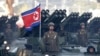
Russia, meanwhile, pulled its own surprise: bringing in thousands of North Korean troops to the battlefield, a move that itself helps relieve recruiting pressure inside Russia.
That threatens Ukrainian supply lines coming from the south, across the border.
In total, Ukrainian forces are estimated to have lost more than half of the territory they initially seized over the summer.
That ultimately could wipe another apparent goal that Ukrainian officials hoped would come from the invasion: using occupied Russian territory as a bargaining chip in future negotiations.
Mike Eckel is a senior international correspondent reporting on political and economic developments in Russia, Ukraine, and around the former Soviet Union, as well as news involving cybercrime and espionage. He's reported on the ground on Russia's invasion of Ukraine, the wars in Chechnya and Georgia, and the 2004 Beslan hostage crisis, as well as the annexation of Crimea in 2014.









![Many shops here are closed and apparently abandoned. Svitlana Yaroslavovna (pictured) operates one that is still open, selling sweets, milk and sausage. “When it’s quiet, I get nervous. It feels like maybe the military are surrendering us. I hope they don’t,” she confides after making us coffee. “Because [the nearby settlements of] Novohrodivka and Selydove were both surrendered very quickly even though there were fortifications there. I’m not a soldier, but I wish they hadn’t allowed them to fall." ](https://gdb.rferl.org/07682f19-0cca-4699-bb49-de631d02fd62_w1024_q10_s.jpg)


![Anton, who came to collect water on his day off.<br />
<br />
The local man evacuated his family but has remained to work at a mine in Pokrovsk that was still in operation in early December. “I think everyone is considering leaving. Only those who are waiting [for a Russian takeover] are not," he says. "I hope [Ukraine's military] will drive them away, and we can continue to live here."](https://gdb.rferl.org/55cfa829-1dc1-446b-ad5b-7f77dc02716d_w1024_q10_s.jpg)
![Vasyl, an elderly local crossing an empty street in Pokrovsk.<br />
<br />
“My friends have gone to the Dnipropetrovsk region,” he tells us. “The poor are suffering everywhere. No one needs people. This is a fight for territory, not people. I am 81 years old. I think if [the Russians] restore order there will be heat, gas, and so on. I am being very frank, but, people will have one hell of a time surviving [until then].” ](https://gdb.rferl.org/8610c9a8-c9a7-426e-9426-334a2bc9176d_w1024_q10_s.jpg)