



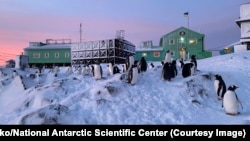

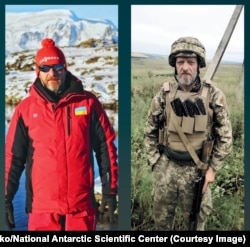
On a freezing day in the Ukrainian capital, Kyiv, Yuriy Lyshenko is amply equipped for the cold in a bright red jacket designed for the winters of Antarctica. "Now this frost has hit, I need to put it on," he laughs.
The 52-year-old is one of Ukraine's "military penguins," a small but growing contingent of men who have served on Ukraine's Antarctic research base and returned to their country to fight.
Ukraine's links to the coldest continent date back to the beginning of the previous century when Anton Omelchenko, born in the Poltava region of today's Ukraine, survived the ill-fated 1910-1913 British expedition to the South Pole.
During the Soviet period, Ukraine's Antonov aircraft company built specialized planes to support polar bases, and a factory in Kharkiv produced tracked vehicles for use in Antarctica.

A large portion of the researchers working at Soviet polar bases were Ukrainians, but when the USSR collapsed, all 12 of the Soviet Union's Antarctic bases were claimed by Russia.
Olena Marushevska, a spokeswoman for Ukraine's National Antarctic Scientific Center, says that through the early 1990s, "we had a lot of scientists who didn't have a place to work. But their specialization was Antarctic researcher."
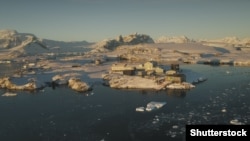
In 1996, the United Kingdom sold its Faraday research base, complete with its cozy British pub, to Ukraine for a single pound sterling. The deal came with the pledge that Ukrainian scientists would continue British studies, including a meteorological survey that had begun in 1947.
Ukraine named the base after Volodymyr Vernadsky, the first president of the Ukrainian Academy of Sciences. On February 6, the base marked the 30th anniversary of its official handover.
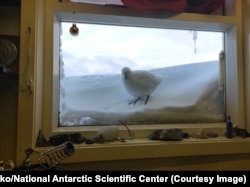
In late February 2022, Lyshenko was partway through the 15,000-kilometer journey to Vernadsky for his fourth deployment at the base when news broke that Russia had invaded.
Lyshenko's role as a diesel electrician on Vernadsky was impossible to fill at short notice, so for nearly a year he could only follow the news as Russian forces pushed toward his native city. "It was very difficult," Lyshenko recalled. "I'm from Kharkiv, my family was in Kharkiv, and I couldn't influence the situation in any way."
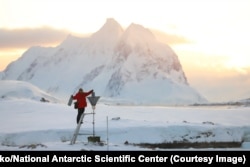
When his Antarctic expedition ended in the spring of 2023, Lyshenko returned to Ukraine and signed up to lead an infantry assault group.
In October that year, he was severely wounded by a Russian shell and had his right leg amputated. While recuperating in a hospital in Kyiv in January 2024, the Antarctic veteran again narrowly escaped death when a Russian Kalibr cruise missile slammed into his hospital ward just 15 meters from his bed. The missile's half-ton warhead failed to explode.
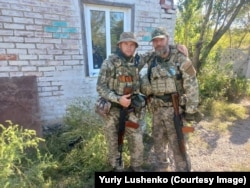
Lyshenko says that what he misses most from Antarctic life is the camaraderie. With a small crew of around a dozen people who endure deployments lasting 13 months in one of the loneliest landscapes on Earth, "the relationships between people there are beyond friendly: They become like family," Lyshenko says. "Because you work alongside these people 24/7 and you depend on each other, the friendships are such that you end up staying in touch all your life."
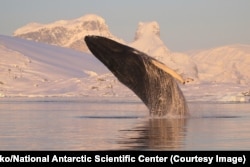
Despite walking on a prosthesis, Lyshenko returned to Vernadsky in February 2025 for a brief deployment due to staffing shortfalls.
"Unfortunately in terms of our personnel, we are not in a great situation because a lot of our guys are fighting," he said. Lyshenko has previously joked that his one-month deployment was as "an Antarctic pirate, with one leg and a penguin on my shoulder."
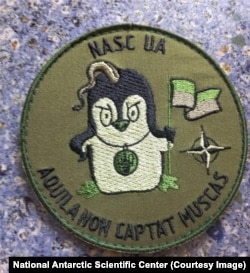
In total there are 32 scientists and technical specialists who have served deployments on Vernadsky and also fought for Ukraine. One of those currently serving at the front is Mykhaylo, whose military call sign is the somewhat inevitable "Biolog" (biologist).
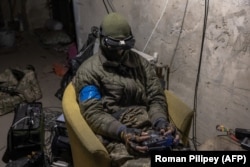
The marine biologist was deployed to Vernadsky in 2021 and is currently stationed at the front lines as a drone specialist.
"In a way, my work now [on the front lines] resembles scientific activity," he told RFE/RL. "I work with unmanned aerial vehicles. So we are doing something new and not understood by many. We go to remote, forgotten places and try to work in any weather."
But there he says, the similarities end.
"When you are on a combat mission, you cannot relax. Every sound can matter. Your every action can have tragic consequences."
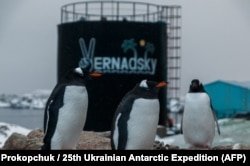
Mykhaylo's scientific career is now on ice, but he hopes to return to it soon. "I can't see my life without it," he says. "And, if my health allows, I want to go to Antarctica again."
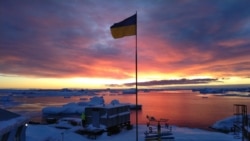

The Vernadsky base has come under criticism for its expense at a time when funds are needed for Ukraine's war effort. The country's National Antarctic Scientific Center has defended the costs of the Antarctic outpost, which is partly funded by foreign grants expressly forbidden to be used for military purposes.
"Ukraine is one of several dozen countries that have year-round stations in the Antarctic and the right to vote in the Antarctic Treaty," the organization said in a May 2024 statement, adding that "Russia has several stations in the Antarctic, finances all of them, and some of them are being modernized even during the war. They will be very happy if Ukraine stops exploring the Antarctic and participating in the Treaty."
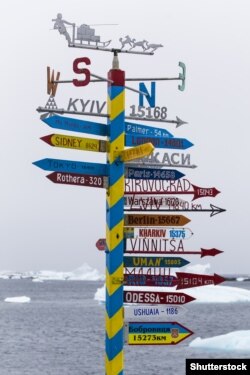
Spokeswoman Olena Marushevska told RFE/RL that as well as putting Ukraine on the map for polar research, the base serves as a significant soft power asset.
"For example, we have a lot of collaboration now with [Latin American countries] which are sometime neutral," she says. "They don't know who to support: us or Russia in the war."
As Ukraine collaborates with these countries on Antarctic research missions, she says, "they start to feel closer to us. They start to follow politics. They start to vote for us at different international platforms."
In the current geopolitical moment she says, the base "has become a really important international tool."

