




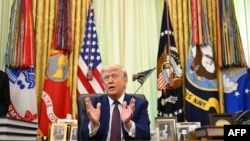
The US House of Representatives approved a war powers resolution aimed at curbing President Donald Trump's military campaign against Iran, delivering a bipartisan rebuke to the administration even as Secretary of State Marco Rubio insisted that US operations against Tehran had ended.
The House voted 215-208 on June 3 in favor of the measure, with four Republicans joining all Democrats in support.
The resolution, introduced by Representative Gregory Meeks of New York, directs Trump to remove US armed forces from hostilities with Iran unless Congress formally declares war or authorizes the use of military force.
The measure now heads to the Senate, where lawmakers are considering a separate war powers resolution. Even if approved by both chambers, Trump is expected to challenge efforts to limit his authority, and the House measure itself is largely viewed as symbolic because it does not carry the force of law.
Bipartisan Vote Signals Growing Congressional Pushback
The vote marked the strongest congressional rebuke yet of a conflict that has stretched beyond three months and fueled concerns about its economic and geopolitical consequences.
In a statement after the vote, Meeks argued that the military campaign had failed to achieve its stated objectives and had instead damaged diplomatic efforts aimed at resolving disputes over Iran's nuclear program.
"If anything, it has pushed a diplomatic resolution of Iran's nuclear program further away," he said.

The New York Democrat also pointed to rising fuel prices and the financial cost of the conflict, saying Americans were paying substantially more for gasoline while bearing the expense of a war that many oppose.
House Democratic leaders echoed those concerns, arguing that the conflict contradicted Trump's campaign pledges to avoid foreign wars and reduce costs for American households.
Republican leaders, however, maintained that the military campaign did not constitute a war requiring congressional authorization and warned restricting presidential authority could benefit Iran's leadership.
Still, opposition within Republican ranks has grown. Representatives Thomas Massie of Kentucky, Brian Fitzpatrick of Pennsylvania, Tom Barrett of Michigan, and Warren Davidson of Ohio broke with most of their party to support the measure.
Rubio Defends Administration's Strategy
Hours before the House vote, US Secretary of State Marco Rubio defended the administration's handling of the conflict during testimony before the House Foreign Affairs Committee.
"We're no longer conducting sustained strikes inside of Iran to degrade their military, because Epic Fury is over," Rubio said, referring to the US military campaign. He added that Washington had achieved its objectives.
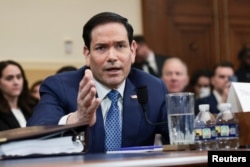
Rubio also argued the administration's goal had never been regime change in Tehran.
"We would love to see a change in Iran, and that they be governed by people, but that was not the goal of our mission," he told lawmakers.
The secretary of state said the US sought to eliminate Iran's ability to threaten the region with large-scale missile and drone attacks, which he argued would have reduced international leverage over Tehran's nuclear ambitions.
Sanctions Relief Tied To Nuclear Concessions
Rubio also said any easing of US sanctions on Iran would depend on concessions regarding its nuclear program.
"They are not going to get any sanctions relief of any kind unless they get rid of enrichment and get rid of the highly enriched uranium," he told lawmakers.
According to Rubio, discussions between Washington and Tehran remain focused on the framework for future negotiations. He said Iran had shown greater willingness to discuss uranium enrichment than in previous talks but had not yet made commitments that satisfy US demands.
"A few months ago they refused to discuss the issues of both enrichment and the highly enriched uranium," Rubio said. "I think now, in some of the papers that have been exchanged back and forth, it's clearly addressed, but we still don't have final sign-off from their system, as of this morning (June 3)."
Rubio added that the United States would only consider lifting its maritime blockade if Iran restores freedom of navigation through the Strait of Hormuz.
The administration has argued that the conflict effectively ended after Trump ordered a cease-fire in early April. The White House has also dismissed the House resolution as an unconstitutional attempt to limit executive authority, saying there are currently no active hostilities from which US forces must be withdrawn.
The Senate has not yet scheduled a final vote on its own war powers measure.

