




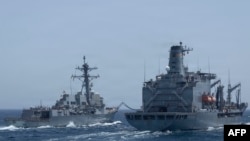
Iran blamed the United States for a recent escalation of skirmishes in the Persian Gulf as Washington awaits a response from Tehran over the latest proposal to end their war.
Senior US officials, from President Donald Trump to Secretary of State Marco Rubio, said on May 8 that Iran’s response to a US proposal aimed at ending the conflict -- which comes as fragile cease-fire efforts continued alongside fresh military incidents in and around the Strait of Hormuz -- was expected within hours.

But as of May 9, there was no word from Tehran on its response other than a tersely worded statement questioning Washington's seriousness in the talks.
"The recent escalation of tensions by American forces in the Persian Gulf and their numerous actions in violating the cease-fire have added to suspicions about the motivation and seriousness of the American side in the path of diplomacy," Foreign Minister Abbas Araqchi said in a call with Turkish Foreign Minister Hakan Fidan, according to an Iranian readout published by the semiofficial ISNA news agency.
A day earlier, Rubio told reporters during a visit to Rome the Trump administration was expecting a response "today [May 8] at some point.
"I hope it's a serious offer, I really do," Rubio added.
Trump backed up that in comments to CNN, saying “We’ll hear from them supposedly tonight.”
Rubio also strongly defended recent US military action in the Persian Gulf and rejected Iranian efforts to regulate shipping through the Strait of Hormuz, a strategic maritime route that accounts for around one fifth of global oil and gas supplies.
"Iran now claims that they own, that they have a right to control, an international waterway... That's an unacceptable thing that they're trying to normalize," Rubio said after reports that Tehran had established an agency to approve vessel passage through the strait.
“The normalizing of their control of an international waterway is both illegal and simply unacceptable,” he added.
Rubio said recent clashes in the Persian Gulf began after Iranian forces targeted American warships.
“What you saw yesterday was US destroyers moving through international waters being fired upon by the Iranians, and the US responded defensively to protect itself,” he said on May 8. “We didn’t fire. They fired on us.”
Iran, however, has said the confrontation began after US vessels attacked an Iranian civilian tanker near the Strait of Hormuz.
Araqchi on May 8 accused Washington of undermining diplomacy, saying in a post on X that “every time a diplomatic solution is on the table,” the United States opts for “a reckless military adventure.”
Despite the exchanges, both sides publicly maintained that the cease-fire remained in effect.

