


Two key documents released in Washington in recent days present differing foreign policy paths, giving US allies and adversaries alike plenty to chew over as they consider major strategic issues.
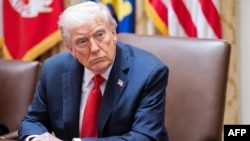
The White House's 33-page National Security Strategy (NSS), released last week, grabbed headlines with an "America First" approach in which "the days of the United States propping up the entire world order are over."
It criticized the European Union and spoke of restoring "strategic stability" with Russia -– drawing praise from Moscow.
Meanwhile, a 3,086-page defense bill, the National Defense Authorization Act (NDAA), seeks to lock in spending on Washington's military commitments to Europe and focus intelligence on Russia's military cooperation with China and North Korea.
"There are differing visions," Olivia Enos, a senior fellow at the Hudson Institute, told RFE/RL, adding that the US Congress was pushing back on the NSS strategy.
"But I think it's a long road to figure out whether or not appropriations actually fully get funded," she said.
Trump's Priority: The Americas And China
The NSS section on regional priorities starts with the Western Hemisphere before moving on through Asia, Europe, and the Middle East.
"Trump's NSS is a much-needed corrective to decades of 'strategies' that...commit the United States to an overstretched conception of national strategy," wrote Alexander Gray, who served on the National Security Council (NSC) in the first Trump administration.
In commentary for the Atlantic Council, he said the focus on the Western Hemisphere was "refreshingly frank about the essential objectives of the United States: securing the homeland."
Other observers have also suggested the order of the list is a direct reflection of White House priorities.
"The decision to place a high premium on foreign policy in the Western Hemisphere was no doubt going toward one of their primary domestic priorities, which is to counter immigration," said Enos.
Enos said the NSS approach to China was also informed by domestic policy concerns. "It's all about reindustrialization. It's all about economic security," she said, noting a lack of comment on human rights abuses, for example.
The NSS is unapologetic on this issue, stating, "We seek good relations and peaceful commercial relations with the nations of the world without imposing on them democratic or other social change."
While the NSS aims to "rebalance" the economic relationship with China, the paper also makes no mention of Beijing's alliance with Moscow.
By contrast, the NDAA calls for US spy agencies to provide "an assessment of the military cooperation between Russia and the People's Republic of China, including defense trade, joint military exercises, and the sharing of military intelligence."
Both the NSS and the NDAA feature strong support for Taiwan.
Europe
The NSS has provoked controversy in Europe, which it says is threatened by "civilizational erasure."
The paper refers to policies in Europe that "undermine political liberty and sovereignty, migration policies that are transforming the continent and creating strife, censorship of free speech and suppression of political opposition, cratering birthrates, and loss of national identities and self-confidence."
That language recalls a speech made by Vice President JD Vance in Munich in February, when he blasted Romania for canceling the results of its presidential election and appears to underline US allegations that right-wing parties are not afforded democratic freedoms.

The paper also condemns Europe for "censorship of free speech," possibly also a reference to EU moves against US social media companies.
US officials have repeatedly raised these issues.
Ahead of a NATO summit last week, Christopher Landau, US deputy secretary of state, issued an angry response to an EU fine levied against the social media network X.
"The nations of Europe cannot look to the US for their own security at the same time they affirmatively undermine the security of the US itself through the (unelected, undemocratic, and unrepresentative) EU. This fine is just the tip of the iceberg," he wrote on X.
"When these countries wear their NATO hats, they insist that Transatlantic cooperation is the cornerstone of our mutual security. But when these countries wear their EU hats, they pursue all sorts of agendas that are often utterly averse to US interests," he wrote later.
The NSS paper continues to provoke strong reactions in Europe. On December 8, European Council President Antonio Costa accused Washington of an unacceptable "threat to interfere in European politics."
"This strategy continues to talk about Europe as an ally. That's fine, but if we are allies, we must act as allies," he added.
Sam Greene, a Russia analyst at Kings College London, told RFE/RL "this strategy marks the beginning of the end of the transatlantic alliance…. Europe cannot accept a relationship on the terms the US is offering: one in which the US determines both the contours of European security and the content of European domestic politics, all while demanding burden-sharing."
Burden-sharing is a key element of the NSS, reflecting longstanding pressure from the Trump administration for European nations to hike their defense spending.
US troop reductions in Europe have been expected for several months since it was announced the Pentagon would conduct a Global Force Posture Review, and in October it was announced that hundreds of US troops rotated out of Romania would not be replaced.
The NDAA offers hope for anxious Europeans, demanding US troops remain at 76,000 and barring the withdrawal of equipment worth $500,000 or more.
Russia, Ukraine
The NDAA also foresees US support continuing to shore up the militaries of the Baltic States -- Latvia, Lithuania, and Estonia -- to deter "aggression by the Russian Federation."
Along with other elements, it adds to a clear sense of countering a Russian military threat in the bill, which has bipartisan support and also the backing of House Speaker Mike Johnson, a Republican.
The NSS does not refer to Russia as a threat or adversary, unlike in previous versions of the strategy -- which has raised eyebrows.
"If you need to have private conversations between Russia and the US about things in order to assuage (Russian President Vladimir) Putin or to stroke his ego, fine," Enos said.
"But to publicly message what I would perceive as a softening…is very concerning. To me China, Russia, Iran, North Korea should all be kind of in the same bucket of adversaries."
David Cattler, who held a series of senior roles at both NATO and US intelligence agencies, noted in an analysis that the White House strategy "suggests that Russia's behavior, while dangerous, is ultimately malleable through engagement."
The NSS does note that Europe perceives Russia as a threat -- and emphasizes efforts to seek peace in Ukraine both as a means to "reestablish strategic stability with Russia" and enable Ukraine's "survival as a viable state."
This echoes many positions taken during talks on ending Russia's full-scale invasion of Ukraine. Recent proposals envisaged lifting sanctions on Russia, while US Secretary of State Marco Rubio has declared the aim of a deal was Ukraine's "long-term prosperity."
"The NSS brings several trends to convergence," wrote Cattler.
"A softer US characterization of Russia, a preference for rapid stabilization in Ukraine, and unprecedented expectations of European self-reliance. None are entirely new, but together they accelerate a transition into a more fragmented international order."

