




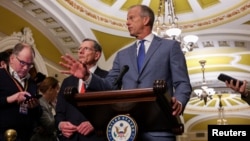
WASHINGTON -- Just one day after Ukrainian President Volodymyr Zelenskyy watched from the Senate gallery as lawmakers overwhelmingly backed moving forward on new Russia sanctions, the US Senate took another decisive step on July 29, reinforcing bipartisan determination to tighten economic pressure on Moscow and expand sanctions targeting Iran.
The Senate voted 84-12 to proceed with legislation that would impose tougher sanctions on Russia over its full-scale invasion of Ukraine while extending key Iran sanctions for another five years. The vote followed an equally commanding 86-12 cloture vote the previous evening, highlighting unusually broad support from both Republicans and Democrats despite lingering disagreements over specific provisions.
The legislation -- now named the Lindsey O. Graham Sanctioning Russia and Iran Act following the senator's death -- has become both a foreign policy measure and a tribute to one of Congress's most outspoken advocates for military and political support for Ukraine.
Republican Senate Majority Leader John Thune said Graham had worked on the bill "on the day he died," describing the legislation as part of the late senator's legacy.
Targeting Russia's Financial Lifeline -- And China's Role
Speaking on the Senate floor, Thune argued that the legislation is designed to attack what Republicans view as the Kremlin's greatest strategic vulnerability: revenues from oil and natural gas exports.
The South Dakota senator also said Russia has been able to prolong the war because energy sales continue to finance its military operations despite years of Western sanctions. According to Thune, the bill would authorize the president to impose tariffs of up to 100 percent on the largest purchasers of Russian energy while sanctioning banks, officials, and companies involved in facilitating those exports.
China figured prominently in Thune's remarks. He described Beijing as Russia's largest customer for oil and gas, arguing that the "no limits partnership" declared by Moscow and Beijing before Russia’s full-scale invasion of Ukraine in 2022 has translated into direct economic support for the Kremlin's war effort.
"This bill doesn't stop with the purchasers of Russian energy," Thune said, noting that it also targets the broader financial and commercial networks enabling Russian energy exports. He argued that only by depriving President Vladimir Putin of this revenue could Moscow be forced into genuine negotiations to end the war.
Thune also linked the legislation to President Donald Trump's stated objective of ending the conflict, saying the measure would provide the White House with additional economic tools to pressure Russia.



Beyond Ukraine, the majority leader emphasized that the bill extends the statutory framework underpinning many existing US sanctions on Iran for another five years, ensuring Washington can continue what he called "maximum economic pressure" against Tehran. He noted that neither the Kremlin, Tehran, nor Beijing would welcome the legislation, arguing that this itself reflected its strategic importance.
'Axis Of Aggression'
Senate Republican Whip John Barrasso portrayed the legislation as a comprehensive geopolitical response extending far beyond Ukraine.
Calling it a "peace through strength" measure, Barrasso said the sanctions package simultaneously targets Russia's leadership, its shadow fleet of oil tankers, major importers of Russian energy, and countries helping Moscow circumvent existing sanctions.
Barrasso repeatedly argued that energy exports remain the financial engine of Russia's military campaign, describing them as "the cash cow of Putin's war machine" while also calling them Russia's "Achilles' heel."
He singled out China as Russia's largest energy customer, followed by India, saying the legislation seeks to strike at the countries whose purchases continue financing Moscow's war.
The Wyoming senator also devoted significant attention to Iran's growing military partnership with Russia.

According to Barrasso, Tehran has supplied Russia with drones, missiles, and other munitions used against Ukraine, while Moscow has provided Iran with military technology, intelligence, and broader strategic support in return.
He argued that Russia and Iran now share sanctions-evasion networks, operate shadow fleets transporting illicit oil, and rely on many of the same energy customers.
"Together, Russia and Iran have built an axis of aggression," Barrasso said, arguing that sanctioning purchasers of Russian and Iranian oil would disrupt both governments simultaneously.
He also claimed both Russia's energy infrastructure and Iran's military capabilities have suffered significant setbacks in recent months but said neither government has demonstrated a willingness to pursue lasting peace.
"Russia and Iran respond only to strength, not to statements," Barrasso told senators as he urged immediate passage of the bill.
House Prospects Improve
Attention is now shifting to the House of Representatives, where lawmakers have already approved their own Russia sanctions package -- sponsored by New York Democrat Gregory Meeks -- but may ultimately take up the Senate version later this year.
Senator Richard Blumenthal, one of the principal Democratic architects of the Senate legislation, expressed confidence that the House would eventually approve the bill, arguing that President Trump's endorsement significantly improves its prospects.
"The Meeks bill is a good measure, but it won't pass," the Connecticut Democrat said, maintaining that the Senate proposal contains stronger sanctions while avoiding funding provisions unlikely to win Republican support.
The Senate Foreign Relations Committee chairman, Idaho Republican Jim Risch, similarly said the overwhelming bipartisan Senate vote should carry weight when House lawmakers consider the legislation.
Trump, however, has weighed in on the legislative debate, telling reporters at the White House that he wants lawmakers to incorporate additional tariffs targeting Iran into the measure, reinforcing the administration's push for broader economic pressure on Tehran.
Small But Vocal Opposition Remains
Despite commanding bipartisan support, the legislation continues to face resistance from a small group of senators.
Twelve senators voted against proceeding with the bill, including eleven Democrats or independents and Republican Senator Rand Paul.
Paul and Democratic Senator Ron Wyden have also been developing an amendment aimed at limiting one of the bill's most contentious provisions: the broad tariff powers it grants the president.
Unless Senate leaders reach an agreement limiting debate, consideration of amendments could extend into next week.
The July 29 vote nevertheless demonstrated that, one day after Zelenskyy's appearance at the Capitol, the Senate remains overwhelmingly united behind legislation intended to increase economic pressure on Russia while broadening US sanctions policy toward Iran.
The debate also underscored an increasingly expansive strategic narrative among the bill's supporters -- linking Russia's war in Ukraine with China's economic backing of Moscow and Iran's military partnership with the Kremlin, framing all three as interconnected challenges to US and allied security.

