




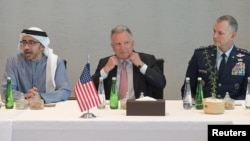
WASHINGTON -- The United States sees a “real shot” at serious progress toward ending Russia’s war in Ukraine at talks between Washington, Kyiv, and Moscow that kicked off in Abu Dhabi early on November 10, senior US officials told reporters, citing signs of growing willingness on both sides to reach a settlement.
But the optimism contrasts with skepticism among European officials and Russia analysts, who see little evidence that Moscow is prepared to make concessions on territory or Ukraine's future security.
US President Donald Trump remains committed to ending the conflict and has instructed his representatives to pursue a lasting peace rather than a quick but fragile agreement, according to the officials, who spoke on condition of anonymity.
Discussions with Russian and Ukrainian representatives had intensified in recent months, with contacts now taking place daily, sometimes several times a day, the officials said.
“Now we're in a position where there is a shot at trying to make serious progress to end the war,” one official said.
The Abu Dhabi meetings are intended to clarify the positions of both sides and identify remaining disagreements. The officials cautioned, however, that they did not expect a final settlement to emerge from the two-day meetings.
Ukraine's chief negotiator, Rustem Umerov, said the goal of the talks ultimately should be to achieve a lasting peace. His Russian counterpart, Vladimir Medinsky, said Moscow believes an end to the war would be in the interests of both countries.
Focus On Lasting Peace
The US officials said the central challenge was convincing both sides that a cease-fire would not simply give the other an opportunity to rearm and prepare for another conflict -- though Ukraine has called for a truce and Russia has rejected the idea. The officials added that Washington is exploring measures such as security consultations, crisis communications, military transparency, and reciprocal de-escalation.
"Alongside a central focus on a lasting peace, the discussion covered how to build upon existing European security institutions and agreements following the conclusion of the war in Ukraine," US envoy Steve Witkoff said in a post on X after US, Ukrainian, and European officials met on November 10 ahead of planned talks with Russia and Ukraine.
The broader postwar framework would seek to address the concerns of Russia, Ukraine, and European countries while preserving national sovereignty and independent decision-making, the officials said. They maintained that NATO would remain central to European collective defense.

US officials said Washington had asked Moscow to accept security guarantees for Ukraine modeled on NATO's Articles 4 and 5, which provide for consultations when an ally is threatened and collective defense in the event of an armed attack.
Any US guarantee would ultimately depend on Trump and Ukrainian President Volodymyr Zelenskyy, one official said. Trump, however, wants Europe to shoulder the financial burden of Ukraine's security.
Territorial questions, particularly the future of Ukraine's eastern Donetsk region, which Russia claims but does not fully control, will be another central issue.
Russia continues to demand the entire Donetsk region, while Ukraine has said a cease-fire that would freeze the front lines in place would be an acceptable basis for talks on a peace deal. Both sides have shown some private flexibility, the US officials said, without providing details.
But Zelenskyy has repeatedly rejected surrendering territory Ukrainian forces still hold, including a heavily fortified part of Donetsk whose loss could leave the country more vulnerable to future Russian attacks.

The officials stressed that territorial arrangements and postwar security guarantees would have to be negotiated in parallel and finalized together.
The Abu Dhabi meetings also include European partners, reflecting Washington's push to move beyond a trilateral format toward broader negotiations.
European Participation
Germany, France, and Britain -- the so-called E3 -- are participating, alongside Italy, NATO, the European Union, and Ukraine. Their initial consultations with US representatives, however, will be separate from the trilateral negotiations with Russia.
European representatives are expected to discuss security guarantees and the longer-term security architecture between Russia and Europe.
The broader proposal has raised concerns in European capitals that Moscow could gain influence over the continent's security arrangements, potentially undermining NATO and the sovereignty of countries once under Soviet domination.
“We already have a European security architecture in place,” EU foreign policy chief Kaja Kallas said on November 6, stressing that any agreement would require EU participation.

Russia, however, remains deeply distrustful of European governments, which it blames for derailing an earlier agreement negotiated in Istanbul, the officials said. But the 2022 talks actually never produced a final agreement, with major differences remaining over Ukraine's security and sovereignty.
The US officials said Washington had been telling Moscow that it remained closely aligned with the European Union, NATO, and its European partners, while arguing that European participation would be constructive rather than an obstacle to an agreement.
“We really need to have Europe at the table” to end the war, one official said.
The officials said coordination with Ukraine and European governments had intensified over the past six weeks, including discussions in Brussels on Ukraine's postwar security and economic recovery.
They described the cooperation as close and constructive, rejecting a narrative of growing divisions between Washington and its European allies.
A separate workstream, led in part by the World Bank, is examining the reforms Ukraine would need to build a viable postwar economy. The discussions include the country's military requirements, financing needs, economic reconstruction, and longstanding corruption problems.
Asked whether Russia was showing flexibility, US officials said Moscow had sent positive signals about wanting to end the war, particularly in discussions on a postwar security framework.
But analysts warn that Moscow may be using negotiations to buy time while maintaining its territorial demands and military pressure on Ukraine.
“For the West, negotiations are a means of ending the war; for Putin, they are potentially a means of winning it,” Sam Greene, a professor at King's College London's Russia Institute, wrote on X on November 8.
Kallas was similarly skeptical, saying on November 9 that Russia was “pretending to negotiate” and had shown no goodwill.
The officials cited earlier conversations with Russian President Vladimir Putin in St. Petersburg, where the idea of establishing a security architecture between Russia and the West was discussed.
“This is the first time I feel like we see real desire on the Russian side to finish,” one official said.
Yet Moscow has continued to reject an unconditional cease-fire and insists that Ukraine relinquish the remaining Ukrainian-held territory in Donetsk. Russia's delegation in Abu Dhabi is being led by Medinsky, a Kremlin aide who headed several earlier rounds of negotiations, including talks in Geneva in February, where he largely reiterated Moscow's demands and showed little willingness to compromise.
The proposed framework could also involve sanctions relief as an incentive for Moscow to honor a future agreement. Sanctions could be eased gradually, with provisions allowing them to be reinstated if Russia violated the settlement, the official said.
US officials said they wanted to move quickly, citing the mounting military and civilian toll of the war, but cautioned that a sustainable agreement would require difficult compromises.
Further meetings with Putin and Zelenskyy could take place soon, depending on the outcome of the Abu Dhabi discussions, they said.
The officials also pointed to humanitarian efforts, including a recent six-day cease-fire in Oleshky, in Ukraine's Kherson region, which they said had enabled civilian evacuations and the delivery of humanitarian assistance.
Washington would continue working with prisoner exchanges and other humanitarian issues, they said.
The diplomatic push comes amid mounting civilian suffering in Ukraine, with Russian attacks on energy infrastructure threatening millions of people with prolonged power and water outages as winter approaches.
At a November 9 UN Security Council meeting, humanitarian officials warned of worsening conditions, with UN Assistant Secretary-General for Humanitarian Affairs Mohamed Yahya cautioning that emergency assistance “cannot replace an electricity grid repeatedly destroyed by attacks.”
For Washington, the immediate objective in Abu Dhabi is to turn the recent intensified diplomatic contacts into a structured negotiating process capable of addressing the territorial dispute and establishing the conditions for a lasting peace.
“We're trying to lay out all the reasons why that's a better scenario, make them concrete, make people believe it, and then build them a bridge to get there,” one official said.

