Accessibility links

Breaking News

'Troubled' By Minsk Visit, U.S. Senator Urges Coordinated Moves To Counter Belarus Abuses

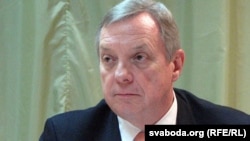
U.S. Senator Richard Durbin during his visit to Minsk on January 14
A group of prominent U.S. senators has called for a strong and coordinated response by the United States and European Union to the crackdown on democracy activists following the December reelection of Belarusian President Alyaksandr Lukashenka.

Six U.S. senators signed the letter, to EU foreign affairs chief Catherine Ashton, urging targeted sanctions against Lukashenka and other officials and a ban on business with Belneftekhim, Belarus's state oil company.

Among the signatories is Senator Richard Durbin (Democrat-Illinois), who just returned from a trip to Minsk. He spoke to RFE/RL correspondent Heather Maher on the eve of Lukashenka's inauguration on January 21, which was boycotted by world leaders.

RFE/RL: Senator Durbin, why did you decide to sign the letter to EU foreign affairs chief Catherine Ashton calling for joint U.S.-EU sanctions against Belarus?

Richard Durbin: I was so troubled by what I found in Minsk. Being with the families of those political candidates who are now languishing in prison -- it just struck me as an outrage that [President Alyaksandr] Lukashenka would do this.

When I met with his foreign minister and asked for an explanation, he asked me to be more forgiving of Belarus because they were, in his words, "a new democracy." And I found that to be totally unacceptable. To think that you would systematically arrest and imprison political prisoners tells me that Belarus is not even close to the democratic values that we want to see.

RFE/RL: Tell me how you came to be in Minsk to meet with these families?

Durbin: I'd just been in Lithuania -- they were observing the 20th anniversary of Bloody Sunday, when 14 just common people in Vilnius were killed by Soviet tankers and paratroopers and 1,000 were injured. I drove over to Minsk and sat down with other families fighting for freedom in that country. You couldn't escape the historic parallel.

RFE/RL: You said you met with government officials, among them the foreign minister. Was it just yourself in the meetings and did the officials know that you were meeting with families of the detained?

Durbin: I doubt if there were many things about my trip that they didn't know or monitor. But I met personally with [Sergei] Martynov, who is the foreign minister in Belarus, and told him about the disappointment we felt over the actions of Lukashenka.

RFE/RL: And in response, he asked you to be more understanding?

Durbin: Yes. And of course they are trumping up these charges that this was a conspiracy inspired by Poland and Germany, and I'm not sure who else, to overthrow the government of Belarus. It is an outlandish charge, as extreme as the actions that they took against their political opponents.

Belarus: Scenes Of The Crackdown

Thousands of opponents of Belarusian President Alyaksandr Lukashenka rallied in the center of Minsk to protest the election, which they say was rigged.
1/18 Thousands of opponents of Belarusian President Alyaksandr Lukashenka rallied in the center of Minsk to protest the election, which they say was rigged.
Police in Belarus beat demonstrators with batons and rounded up opposition leaders in a violent crackdown after an election on December 19 that returned incumbent President Alyaksandr Lukashenka for a fourth term with 80 percent of the vote.
2/18
Police in Belarus beat demonstrators with batons and rounded up opposition leaders in a violent crackdown after an election on December 19 that returned incumbent President Alyaksandr Lukashenka for a fourth term with 80 percent of the vote.
A man from among the group of protesters smashes a glass door of the parliament building during a rally denouncing the results of the presidential election.
3/18 A man from among the group of protesters smashes a glass door of the parliament building during a rally denouncing the results of the presidential election.
Police in Belarus beat demonstrators with batons and rounded up opposition leaders in a violent crackdown after an election on December 19 that returned incumbent President Alyaksandr Lukashenka for a fourth term with 80 percent of the vote.
An opposition supporter appeals to riot police for sympathy.
4/18 An opposition supporter appeals to riot police for sympathy.
Police in Belarus beat demonstrators with batons and rounded up opposition leaders in a violent crackdown after an election on December 19 that returned incumbent President Alyaksandr Lukashenka for a fourth term with 80 percent of the vote.
Police in Belarus beat demonstrators with batons and rounded up opposition leaders.
5/18 Police in Belarus beat demonstrators with batons and rounded up opposition leaders.
Police in Belarus beat demonstrators with batons and rounded up opposition leaders in a violent crackdown after an election on December 19 that returned incumbent President Alyaksandr Lukashenka for a fourth term with 80 percent of the vote.
Riot police chase an opposition protester.
6/18 Riot police chase an opposition protester.
Police in Belarus beat demonstrators with batons and rounded up opposition leaders in a violent crackdown after an election on December 19 that returned incumbent President Alyaksandr Lukashenka for a fourth term with 80 percent of the vote.
Presidential candidate Uladzimir Nyaklyaeu lies on a street after he was beaten during the rally in Minsk.
7/18 Presidential candidate Uladzimir Nyaklyaeu lies on a street after he was beaten during the rally in Minsk.
Police in Belarus beat demonstrators with batons and rounded up opposition leaders in a violent crackdown after an election on December 19 that returned incumbent President Alyaksandr Lukashenka for a fourth term with 80 percent of the vote.
Supporters carry the injured Neklyayev to his campaign headquarters.
8/18 Supporters carry the injured Neklyayev to his campaign headquarters.
Police in Belarus beat demonstrators with batons and rounded up opposition leaders in a violent crackdown after an election on December 19 that returned incumbent President Alyaksandr Lukashenka for a fourth term with 80 percent of the vote.
Opposition candidate Andrey Sannikau lies on a street after being beaten during a clash between protesters and police.
9/18 Opposition candidate Andrey Sannikau lies on a street after being beaten during a clash between protesters and police.
Police in Belarus beat demonstrators with batons and rounded up opposition leaders in a violent crackdown after an election on December 19 that returned incumbent President Alyaksandr Lukashenka for a fourth term with 80 percent of the vote.
A supporter of presidential candidate Uladzimir Neklyayev is seen at his campaign headquarters after he was beaten.
10/18 A supporter of presidential candidate Uladzimir Neklyayev is seen at his campaign headquarters after he was beaten.
Police in Belarus beat demonstrators with batons and rounded up opposition leaders in a violent crackdown after an election on December 19 that returned incumbent President Alyaksandr Lukashenka for a fourth term with 80 percent of the vote.
11/18
Police in Belarus beat demonstrators with batons and rounded up opposition leaders in a violent crackdown after an election on December 19 that returned incumbent President Alyaksandr Lukashenka for a fourth term with 80 percent of the vote.
12/18
Police in Belarus beat demonstrators with batons and rounded up opposition leaders in a violent crackdown after an election on December 19 that returned incumbent President Alyaksandr Lukashenka for a fourth term with 80 percent of the vote.
13/18
Police in Belarus beat demonstrators with batons and rounded up opposition leaders in a violent crackdown after an election on December 19 that returned incumbent President Alyaksandr Lukashenka for a fourth term with 80 percent of the vote.
14/18
Police in Belarus beat demonstrators with batons and rounded up opposition leaders in a violent crackdown after an election on December 19 that returned incumbent President Alyaksandr Lukashenka for a fourth term with 80 percent of the vote.
15/18
Police in Belarus beat demonstrators with batons and rounded up opposition leaders in a violent crackdown after an election on December 19 that returned incumbent President Alyaksandr Lukashenka for a fourth term with 80 percent of the vote.
Members of the Election Commission count ballots late on December 19 in Minsk. The incumbent, Alyaksandr Lukashenka, won in the first round with almost 80 percent of the vote.
16/18 Members of the Election Commission count ballots late on December 19 in Minsk. The incumbent, Alyaksandr Lukashenka, won in the first round with almost 80 percent of the vote.
Police in Belarus beat demonstrators with batons and rounded up opposition leaders in a violent crackdown after an election on December 19 that returned incumbent President Alyaksandr Lukashenka for a fourth term with 80 percent of the vote.
An opposition supporter flashes a victory sign from a police bus near a detention center in Minsk.
17/18 An opposition supporter flashes a victory sign from a police bus near a detention center in Minsk.
Police in Belarus beat demonstrators with batons and rounded up opposition leaders in a violent crackdown after an election on December 19 that returned incumbent President Alyaksandr Lukashenka for a fourth term with 80 percent of the vote.
A woman cries outside a prison in Minsk where hundreds of antigovernment protesters are being held.
18/18 A woman cries outside a prison in Minsk where hundreds of antigovernment protesters are being held.
Police in Belarus beat demonstrators with batons and rounded up opposition leaders in a violent crackdown after an election on December 19 that returned incumbent President Alyaksandr Lukashenka for a fourth term with 80 percent of the vote.
Previous slide
Next slide


RFE/RL: How would you characterize the meeting after you expressed your concern and the minister responded by saying the West needs to show more understanding? Did the mood become hostile? How did it end, diplomatically speaking?

Durbin: Well, diplomatically [speaking], they called it "frank and candid." And I would say it ended with Martynov and the Lukashenka government totally unrepentant. In fact, he turned around and flew into Europe to meet with some representatives of the EU to charge that Poland and Germany were involved in some conspiracy against Belarus. I mean, it was unfortunately a very extreme comment by someone who has little or no defense to offer.

RFE/RL: The letter that you signed asks the EU to join the United States in speaking with one voice on Belarus and impose sanctions that carry "very real and significant consequences" for Lukashenka and other Belarusian officials responsible for human rights abuses, vote fraud, and the continued detention of opposition presidential candidates and party leaders following the December 19 presidential election. If that doesn't happen, are there any steps you plan to take in the U.S. Congress to keep the pressure on Belarus?

Durbin: I have tried to work with the [Obama] administration to make sure we did things in concert with the European Union, and my feeling is that [White House] is going to move forward. I've spoken to some of their representatives. I think we ought to work with [the EU]. My impression is that sanctions, whatever they might be, are not very effective unless they're coordinated by many nations. So unilateral efforts have very little impact; I think we will have much greater impact if we work together.
This item is part of
XS
SM
MD
LG