





KYIV -- Ukrainian forces have struck an oil refinery in Russia's Ryazan region, Russian officials said, hours after President Volodymyr Zelenskyy said Ukraine would resume attacks on Russian energy facilities and voiced anger over a "dangerous" disruption of satellite intelligence from the United States.
Defying an "energy cease-fire" announced unilaterally last week by US President Donald Trump, Zelenskyy told the Financial Times in an interview published on October 15 that "we're done" with holding off on launching attacks on Russia oil structures.
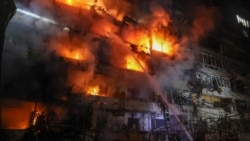
Hours later, Ryazan Governor Pavel Malkov said in a post on Telegram that "our region came under a massive drone attack," adding that "a fire broke out at the oil refinery."
Russia's Defense Ministry later said Ukraine had attempted a massive attack on the Ryazan oil refinery, adding falling drone debris had sparked a fire at the facility.
The Ukrainian military has not immediately confirmed the attack, which would be the first by Kyiv since Trump announced the cease-fire on October 11. The Rosneft-owned Ryazan refinery has been targeted by drones several times in recent months and accounts for nearly 5 percent of Russia's total oil refining capacity.
Neither of the warring parties officially confirmed agreeing to the truce announced by Trump, and while Ukraine halted attacks on Russian refineries for three days, Russia continued to strike Ukrainian energy facilities and other installations.
"The block [on attacking refineries] is out. We're done," Zelenskyy told the Financial Times in the interview.

Zelenskyy had said Ukraine was willing to halt attacks on Russian oil refineries if Moscow agreed to stop striking Ukraine's energy infrastructure.
The Ukrainian leader's sharp tone continued when discussing a recent crisis involving a cut in the supply of US intelligence to Kyiv.
Zelenskyy told the FT that the suspension was presented to Kyiv as a technical glitch, an idea he dismissed while calling the disruption in the Starshield, the military version of the Starlink satellite communications system, "dangerous."
Pressure On The Pentagon
Pressure is mounting on the Pentagon to explain the reported restrictions on satellite communications used by Ukraine's military, with Republican Senator Thom Tillis calling for an inspector-general investigation and warning that Ukrainian civilians and US personnel may have been put at unnecessary risk.
Tillis, a Republican, said on October 14 he would ask the Defense Department's inspector-general to investigate what he described as a potentially dangerous breakdown involving Starshield, which is controlled by the US government.
"The latest reporting suggests this strategic snafu may have occurred more locally within DOD Starshield systems, not with Starlink or SpaceX," Tillis wrote on social media.
He said Ukrainian civilians and US diplomatic and security personnel had been placed at unnecessary risk without warning.
"At best, this was an unacceptable error or lapse, and at worst a conscious decision to clear the field for a Russian attack," Tillis added.
RFE/RL has learned from congressional sources that a group of lawmakers was circulating a letter on October 14 calling on the Defense Department's inspector-general to investigate the episode. The letter was expected to be sent in the coming days.


The call for an investigation comes amid mounting bipartisan concern over reports that satellite connectivity restrictions have disrupted Ukrainian military operations. Some have also speculated that it could possibly be a move by the administration to pressure Kyiv into refraining from oil refinery attacks on Russia.
But it remains unclear who authorized the restrictions, whether they affected commercial Starlink or Starshield, and whether Washington also reduced intelligence support to Kyiv.
Axios, quoting sources, reported that the White House told Ukraine it does not control Elon Musk's SpaceX, the owner of Starlink.
Musk wrote on X, which he owns, that "Starshield systems are owned and controlled by the US government. Any limits on speed or usage are decided by the US military and ultimately POTUS."
Dan Rice, president of American University Kyiv and a former special adviser to the commander in chief of Ukraine's armed forces, warned that restrictions could have grave consequences if they prevented Ukrainian forces from directing interceptors against incoming Russian drones.
"When you have 500 inbound Shaheeds, jet-powered Shaheeds, and I was hit within 400 meters twice this week," Rice told RFE/RL, "you need to have interceptors going out to protect Ukrainian civilians."
He warned that if satellite connectivity prevented high-speed interceptors from reaching their targets, Russian drones could strike civilian locations, killing women, children, and other noncombatants. He also noted Russian forces had targeted universities, schools, and children's hospitals.
Retired Rear Admiral Mark Montgomery, senior director of the Center on Cyber and Technology Innovation and a senior fellow at the Foundation for Defense of Democracies, told RFE/RL the reported limits impaired Ukraine's ability to control medium-range drone strikes against Russian logistics routes and command-and-control facilities supporting Moscow's forces in occupied Ukrainian territory.
He described the affected operations as involving targets roughly 150 to 250 kilometers behind Russian lines. He also distinguished the satellite-service issue from the reported failure to provide warnings of incoming attacks, saying the Pentagon inspector-general should investigate both.
Meanwhile, Moscow continued its attacks on Ukraine on October 15, a day after Russian missile and drone strikes pounded civilian and energy infrastructure across the country, killing at least nine people and leaving hundreds of thousands without power.
Ukraine's Air Force reported on the morning of October 15 that Russia had launched 580 drones and two Kh-59 missiles at Ukraine overnight, adding the attack was ongoing.