


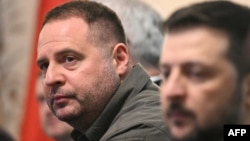
A scandal that has dogged Volodymyr Zelenskyy since last year has come to the fore again with the news that anti-corruption agencies have handed the Ukrainian president's longtime former chief of staff, Andriy Yermak, a notice of suspicion in connection with an alleged multimillion-dollar money-laundering scheme.
The notice of suspicion, which is short of a formal charge, is the biggest recent development in an investigation that emerged in 2025 and led to several moves by Zelenskyy to avert severe political fallout, including engineering Yermak's departure after more than five years as the influential head of his administration.
The notice, which Yermak called "unfounded" in a May 12 post on Telegram, comes at a sensitive juncture in Ukraine's defense against Russia's full-scale invasion, now in its fifth year, and at a time when Washington-led peace talks are stalled amid the US-Israeli war with Iran.
How could this development affect Zelenskyy and the situation in Ukraine?
Here's why it could hit Ukraine's wartime president hard and why he may hope to escape substantial damage.
'Almost A Single Entity'
In the minds of many Ukrainians, Zelenskyy and Yermak may be all but inseparable despite Yermak's departure as chief of staff last November. Their ties go back about a decade before the comic actor and political novice Zelenskyy won the presidency in 2019.

"They've become fused together" and "become almost a single entity," Volodymyr Fesenko, head of the Penta Center for Political Studies in Kyiv, told RFE/RL in November.
That close relationship, and the outsize influence Yermak wielded as chief of staff, mean any blemish on Yermak risks bleeding over onto Zelenskyy.
"Unlike Volodymyr Zelenskyy, Andriy Yermak was someone whom no one had voted for," Yevhen Mahda, director of the Institute of World Policy in Kyiv, told Current Time on May 12. "The responsibility for appointing him as head of the administration, and subsequently granting him all the powers he exercised, lay squarely with Volodymyr Zelenskyy."
'Vova'
On May 11, the National Anti-Corruption Bureau of Ukraine (NABU) and the Specialized Anti-Corruption Prosecutor's Office (SAPO) announced they had "exposed an organized group involved in the legalization" -- laundering -- "of 460 million hryvnyas ($10.5 million) in luxury construction near Kyiv."
This refers to an elite housing development called Dynastia that the anti-graft authorities say was being built in part with some of the $100 million in graft-tinged money from the energy sector, some of it from kickbacks the suspects allegedly charged subcontractors of state nuclear power company Energoatom.
There were indications that may have included contracts for the construction of installations to protect energy facilities, and the idea that corrupt officials could have been increasing the dangers posed by Russian attacks on power infrastructure added to public anger.
There were indications the scheme may have extended to contracts for protective installations at energy facilities. The idea that corrupt officials could have been increasing the dangers posed by Russian attacks on power infrastructure added to public anger.

One of the elements of the sprawling corruption scandal is a series of audiotapes in which some of the suspects, using code names such "Surgeon" and "Ali Baba," discuss matters including the Dynastia project. Participants in one of those discussions reportedly say one of the homes in the complex would be for "Andriy" and one for "Vova," which is short for Volodymyr, prompting speculation that it's a reference to Zelenskyy.
At a news conference on May 12, NABU chief Semen Kryvonos said Zelenskyy "has not been and is not currently a subject of the pretrial investigation." He said various "investigative theories regarding the ownership of certain assets are being examined" as part of the ongoing probe.
Zelenskyy's communications adviser, Dmytro Lytvyn, said on May 11 that it was too early to comment on the accusation leveled against Yermak, citing the ongoing legal process.
Yermak told reporters the only real estate he owns is a Kyiv apartment. His lawyer, Ihor Fomin, denied in comments to Suspilne public television that Yermak was involved in the alleged money-laundering scheme.
The War And The West
Despite the assurance he is not under investigation, and regardless of what trials are held or verdicts handed down in the future, Zelenskyy may be concerned about the potential effects of the scandal on his standing in the West and the future of European and US support in the defense against the Russian onslaught.
Corruption, both real and perceived, has hampered Kyiv's relations with the West since it gained independence from the collapsing Soviet Union in 1991, and the scandal comes at a time when Ukraine is seeking membership in the European Union.
With US aid all but dried up aside from a program under which European countries acquire weapons from the United States and supply them to Ukraine, Kyiv has taken strides in reducing its reliance on Western weapons. But arms such as US-made Patriot missiles are still crucial to Ukraine's defense.
On the diplomatic front, Zelenskyy may also be wary of how the case could affect his sometimes tense relationship with US President Donald Trump and his administration, particularly whether it might lead Washington to increase pressure on Kyiv to cede the remaining territory it holds in the partially Russian-occupied Donetsk region to Moscow or make other painful concessions under any peace deal.
The flip side of this is that for now, at least, Zelenskyy can make the argument that the investigation and the notice of suspicion for Yermak are signs Kyiv is seeking to fight corruption regardless of how close it comes to him and his administration.
Whether Ukrainians and audiences abroad will accept that argument is another matter. But a factor that could work in Zelenskyy's favor is the fact that the developments have come in a staggered fashion: In late November, Yermak resigned hours after NABU and SAPO searched his office, so the notice of suspicion was not a huge surprise.
However, if he were to flee Ukraine, as some others implicated in the case have, that would raise major questions about Zelenskyy's handling of the developments.
In his Telegram post after a May 12 hearing in which prosecutors asked a Kyiv court to order his detention on bail of 180 million hryvnyas ($4.1 million), Yermak said he plans to remain in Ukraine and continue to practice law.
A Political Pause
Earlier in November, tycoon Tymur Mindich, an old friend and longtime associate of Zelenskyy's who was a major figure in the alleged energy-sector corruption scheme, fled by taxi across the Polish border hours before authorities launched raids linked to the investigation, Schemes, the investigative unit of RFE/RL's Ukrainian Service, determined.

Another key figure, ex-Energy Minister Herman Halushchenko, was detained while trying to leave Ukraine by train in February and charged the next day with money laundering.
Whatever the ramifications of the accusations against Yermak in the coming weeks or months, for the time being Zelenskyy is shielded from the most concrete potential political repercussions by martial law, which has been in place since the start of the full-scale invasion in 2022 and bars the country from holding elections.

But while strong Ukrainian unity in the face of the Russian invasion is also a political boon for Zelenskyy, it doesn't mean he is immune to public discontent. Last summer, he extricated himself from a potentially explosive situation by backing down after crowds hit the streets to protest a bill they said would have stripped NABU and SAPO of their autonomy, dealing a big blow to anti-corruption efforts.
Zelenskyy withdrew the legislation, which opponents had warned that, if passed, would have been major step toward tighter state control and authoritarianism under Zelenskyy and Yermak, whom critics accused of being behind the bill in an effort to prevent corruption probes from reaching the president's circle, himself included.

