


Accessibility links

Breaking News

Wider Europe

Armenian Foreign Minister Ararat Mirzoyan (right) and EU foreign policy chief Kaja Kallas (file photo)

Welcome to Wider Europe, RFE/RL's newsletter focusing on the key issues concerning the European Union, NATO, and other institutions and their relationships with the Western Balkans and Europe's Eastern neighborhoods.

I'm RFE/RL Europe Editor Rikard Jozwiak, and this week I am drilling down on two issues: EU support for Armenia and what’s going on with EU sanctions on Russia.

please wait

No media source currently available

0:00 0:10:56 0:00

Briefing #1: How The EU Plans To Help Armenia During A Crucial Year

What You Need To Know: The European Union is preparing to help Armenia counter Russian interference in its parliamentary elections slated for June by first deploying “a hybrid rapid response team” to tackle Kremlin disinformation and then, potentially, rolling out a more permanent civilian mission to the South Caucasus nation.

According to a letter seen by RFE/RL, Armenian Foreign Minister Ararat Mirzoyan asked Brussels on February 13 to dispatch a rapid response team to Yerevan.

The EU sent a similar team to Moldova during its parliamentary elections last year, consisting of roughly 20 people who worked alongside Moldovan authorities to detect and counter disinformation emanating from Russia on social media in a timely manner.

Both Brussels and Chisinau deemed the project a success and the European Union is now keen to replicate the effort in Armenia as the country faces crucial elections that Russia is expected to try to influence.

Deep Background: According to diplomatic notes from discussions in Brussels, the EU is keen to “express support for strengthening Armenia’s democratic resilience and information integrity both ahead of the June 2026 elections, and during the ongoing peace process between Armenia and Azerbaijan.”

It added that “the proposed support for Armenia should be aimed clearly at reducing and mitigating Russia’s destabilizing activities.”

There is also a request for the EU’s diplomatic corps, the EEAS, to “continue its outreach to Azerbaijan to explain the purpose of the EU’s support to Armenia and the need to avoid negatively impacting the ongoing peace process.”

Baku has previously expressed misgivings both about the nonlethal military aid the EU has started to provide to Armenia in recent years and the current EU mission to Armenia, called EUMA.

EUMA was established in 2023 and deploys around 225 personnel along Armenia’s border with Azerbaijan, where they patrol the Armenian side of the frontier to help build confidence on the ground.

A potential new EU mission would overlap with EUMA, whose mandate ends in early 2027. But the new mission would be more focused on hybrid threats, dealing with similar issues as the potential hybrid response team, with one diplomatic note describing its role as “safeguarding the integrity of the election process, possibly closely followed by a constitutional referendum.”

According to several EU diplomats that RFE/RL has been in touch with, the idea is to get the mission up and running by the time of the EU-Armenia summit in Yerevan on May 4. That means that some sort of decision should be taken during March.

Drilling Down

  • Yerevan already requested such a mission in December 2025, but getting it off the ground is not entirely straightforward.
  • Two decisions are needed by EU member states -- one to technically establish it and one to actually launch it. And while no one yet has voiced any misgivings, diplomats RFE/RL has been in contact with point out that Armenia doesn’t have the same European and international support as Moldova, which is an official candidate country looking to join the bloc as early as this decade.
  • Hungary has previously blocked EU decisions related to support for Yerevan, often arguing in Brussels that Azerbaijan should be given whatever Armenia is granted.
  • EU officials have noted that if “equal treatment” is requested by either Baku or other EU member states, parallel support actions for Azerbaijan could be considered even though few believe that the country would be interested in hosting a similar EU mission.
  • There is also hope in EU corridors that Azerbaijan can be more positively inclined toward a new mission in Armenia as it would be linked to supporting the US-led peace process and a normalization of relations between Armenia and Azerbaijan in the first instance, and potentially even ensure better relations between Armenia and Turkey going forward.
  • Another potential stumbling block could be financing. Several diplomats have pointed out that the EU budget is stretched as Brussels is also looking to extend or establish other missions in places such as Egypt, Gaza, Jordan, and Lebanon.
  • There is hope, however, that a possible new Armenia mission would have a “lean footprint” with a core team of just a few experts and most of the other mission members transferred from EUMA acting as support staff.

Briefing #2: What Now For The EU Sanctions Package On Russia?

What You Need To Know: EU foreign ministers failed to agree on fresh sanctions on Russia when they met in Brussels on February 23.

It had been widely expected that these would be green-lighted to coincide with the fourth anniversary of Russia’s full-scale invasion on February 24, but Hungary and Slovakia vetoed the entire package over something unrelated -- the disruption of deliveries of Russian oil to the two landlocked Central European countries via the Soviet-era Druzhba pipeline.

On top of that, Hungary is also blocking the 90-billion-euro loan ($106 billion) to Ukraine that was tentatively agreed by EU leaders in December.

EU diplomats that RFE/RL has spoken to hope that the sanctions will be agreed soon, especially as they expect both Budapest and Bratislava to have enough oil to see out both winter and spring. They also expect approval because the text of the sanctions package has more or less been agreed.

Deep Background: The main issue is a proposal to introduce a maritime service ban on all Russian oil products which would prevent EU economic operators from providing services to any vessel transporting these products from Russian ports.

This would do away with the current oil price cap -- imposed by the Group of Seven (G7) -- by completely stopping EU vessels from transporting Russian oil while non-EU boats could still continue but would not be able to rely on EU port services or insurance.

The main obstacle, however, has been that EU states with a strong maritime sector, such as Greece and Malta, wanted an agreement at G7-level before a full EU ban takes place.

In the draft sanctions text, seen by RFE/RL, there is something of a compromise as it reads that “the [European] Council should be informed as soon as possible of any agreement of the Price Cap Coalition, and the Council should decide, based on a proposal from the High Representative of the Union for Foreign Affairs and Security Policy, that the oil price cap is no longer applicable, with the result that a full ban on maritime services related to Russian crude oil and petroleum products would enter into force.”

The “Price Cap Coalition” mentioned is not a formal international forum like the G7. Instead, it is an informal group consisting of the G7 countries, all EU member states, and Australia.

The EU has previously worked on lowering the oil cap with only some members of the coalition and the thinking in Brussels is that a number of non-EU countries will be ready to get rid of the cap altogether if the EU indicates that it will move.

Drilling Down

  • On top of the maritime ban, an additional 45 shadow fleet vessels will be targeted, taking the number of boats that can no longer be serviced in EU ports to nearly 700.
  • Sanctions will also be levied on Russian icebreakers, with Brussels believing that such boats are instrumental in oil and gas exports from northernmost Russia.
  • The package also includes import restrictions on Russian and Belarusian vulcanized rubber, tanned animal hides, scrap steel, and some minerals. An EU export ban is also being imposed on the two countries for the same products as well as industrial tractors.
  • The EU broadcast ban of Russian media such as RT and Sputnik, which has been in place since 2022, will now be extended to other outlets mirroring their content.
  • While most big Russian banks have already been targeted, this raft of measures also includes 20 smaller, regional financial institutions in the country. A ban on engaging with the “digital ruble,” which still isn’t fully functional but is expected to become a common method of payment for Russia’s central bank, has also been included in the sanctions package.
  • Furthermore, the new package is introducing more restrictive measures than previous rounds of sanctions against other countries beyond Belarus and Russia. Numerous companies from China, Thailand, Turkey, and the United Arab Emirates will be under tighter export restrictions from the EU, and some Chinese, Kazakh, and Uzbek firms will have their assets in the EU frozen.
  • For the first time ever, the EU is also triggering its anti-circumvention tool (ACT) prohibiting EU companies from exporting Computer Numerical Control (CNC) machines and radio equipment to Kyrgyzstan -- items that can be used in the war, notably for drones.
  • This comes after Brussels noted an almost 800 percent increase in exports of these products from the bloc to the Central Asian country in 2025 and that exports from Kyrgyzstan to Russia for the same period shot up by 1,200 percent.
  • The Georgian port of Kulevi has also been slapped with a transaction ban, together with a port in Indonesia, for having aided the Russian shadow fleet by letting it operate from there, according to the EU.
  • Azerbaijan’s Yelo Bank has been targeted for aiding Russian circumvention and two Kyrgyz banks have been sanctioned for this as well. However, three Tajik banks have been removed from a previous blacklist from late last year after it was shown that they no longer engage in sanctions circumvention.
  • An Armenian bank, OJSC Unibank, was slated for sanctions in an early draft seen by RFE/RL but has since been dropped from the proposal after Yerevan proved to Brussels that it doesn’t engage in such transactions with Russia.

Looking Ahead

This week is really about the fourth anniversary of Russia’s full-scale invasion of Ukraine on February 24.

The European Parliament will have an extra plenary session, which will be addressed by Ukrainian President Volodymyr Zelenskyy via videolink, and the chamber will also pass a nonbinding resolution calling for more sanctions on Moscow and more arms deliveries to Ukraine.

The EU’s top officials, Ursula von der Leyen and Antonio Costa, are in Kyiv and will have “a coalition of the willing” meeting in the Ukrainian capital alongside Zelenskyy and a number of other European leaders.

That's all for this week!

I am off next week so the next issue will come on March 10.

Feel free to reach out to me on any of these issues on X @RikardJozwiak, or on e-mail at Rikard Jozwiak.

Until next time,

Rikard Jozwiak

If you enjoyed this briefing and don't want to miss the next edition subscribe here .
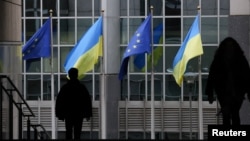
Ukrainian flags fly outside the EU Parliament building in Brussels. (file photo)

Welcome to Wider Europe, RFE/RL's newsletter focusing on the key issues concerning the European Union, NATO, and other institutions and their relationships with the Western Balkans and Europe's Eastern neighborhoods.

I'm RFE/RL Europe Editor Rikard Jozwiak, and this week I am drilling down on two issues: the EU's push to get Russian concessions and Ukraine's EU 2027 EU membership bid.

please wait

No media source currently available

0:00 0:12:36 0:00

Briefing #1: What The EU Says Russia Should Concede

What You Need To Know: The EU top diplomat, Kaja Kallas, has distributed a paper among EU member states, seen by RFE/RL, that spells out concessions Russia should make in ongoing diplomatic talks with Ukraine, which the United States is mediating. The demands include a reduction of Russian troops levels and their withdrawal from neighboring countries, reparation payments, and the need to democratize its society.

Neither the EU nor individual European nations have a seat at the table in the various negotiations that have been ongoing for close to a year to stop the war in Ukraine. Seeing as the EU funds most aid to Ukraine and a potential 20-point peace plan spells out clear Brussels competences such as Ukrainian EU membership by 2027, European leaders have bemoaned their lack of political clout in the talks.

Deep Background: The discussion paper, titled European Core Interests in Ensuring a Comprehensive, Just and Lasting Peace and Continent's Security, insists that there can be no peace or security "without the EU at the negotiating table and without taking into account [the] EU's core interests."

The document presents a very "EU maximalist" view on what Russia should do, with one EU diplomat telling RFE/RL that "we pay back to Russian maximalists demands on Ukraine." The Kremlin has so far refused to give up its goal of controlling the entire Ukrainian region of Donbas and reportedly also balked at ideas such as stationing NATO troops in western Ukraine as a post-deal security deal or paying for damages caused by the war.

Another European official familiar with the paper says: "Getting to peace isn't all about Ukraine conceding. We also have to talk about what Russia must do, ahead of sending any envoy there."

There have been discussions among EU capitals about creating an EU envoy who deals specifically with Russia even though there is no agreement who this person would be or what their mandate would be.

The paper will be discussed by EU ambassadors on February 17, and it is expected that at least parts of might come up for debate when the bloc's foreign ministers meet in Brussels on February 23.

Drilling Down:

  • In the first chapter, titled Russia to Respect Independence, Sovereignty and Territorial Integrity of States, the main idea is that if Ukraine should cap its troop levels or even withdraw them from some areas -- something discussed during the US-mediated talks -- then Russia should do the same. It also demands that no "de jure" recognition of the occupied Ukrainian territories occur and that those areas are de-militarized.
  • The next chapter, A Secure and Stable Europe, includes a demand that "Russia stops disinformation campaigns, sabotage, cyber-attacks, airspace violations and interference in elections on European territory and in neighbouring countries."
  • Another ultimatum stipulates no nuclear weapons in Belarus and a "ban of Russian military presence and deployments in Belarus, Ukraine, Republic of Moldova, Georgia and Armenia." Russian troops have for decades been stationed in Russian-controlled breakaway regions such as Abkhazia, South Ossetia, and Transdniester, as well as bases in Armenia and Belarus.
  • On the need for Moscow to adhere to international law, the call by the EU includes no blanket amnesty for war crimes, access for international investigators to sites of suspected war crimes, and that no domestic Russian law is elevated above international treaties spelling out various Russian obligations globally.
  • When it comes to reparations, the text notes that "Russia must compensate and contribute to Ukraine's reconstruction, for damages to European states and European companies, and for ecological damages it has caused."
  • The EU has frozen some 210 billion euros worth of Russian sovereign wealth assets but has so far failed to agree on a method to either legally confiscate them or leverage them to channel funds to Ukraine. Brussels has, however, sent the quarterly windfall profits of this money to Kyiv.
  • The final demands concern the domestic situation in Russia with the paper calling for free and fair elections with international monitoring, a release of all political prisoners, a return of deported civilians and children, media freedom, a repeal of the foreign agent law, ceasing "historical falsification and other laws that criminalize dissent and delegitimize independent media and civil society" and full cooperation in investigations of the killings of the Russian opposition leaders Aleksei Navalny and Boris Nemtsov.


Briefing #2: Ukraine's EU Membership Pipe Dream

What You Need To Know: The question of a speedy Ukrainian EU membership, possibly even as early as next year, has resurfaced again. Ukrainian President Volodymyr Zelenskyy notably tweeted, "It is important that Ukraine will do everything to be technically ready for EU accession by 2027. At least the main steps we will accomplish. I want a specific date." He elaborated at the Munich Security Conference on February 14 that "we need a date because otherwise Russia will try to block us -- directly or through maybe other countries."

In parallel, Brussels is starting to look at potential creative solutions to help Kyiv in this regard. In a meeting with ambassadors of the 27 members states earlier in February, European Commission President Ursula von der Leyen floated the idea of "a reversed enlargement," meaning a country could join but without many or most of the privileges of membership such as voting rights, its own European commissioner, or even full access to funding. Such rights and obligations would be gradually phased in later as the country continues necessary reforms to become a fully-fledged member.

Deep Background: There are two reasons this potential partial membership is being examined. There's no way Ukraine can become a fully-fledged member already by next year. While the country became an official EU candidate country in 2022, it still hasn't opened EU accession talks yet. This is largely due to a Hungarian veto over what Budapest alleges is Ukrainian discrimination of the Hungarian minority in Ukraine.

Accession talks as well as the opening, closing, and sometimes even interim benchmarks of the 33 accession chapters need unanimous support of the EU member states -- there are close to 100 veto opportunities for each and every capital in this process. Even if Viktor Orban's Fidesz loses the Hungarian parliamentary election in April and a slightly more pro-Ukrainian Tisza party comes to power, Ukraine may only be able to open talks on all chapters and potentially close some by 2027.

A quick look at the European Commission's own assessment from late 2025 of Kyiv's readiness for membership shows the country only has "a good level of preparation" in a handful of the 33 chapters. To illustrate, it has taken Montenegro -- a smaller, richer, and less geopolitically complicated country than Ukraine -- 13 years of EU accession negotiations to close 13 of the 33 chapters. Ukraine joining the EU sometime in the 2030s would still be regarded as "speedy" according to most EU enlargement experts.

But the main reason for the EU's quest for creativity is the 20-point peace plan that Russia, Ukraine, and the United States are currently negotiating. One of those 20 points spells out Ukrainian EU membership by 2027. It is fair to say the Europeans aren't happy that they aren't around the table and even more so when it comes to issues they should have a say on.

Speaking to RFE/RL at the Munich conference, Dutch Prime Minister Dick Schoof remarked, "No doubt, Ukraine belongs to the European family, but the Americans and the Russian will not decide when Ukraine is going to enter the European Union. That is up to the European Union and to the European Union only together with Ukraine."

Drilling Down:

  • Several EU officials RFE/RL spoke to off-the-record acknowledge that even though a peace deal currently looks distant, they cannot be the ones torpedoing it over a single point.
  • They also agree they need to help Zelenskyy in some way. And EU membership, even partial, is one of the few sweeteners in an otherwise seemingly harsh settlement he can "sell" to the Ukrainian people.
  • Can it be done by 2027? Speaking to RFE/RL in Munich, former European Commission President Jose Manuel Barroso noted that "the creativity of European lawyers is boundless when there is a real need."
  • He added: "The most likely scenario is to have some kind of expedited membership, not putting down the standards but in fact showing Ukraine that we are serious about EU membership."
  • Even something fast-tracked, partial, front-loaded, or reversed may be a step too far for the EU. Current EU Enlargement Commissioner Mata Kos pinpointed the key obstacle in a recent interview with RFE/RL. "In the accession process there are two important pillars: One is the technical process that I am leading, and the other is the dynamics in the member states so whatever we do we have to get the approval of the member states," she said.
  • A sudden change of methodology requires unanimity, and it's not only Hungary that has major reservations. Several other EU member states, according to RFE/RL Brussels sources familiar with the topic, are also wary.
  • Schoof noted that "we can find ways, but I think it is going to be a difficult discussion." Latvian President Edgars Rinkevics, asked about it in a panel discussion in Munich on February 15, was even blunter, saying, "Speaking to many EU heads of state and government, I felt that at the moment there is no readiness to agree on a date."
  • Arguments range from the "Pandora's box" one could open up by potentially changing EU treaties and the bloc being bogged down in such discussions for years to how much access Ukraine should get to EU cash cows such as regional and agricultural funding, potentially upending what already is expected to be very complex and fraught discussions of the next EU budget (2028-2034) that will consume Brussels in the next two years.
  • Others are also reluctant to commit to what is known as a "two-speed EU." "You are either in or out, that has always been the principle and the core strength of the Union", as one diplomat put it to RFE/RL.
  • There is also the question of fairness, perhaps best put by Croatian Prime Minister Andrej Plenkovic when speaking to RFE/RL on the issue. "If we will change the methodology to the geopolitical approach, then it will change not only vis-a-vis Ukraine," he said. "I support Ukraine, but it will have to change with everyone. And that will mean a big bang (enlargement), and we haven't had a big bang for many years."
  • The last "big bang" enlargements were in 2004 and 2007, when 10 Central and Eastern European countries joined the club. And that took a fundamental economic and political reorganization of the EU.
  • "Everyone," in Plenkovic's view, entails all the other EU hopefuls: Albania, Bosnia-Herzegovina, Georgia, Kosovo, Moldova, Montenegro, North Macedonia, Serbia, and Turkey. Of those nine, Albania, Montenegro, Serbia, and Turkey are technically more advanced than Ukraine as they all have started EU accession talks. They have been trying to gain membership for years, if not decades, under the current merit-based methodology.
  • But would all current EU member states agree to some sort of EU membership all for those countries as well, and if not, which ones? A sudden Ukrainian EU membership, partial or otherwise, would in other words probably create more problems than it solves.


Looking Ahead

This week is a slower one in Brussels as the legislative agenda to a large extent is synched with the February school holidays in Belgium. There is, however, a chance the bloc's ambassadors might agree on the 20th package of sanctions against Russia ahead of the fourth anniversary of Moscow's full-scale invasion of Kyiv on February 24.

That's all for this week!

Feel free to reach out to me on any of these issues on X @RikardJozwiak, or on e-mail at jozwiakr@rferl.org.

Until next time,

Rikard Jozwiak

If you enjoyed this briefing and don't want to miss the next edition subscribe here .

Load more

XS
SM
MD
LG